
The Best Attack Path Analysis Tools in 2026
By David Mundy, VP of Marketing, Tuskira · Last updated November 16, 2026
Tuskira is on this list, so read our entry with the skepticism you'd bring to any vendor writing about its own market. In return, we'll be straight about everyone else. Each tool below does something well, and we say which teams each one suits.
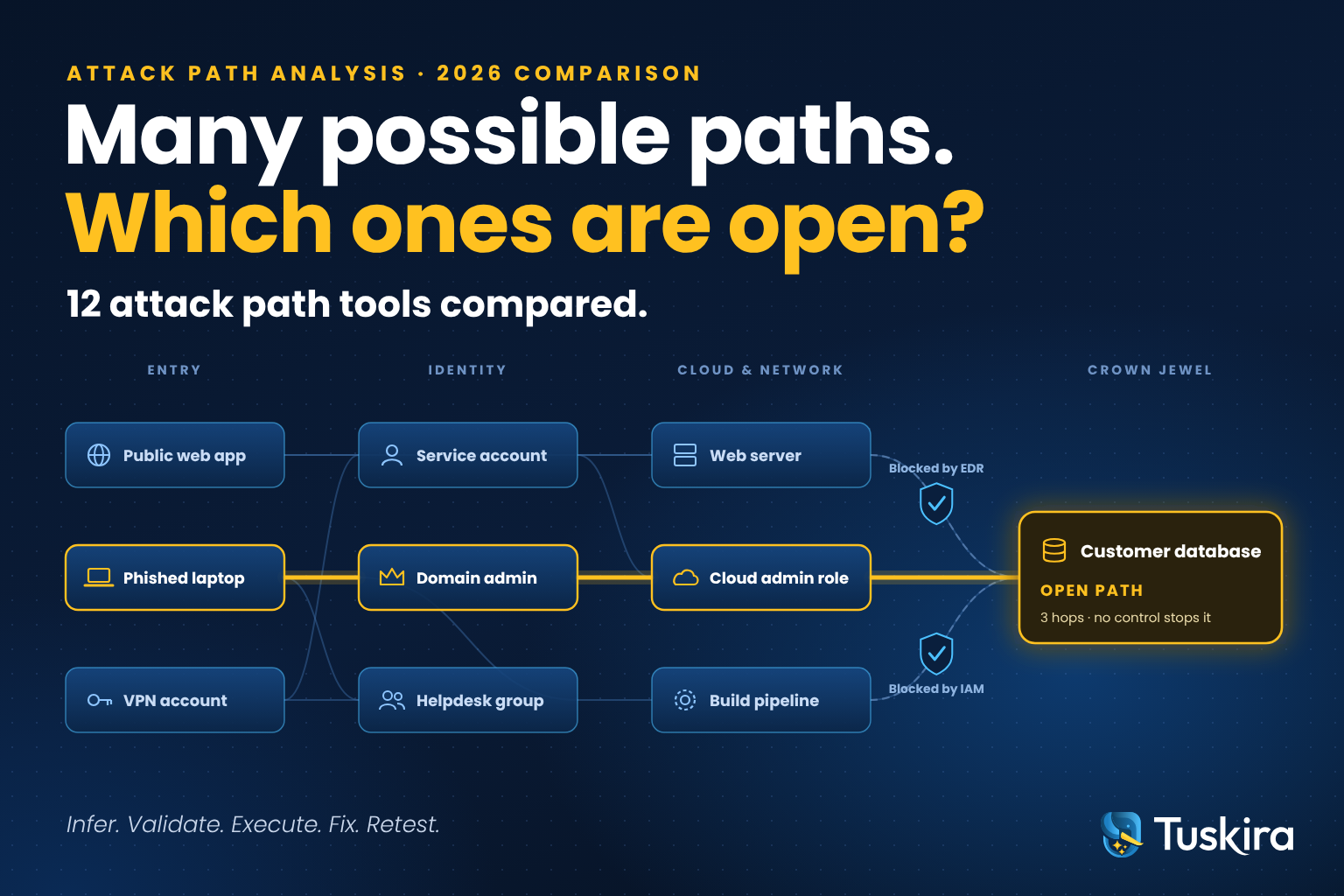
Attack path analysis answers one question. If an attacker gets a foothold, or starts from the internet, which routes lead to the systems you can't afford to lose? A scanner tells you what's broken on each asset. An attack path tool shows how those weaknesses chain together across identities, cloud, endpoints and the network, and where one fix breaks many routes at once.
Key takeaways
- Attack path tools infer paths from your data, validate them against runtime evidence or your controls, or execute real techniques to get direct evidence. Many combine two or three.
- Scope varies a lot. A path from a laptop to Entra ID to an AWS bucket is invisible to a tool that only sees one of those.
- Paths rise in priority for different reasons, such as evidence of exploitation, reachability, gaps in your controls, what sits at the destination, or a shared choke point where one fix breaks many paths. Ask every vendor which signals it uses.
- Finding a path is half the job. The other half is breaking it and retesting to confirm it's closed.
- Lean and cloud-first teams should weigh deployment effort, existing licenses and who will apply the fix as heavily as detection depth.
How attack path tools work
"Attack path analysis" covers products that work in very different ways. Sorting them by method helps.
- Infer: the tool builds a graph from relationships, configurations and state, then works out which paths could exist.
- Validate: the tool checks whether each step of an inferred path still holds, using runtime evidence or the controls you've deployed.
- Execute: the tool safely runs attack techniques in your environment and records what worked.
Many products combine two or three. Either way, someone still has to fix the path and retest it.
The comparison at a glance
We included generally available products that find or validate multi-step attack paths, publish enough product detail to compare their approach, and sell a current enterprise offering as of November 2026. The list is a representative sample of the market, and it doesn't include every vendor. Descriptions reflect public vendor information as of November 2026. This market moves quickly, so verify current capabilities directly with each vendor.
Scroll to compare →
| Vendor | Attack path scope | Method | What it does about a path | Best fit | Main caveat |
|---|---|---|---|---|---|
| Tuskira (Kairo, Vector) | Identity, cloud, network, endpoint; external through Vector | Infer and validate. Paths modeled on a Digital Twin, with each hop validated against deployed controls | Recommends the change that breaks the path, or executes it once approved through supported integrations with tools you already run, then retests | Teams with plenty of discovery tools whose paths stay open after they're found | Consumes discovery from your existing tools, so value depends on what you connect |
| BloodHound Enterprise (SpecterOps) | Identity across AD, Entra ID, Okta, AWS, GitHub, Jamf | Infer. Graph of identity and trust relationships | Chokepoints, remediation guidance, Privilege Zones | Identity-heavy estates, especially hybrid AD and Entra | Identity-centric; software vulnerabilities and network exposure come from other tools |
| CrowdStrike Falcon Exposure Management | Endpoint, cloud, hybrid on-prem to cloud | Infer. Paths in Threat Graph, ranked with AI and ExPRT.AI | Guided fixes, containment actions, Falcon Fusion SOAR automation | Falcon customers who want paths without another agent | Strongest where Falcon sensors and Falcon Cloud Security reach |
| Horizon3.ai NodeZero | Internal network, AD, external, cloud, Kubernetes, web apps | Execute. Autonomous pentests that chain and safely exploit weaknesses | Fix guidance plus Quick Verify retests | Teams that want exploit proof often, without scheduling consultants | Each result reflects a test run; the fix itself goes through your other tools |
| Microsoft Security Exposure Management | Endpoint, identity, cloud (Azure, AWS, GCP via Defender for Cloud), external | Infer and validate. Attack simulation on the enterprise exposure graph, plus active cloud reachability scans | Choke points, blast radius, recommendations in the Defender portal | Microsoft Defender and E5 shops | Results depend on Defender data and licensed workloads; public cloud only |
| Orca Security | Multi-cloud workloads, identities, data | Infer. Graph from agentless scanning and a unified data model | Path scoring, choke points, remediation through Orca Missions | Cloud-first teams that want agentless coverage | Cloud-scoped; on-prem and AD paths sit outside its focus |
| Palo Alto Networks Cortex Cloud | Cloud, IAM and effective permissions, network flows, code | Infer. Cortex Cloud Security Graph built on effective permissions, with AI feasibility checks | Break one link through config change or credential rotation; automated playbooks and agents | Palo Alto customers consolidating cloud security on Cortex | Cloud-scoped; strongest inside the Cortex platform |
| Pentera | Internal network, external, cloud, identities and credentials | Execute. Real attack techniques run in your environment | Pentera Resolve prioritizes fixes, routes tickets and retests | Teams that need exploit-level proof across internal, external and cloud | Closure runs through tickets and the teams who own each system |
| Tenable One | Network, identity (AD, Entra ID), cloud, external, OT | Infer. Graph analytics mapped to MITRE ATT&CK | Choke points as top attack techniques; fix and rescan | Tenable customers with credentialed scanning in place | Needs Tenable data sources and specific license tiers |
| Upwind | Cloud, identity, code, APIs | Infer and validate. Attack graph across code, cloud and identity, checked against runtime reachability | Blast-radius ranking, isolating risky relationships | Cloud-native teams that want runtime context | Cloud-scoped |
| Wiz | Cloud workloads, identities, data and code | Infer and validate. Security Graph built from agentless scanning, checked against live connections from the Wiz Runtime Sensor | Raises each validated path as one Issue with root cause and blast radius; Green Agent writes remediation steps | Cloud-first teams that want code-to-cloud context | Cloud-scoped; runtime validation needs the sensor |
| XM Cyber | Hybrid on-prem, cloud, identity, external | Infer and validate. Attack graph that tests exposure combinations for exploitability and reachability | Choke points, step-by-step remediation, fixing an earlier hop when a device can't be patched | Hybrid AD and cloud estates focused on crown jewels | Fixes are delivered as guidance for your teams to apply |
The twelve platforms
Tuskira is listed first because it's ours. The others follow in alphabetical order. This isn't a ranking.
Jump to: Tuskira · BloodHound Enterprise · CrowdStrike Falcon Exposure Management · Horizon3.ai NodeZero · Microsoft Security Exposure Management · Orca Security · Palo Alto Networks Cortex Cloud · Pentera · Tenable One · Upwind · Wiz · XM Cyber
Tuskira
- Best at: proving which breach paths are real in your environment and getting them closed through the controls you already own. Kairo, Tuskira's breach path agent, starts from an assumed-breach foothold and walks to your crown-jewel assets across identity, cloud, endpoint and network, working on a live Digital Twin fed by the Security Data Fabric. Each hop is validated inside the scope you approve, and each control on the path is recorded as blocked, detected or missed. For the paths your controls miss, Kairo recommends the change that breaks the chain, or executes it once approved through supported integrations with your EDR, firewall, IAM and WAF tools. Your policy decides which changes need sign-off. Kairo then retests the path and keeps revalidating as the environment changes. For paths that start on the internet, Vector runs autonomous red teaming against your perimeter and hands what it finds to Kairo. In one financial-services deployment, Tuskira reduced 12.3 million ingested findings to 0.46% requiring action after deduplication, suppression and known-exploit correlation. Internet exposure then set which findings were fixed first, and control validation showed which paths stayed undefended.
- Worth knowing: Tuskira doesn't replace your discovery tools. It consumes findings from your scanners, cloud security, identity and endpoint tools through 200+ integrations, so the paths it sees are only as complete as the data you connect.
- Pick it if: you already have a long list of findings and a map of possible paths, and the hard part is proving which ones your controls don't stop and getting them closed.
BloodHound Enterprise (SpecterOps)
- Best at: identity attack paths. SpecterOps says BloodHound Enterprise builds a single attack graph of trust and identity relationships across Active Directory, Entra ID, Okta, GitHub, Jamf and, since July 2026, AWS. It traces how a foothold in one system reaches critical assets in another and shows the chokepoints where a path can be cut. Privilege Zones let teams draw boundaries around sensitive roles and data.
- Worth knowing: The free, open-source Community Edition gives point-in-time assessments, and continuous mapping, chokepoints and remediation guidance are Enterprise features. The scope is identity and access, so vulnerability and network exposure data comes from your other tools.
- Pick it if: your worst paths run through AD, Entra ID or cloud identity, which is true for most enterprises.
CrowdStrike Falcon Exposure Management
- Best at: attack paths built from telemetry you already collect if you run Falcon. CrowdStrike says it uses "predictors of attack" to anticipate paths in Threat Graph, including routes from on-prem into the cloud. Falcon Cloud Security finds the most exploitable route from an internet-facing asset to a sensitive target and ranks paths by asset sensitivity, exploitability and complexity, with ExPRT.AI scoring which vulnerabilities are likely to be exploited.
- Worth knowing: response goes beyond remediation guidance into supported containment actions, such as isolating assets, along with guided fixes and automation through Falcon Fusion SOAR. Coverage is strongest where Falcon sensors and Falcon Cloud Security reach.
- Pick it if: you're committed to Falcon and want attack paths and response in the same console.
Horizon3.ai NodeZero
- Best at: proving paths by walking them. Horizon3.ai says NodeZero pivots through your network, chains weaknesses the way an attacker would, and safely exploits them, with no agents and no scripts. It runs internal, external, cloud, Kubernetes and web application tests.
- Worth knowing: internal tests run from a Docker host or OVA you deploy, and external tests run from Horizon3's cloud. After a fix, Quick Verify reruns the test to confirm it worked. Results are as fresh as your last scheduled run, and the fix itself happens in your other tools.
- Pick it if: you want attacker-proven results often, and your team can act on them.
Microsoft Security Exposure Management
- Best at: cross-workload attack paths inside the Microsoft Defender portal. Microsoft says the product generates paths automatically from data across assets and workloads, simulates attack scenarios on the enterprise exposure graph, and shows choke points where paths converge on critical assets, with a blast radius view for each. For cloud exposures it runs active reachability scans to check what's accessible from outside. A built-in catalog classifies critical assets, and you can add your own.
- Worth knowing: Microsoft's documentation says results depend on the data sources and the licensed workloads represented in a path, and some on-prem paths may appear without a direct recommendation. It's available in public cloud only, with no national or sovereign clouds.
- Pick it if: you're a Defender and E5 shop and want attack paths where your analysts already work.
Orca Security
- Best at: agentless attack path analysis for cloud. Orca says it surfaces toxic risk combinations that endanger high-value assets, using its Unified Data Model and SideScanning, its agentless workload scanning. It scores paths on exploitability and business impact, highlights choke points, and follows paths across clouds, such as from AWS to Google Cloud.
- Worth knowing: in March 2026, Orca added Missions, which group related findings into remediation efforts with defined goals and verification. Its scope is cloud, so on-prem AD and network paths need another tool.
- Pick it if: you're cloud-first and want path analysis without deploying agents.
Palo Alto Networks Cortex Cloud
- Best at: cloud attack paths built on effective permissions. Cortex Cloud combines Prisma Cloud and Cortex CDR, and its Security Graph evaluates effective permissions at the object level, including resource policies, permission boundaries and SCPs, and uses AI to check whether a path is feasible. Paths are weighted with threat intelligence from Unit 42.
- Worth knowing: Palo Alto says breaking one link, such as a configuration change or a credential rotation, can neutralize a path, and it shows remediation through automated playbooks and agents. The scope is cloud, and the fit is strongest when Cortex is already your platform.
- Pick it if: you're on Palo Alto for cloud security and want path detection tied to Unit 42 intelligence.
Pentera
- Best at: real attacks across internal, external and cloud. Pentera says Pentera Core runs complete kill chains on internal networks to show how an attacker bypasses security, moves laterally and escalates privileges. Pentera Surface tests internet-facing entry points, and Pentera Cloud tests how compromised identities and misconfigurations lead to sensitive cloud resources.
- Worth knowing: Pentera Resolve prioritizes validated paths, routes tickets through existing workflows and retests to confirm exposure has dropped. The fix itself still lands with the teams who own each system.
- Pick it if: your board or auditors want exploit-level proof across internal, external and cloud.
Tenable One
- Best at: attack path analysis on top of a broad exposure data set. Tenable says Attack Path pairs your data with graph analytics and the MITRE ATT&CK framework to map paths from valid origins, such as an external asset, a workstation or a domain user, to critical assets. Its choke points are the attack techniques that appear most often across paths to critical assets.
- Worth knowing: it runs on Tenable data. Tenable's docs call for credentialed scans, identity and cloud exposure data, and specific Tenable One license packages, and updates can take up to five hours to show.
- Pick it if: Tenable is already your vulnerability and identity exposure foundation.
Upwind
- Best at: cloud attack paths with runtime context. Upwind says it connects code, cloud and identity insights into one attack graph, maps lateral movement across services, identities, APIs and data, and confirms whether services and dependencies are reachable at runtime. It ranks paths by blast radius.
- Worth knowing: Upwind offers an eBPF sensor for runtime data. Its stated goal is to close pathways and isolate risky relationships. The scope is cloud.
- Pick it if: you're cloud-native and want path analysis that reflects what's running.
Wiz
- Best at: cloud attack paths with code and runtime context. Wiz says its Security Graph maps every cloud asset, identity and relationship, and correlates misconfigurations, vulnerabilities, network paths and identity access to show what's exploitable. It also ties risks back to the code repositories and teams that introduced them. In June 2026, Wiz added live connection data from its Wiz Runtime Sensor to the graph, so a path from an internet-facing container to a sensitive data store can be confirmed by observed traffic and raised as a single critical Issue. Wiz says runtime context surfaced a high or critical path that earlier analysis had missed in 1 in 6 monitored environments.
- Worth knowing: the baseline is agentless scanning, and the runtime checks need the sensor deployed. Wiz Green Agent investigates a flagged path and writes remediation steps, and Wiz's announcement doesn't describe automated containment. Google completed its acquisition of Wiz in March 2026. Google says Wiz keeps its brand and will keep working across AWS, Azure, Google Cloud and Oracle Cloud. The scope is cloud, so on-prem AD and network paths need another tool.
- Pick it if: you're cloud-first and want attack paths tied to the code and owners behind them.
XM Cyber
- Best at: attack graph analysis to critical assets in hybrid environments. XM Cyber says its graph combines misconfigurations, leaked credentials, excessive permissions, CVEs and non-human identities into paths from external assets through to the internal network. It tests exposure combinations for exploitability and reachability, discards dead ends (it cites 74% of exposures as dead ends) and highlights choke points where paths converge on business-critical assets.
- Worth knowing: XM Cyber uses agent-based and agentless discovery. It provides step-by-step remediation guidance, and where a device can't be patched it lets you fix an earlier step in the path. Applying the fix is up to your teams. We compare the two approaches in Tuskira vs XM Cyber.
- Pick it if: your main gap is seeing how attackers would reach crown jewels across on-prem AD and cloud.
Continuous analysis and point-in-time testing
Buyers asking for "continuous" attack path analysis usually mean one of two things. Graph-based tools rebuild paths as your environment changes. Microsoft says paths shift when a user logs on, joins a group or a segmentation policy changes, and Tenable processes new data every 30 minutes. BloodHound Enterprise maps identity paths continuously, while its free edition is point-in-time. Testing tools such as NodeZero and Pentera are as current as their last scheduled run.
A model updates quickly and covers everything it can see. A test shows that a specific path worked within the test's scope and conditions on the day it ran. Many mature programs use both, or clearly separate inferred paths from paths backed by runtime, control or execution evidence.
How tools decide which attack paths matter most
Paths rise in priority for different reasons, and the reasons mean different things. A choke point tells you where one fix does the most good. A critical destination tells you how bad a breach would be. Neither tells you which route an attacker will take, so ask which signals each tool leans on.
- Choke points: where many paths converge on a critical asset. Microsoft, XM Cyber, Tenable, Orca and BloodHound all surface them. One fix there breaks many paths.
- Evidence of exploitation: threat intelligence about what attackers are using now, or proof from a test. Palo Alto uses Unit 42 data, CrowdStrike uses ExPRT.AI, and Tenable maps techniques to MITRE ATT&CK. NodeZero and Pentera rank paths they've proven by running them.
- Reachability: whether an attacker can get to each step. Microsoft runs active reachability scans for cloud exposures, and Upwind and Wiz check paths against runtime activity.
- Control gaps: whether the EDR, WAF, firewall and identity controls you already run would stop or detect each step. Tuskira's Kairo filters to the paths those controls miss. XM Cyber also says it checks compensating controls.
- Destination impact: how critical the asset at the end of the path is. Every tool depends on you defining crown jewels well. Microsoft notes that incomplete critical asset definitions make results less representative.
Ask each vendor to show you a path it ranked low and explain why, and a path it ranked high that your current controls wouldn't stop.
Seeing attacker movement across identity, cloud and endpoints
Real breaches cross domains. A phished credential lands on a laptop, and the attacker escalates in AD, pivots into Entra ID and reaches cloud storage. CrowdStrike's 2025 Global Threat Report found valid account abuse was the leading initial access vector to the cloud, at 35% of cloud incidents in the first half of 2024.
Microsoft Security Exposure Management, XM Cyber, Tenable One and Tuskira draw one graph across endpoint, identity, network and cloud. BloodHound Enterprise links identity systems, including AWS. Orca, Upwind, Cortex Cloud and Wiz draw detailed graphs inside the cloud and leave on-prem AD to others. Give each vendor one real cross-domain path from your last red team or incident and see whether it draws the whole thing.
Mid-market and cloud-first teams
For a lean team, the useful question is which tool you can deploy, keep fed and act on with three people.
- Start with what you license: if you're on Microsoft E5 or Defender, Security Exposure Management may already be within reach. If you run Falcon, CrowdStrike's path analysis uses sensors you've deployed. Check before you buy something new.
- Weigh deployment effort: Orca scans cloud workloads without agents. NodeZero needs no agents and runs internal tests from a single Docker host. Tenable's attack paths depend on credentialed scans, and Tenable recommends covering at least 40% of assets that way.
- For cloud-first or cloud-heavy stacks: Orca, Upwind, Cortex Cloud and Wiz are built for cloud paths, including cloud identities and permissions. Add identity coverage for your IdP, because a cloud-only view will miss paths that start with a stolen login.
- Plan who applies the fix: favor tools that break many paths with one change at a choke point, or that can make the approved change through tools you already run, and that retest the result.
- Count the hours: ask each vendor how many analyst hours a week the tool needs once it's running, and get a reference customer of your size to confirm.
How to choose
Start with where your worst paths run. If they run through identity, BloodHound Enterprise, Microsoft or Tenable's identity coverage belong on the shortlist. If they run through cloud, look at Orca, Upwind, Cortex Cloud and Wiz. If you need execution evidence, add NodeZero or Pentera. If your problem is that known paths stay open, look at tools that validate paths against your controls and drive the fix, which is where Tuskira sits.
Closing paths follows the same loop with any tool. Define crown jewels clearly, then fix choke points first. Where you can't patch quickly, break an earlier hop with a control you already run, such as removing a standing admin right, blocking a port, adding a WAF rule or tightening an IAM policy. Our zero-day response platforms guide covers compensating controls in more detail. Then retest, because a ticket marked done doesn't prove the path is closed. For a worked example of how one path forms, see the anatomy of a breach path.
Then run the evaluation on your own environment. Give every vendor, including us, the same three tasks. Draw a real path from your last pentest end to end. Show which controls on that path would stop or detect each step. Show the change that breaks it and the retest that shows it's closed. Our AI cyber defense buyer's guide has more questions to ask, and the best CTEM tools for 2026 covers the wider exposure management market.
Frequently asked questions
What is attack path analysis?
Attack path analysis maps how an attacker could chain weaknesses, such as a vulnerability, a misconfiguration and an over-privileged account, to move from an entry point to a critical asset. It shows which combinations of issues create real routes, so teams can fix the ones that break the most paths.
What are the leading continuous attack path analysis platforms?
Microsoft Security Exposure Management, XM Cyber, Tenable One, CrowdStrike, BloodHound Enterprise, Orca, Upwind, Cortex Cloud, Wiz and Tuskira all keep paths current as the environment changes. NodeZero and Pentera run real tests on a schedule.
Which attack path tools prioritize the breach routes most likely to be used?
No tool can tell you for certain which route an attacker will take. Tools rank paths by different signals. Most use choke points and asset criticality. Palo Alto and CrowdStrike add threat intelligence, NodeZero and Pentera rank by proven exploitation, and Tuskira ranks by whether your deployed controls would stop each step. Ask which signals a tool uses and test them on paths from your own environment.
Which attack path tools suit mid-market or cloud-first companies?
For cloud-first or cloud-heavy stacks, Orca, Upwind, Cortex Cloud and Wiz focus on cloud paths, and Orca and Wiz start from agentless scanning. For mixed environments with a lean team, NodeZero needs no agents, and Microsoft or CrowdStrike may extend tools you already license. Whatever you pick, cover identity too, and favor tools that reduce the number of fixes your team has to apply by hand.
How can teams visualize attacker movement across identity, cloud and endpoints?
Use a tool that builds one graph across those domains. Microsoft Security Exposure Management, XM Cyber, Tenable One and Tuskira draw cross-domain paths, and BloodHound Enterprise links identity systems such as AD, Entra ID, Okta and AWS. Test this with a real path from your own environment.
How do teams proactively disrupt likely breach paths?
Fix choke points first, break earlier hops with controls you already run when you can't patch, then re-test to confirm the path is closed. Repeat as new identities and workloads change the picture.
See Kairo prove and close breach paths in your own environment, or read how Kairo detects and disrupts breach paths.
The Best AI Vulnerability Prioritization Tools in 2026

Open Offensive AI Is Compressing the Exploit Window. CVE Counts Won't Tell You What's Exposed.
