
Kairo: Breach Modeling for Attack Surface Management
Kairo maps how exposures, identities, workloads, and controls chain into real attack paths, then identifies the highest-leverage action to break them.
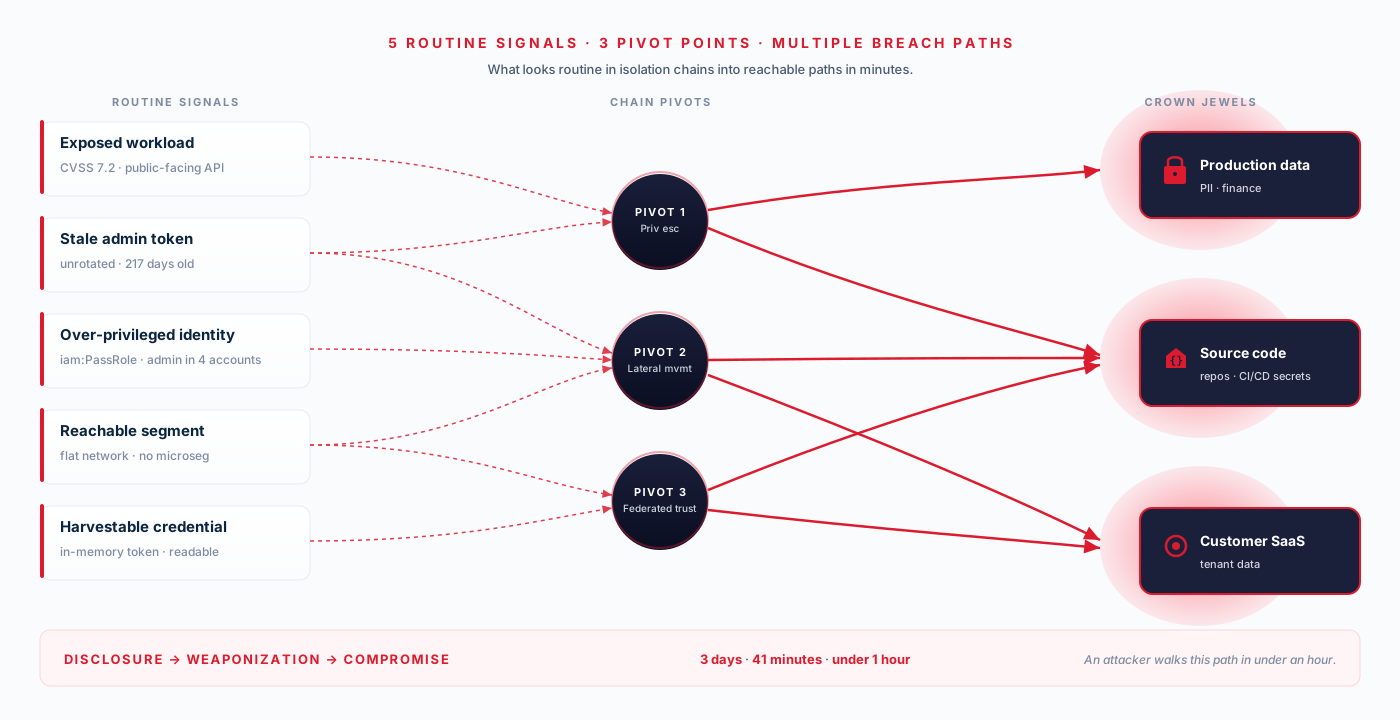
Five ordinary-looking signals chain through three pivot points to reach your crown-jewel assets. Each chain is a breach path attackers can walk in under an hour.
Why current approaches miss breach paths
- Scanners count findings, not paths. Most tools rank issues by severity, not by whether they are reachable, chainable, or exploitable.
- Security tools live in separate graphs. Identity, cloud, endpoint, network, and exposure data rarely connect into one breach path.
- Risk is scored, not traversed. CVSS can't answer which crown jewels are reachable, which controls reduce risk, or which paths your SOC is monitoring.
The Inflection PointWhy this matters right now
Frontier AI models like Anthropic's Mythos can discover zero-day weaknesses, chain lower-severity issues into working exploits, and generate functional exploit code at machine speed. In a 7-week internal eval, Mythos autonomously found 2,000+ zero-day vulnerabilities and generated working exploits, roughly 30% of the world's annual zero-day output, from a single model. Kairo shows whether newly disclosed or AI-discovered zero-days create a reachable breach path in your environment, then identifies the control action needed to break the chain.
+33% more CVEs in 2026 vs. 2025 (after +45% in 2025 vs. 2024). Disclosure-to-weaponization window: weeks to minutes for AI-discovered exploits.
How Kairo works
Unify
Normalize identity, cloud, workload, network, exposure, and control data into a single source.
Model
Build a live digital twin of reachability, privilege, exploitability, and business criticality.
Map
Enumerate every traversable path attackers could walk to crown-jewel assets.
Identify Residual
Filter to the paths your existing controls and detections don't cover.
Disrupt
Orchestrate the highest-leverage action through existing tools (EDR, firewall, IAM, WAF).
Resolve
Revalidate reachability as the environment changes, continuously.
Works across 150+ integrations →
Common breach paths Kairo detects
Identity to Lateral Movement
Kill chain: phished credential → MFA bypass → admin escalation → DC access → Golden Ticket.
What Tuskira detects: the privilege chain across identity and endpoint, not just the individual events.
How Tuskira breaks it: removes privilege escalation paths before domain compromise.
Endpoint to Ransomware Staging
Kill chain: macro execution → Cobalt Strike → LSASS dump → SMB spread → shadow deletion.
What Tuskira detects: the staging sequence, not just the ransomware payload at the end.
How Tuskira breaks it: contains ransomware staging before encryption begins.
Multi-Cloud Pivot
Kill chain: Azure AD compromise → federated trust to AWS → cross-account role → RDS data access.
What Tuskira detects: the cross-cloud identity path, a blind spot in every single-cloud detection model.
How Tuskira breaks it: breaks cross-cloud trust paths before sensitive data access.
On-Prem to Cloud Pivot
Kill chain: exposed appliance (e.g., Ivanti CVE-2024-21887) → in-memory token theft → cached AWS SSO token → cross-account assume-role → RDS snapshot export.
What Tuskira detects: the residual path from a known weakness through cached cloud credentials and federated trust into production data.
How Tuskira breaks it: collapses CVE-to-cloud access paths before exfiltration.
Every path mapped to MITRE ATT&CK, correlated across endpoint, identity, cloud, and network, and backed by detection logic that runs where your data lives.
Competitive Landscape: The Three Camps
Cloud-only path modelers (CNAPP category)
What they do well: visualize attack paths within the cloud control plane.
Where they stop: cloud-only scope, built largely from static configuration and posture data, with no extension to identity, endpoint, or on-prem, and no closed loop to detection coverage.
Exposure and path expanders (Exposure-management category)
What they do well: extend path modeling to Active Directory and on-prem alongside cloud.
Where they stop: still working from static configurations and point-in-time snapshots, with no live telemetry and no detection-engineering loop.
Simulators and detection writers (BAS and SIEM/XDR categories)
What they do well: simulate attack paths and write or test detections.
Where they stop: run against a hypothetical environment, not yours, with no live state and no closed loop from your actual exposed path to deployed detection.
Tuskira (Kairo)
What we do: a live digital twin built from real assets, identities, controls, exposures, and telemetry, kept current by the Security Data Fabric. Kairo computes attack paths that are true in your environment right now, not modeled, not hypothetical, not a config snapshot.
How we're different: Kairo closes the loop. It surfaces residual attack paths that existing controls don't block and existing detections don't see, then orchestrates control changes through tools you already own.
What our customers say
"2026 is the year cyber defenses are seeing the shift from AI-assisted attacks to AI-enabled attacks, and defenders need to adapt. That's why Intrado partnered with Tuskira."
Charles Gifford, CISO, Intrado
Map reachable, exploitable paths in days
Break them through the controls you already own, and move from finding counts to breach resilience.
See Agentic Cyber Defense in Action
Surface signals across the tools you already run, connect them through shared context, and accelerate triage and response across the SOC.


Watch the video
See how Tuskira helps security teams validate threats, uncover breach paths, and move faster from signal to action.