
What is a Digital Twin in Cybersecurity? (And Why Your Defenses Need One)
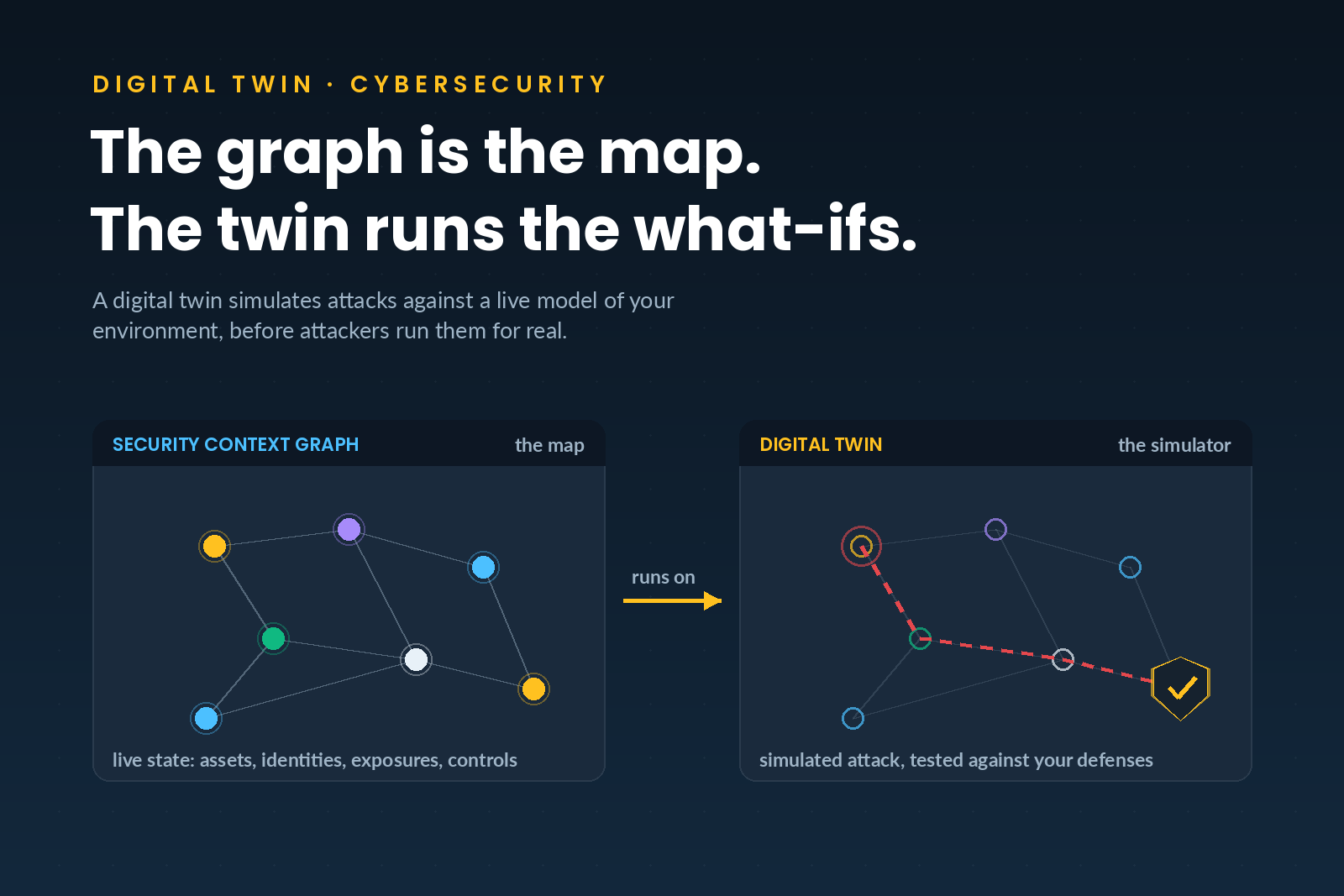
A digital twin in cybersecurity is a live simulation of your environment, one that lets you test how an attack would actually play out against your deployed defenses without touching production. Ask it whether a newly disclosed CVE is exploitable as configured, whether your WAF rule would block the exploit pattern, or what an attacker could reach after compromising a given workload, and it answers with evidence from a current model of your environment rather than a lab guess.
The idea borrows from engineering, where digital twins of jet engines and factories let teams simulate stress before reality applies it. Security's version does the same for breach scenarios, and it matters now for a blunt reason: attackers armed with frontier AI can find and weaponize weaknesses faster than patch cycles close them, so the defenders who win are the ones who can test their defenses continuously instead of waiting for the incident to grade them.
The digital twin and the security data fabric aren't the same thing
These two terms get conflated constantly, including in earlier writing of ours, so here's the clean distinction. The security data fabric is the map: a live, connected model of your assets, identities, exposures, controls, and detections, built from native integrations across the stack you already own and resolved so that three identifiers across three tools mean one machine. The digital twin is the simulator that runs on that map. The graph tells you what is; the twin tells you what would happen.
The order matters because a simulator is only as honest as its model. Run attack simulations over stale or fragmented data and you get confident answers about an environment that no longer exists. Build the graph first, keep it continuously current, and the twin's verdicts inherit that accuracy.
What a digital twin lets you test
With a current graph underneath it, the twin answers the questions that static assessments can't touch. Whether an exposure is exploitable as deployed, in your configuration with your settings, rather than in a researcher's lab. Whether the controls you already own, the EDR policy, the WAF rule, the segmentation, would actually interrupt a given exploit chain or quietly wave it through. Which paths an attacker could traverse from a compromised foothold to crown-jewel systems, factoring in identities, trust relationships, and the defenses along the way. And what changes when you change something, so a proposed firewall rule or privilege reduction can be tested for effect before it ships.
How Tuskira's agents use the twin
In the Tuskira platform, the twin isn't a separate product you operate; it's how the AI agents validate their decisions before recommending or acting. Lattice uses it to prove which of millions of findings are exploitable, reachable, and undefended, which is how one financial-services deployment cut 12.3M raw findings to 0.46% actionable. Kairo runs breach-path analysis through it, chaining exposures and identities into the paths an attacker could actually traverse and identifying the control change that severs them. Iris works the investigation side of the same model, validating alerts into verdicts at L1 and mapping the blast radius an attacker would inherit at L2, which is how an alert becomes an evidence-backed decision instead of an escalation. And when a zero-day drops, Quell simulates the exploit against your deployed controls to answer the only question that matters in hour one: are we actually exposed, and what closes the path while the patch waits?
Every verdict that comes out of this loop carries its evidence, the state examined, the controls tested, and the outcome, so a deferred patch or a deployed compensating control is a defensible decision rather than a hopeful one.
Why this beats point-in-time testing
Penetration tests and red-team exercises answer the same questions the twin does, and they answer them well, four times a year at best. Attack paths open and close in hours as identities change, workloads ship, and configurations drift. A simulation layer that runs continuously against a continuously current model turns validation from an annual event into an operating condition, which is exactly the shift continuous threat exposure management asks for and manual programs struggle to deliver.
Frequently asked questions
What's the difference between a digital twin and a security data fabric?
The graph is the live model of your environment: assets, identities, exposures, controls, detections, and their relationships. The twin is the simulation capability that runs attack scenarios against that model. You need the graph to have a trustworthy twin, and you need the twin to turn the graph's state into tested decisions.
Is a digital twin the same as breach and attack simulation?
They overlap but differ in where the test runs. BAS tools execute techniques against your live environment to test controls directly. A digital twin simulates against the model, which means it can explore destructive scenarios, chained paths, and what-if changes safely, at machine speed, and as often as the environment changes.
Does simulation touch production systems?
No. Simulations run against the model, and that's the point: you can test an exploit chain against your crown-jewel systems' defenses without any packet touching those systems. Actions that follow from a verdict, like a control change, go through your existing tools under your approval policies.
Do I need new instrumentation to build one?
Generally no. The graph underneath is built from the tools you already run, scanners, EDR, cloud, identity, and network sources, connected through native integrations. If your stack can describe your environment, the twin can simulate against it.
See a simulation run against your own stack, or start with the security data fabric that makes it trustworthy.
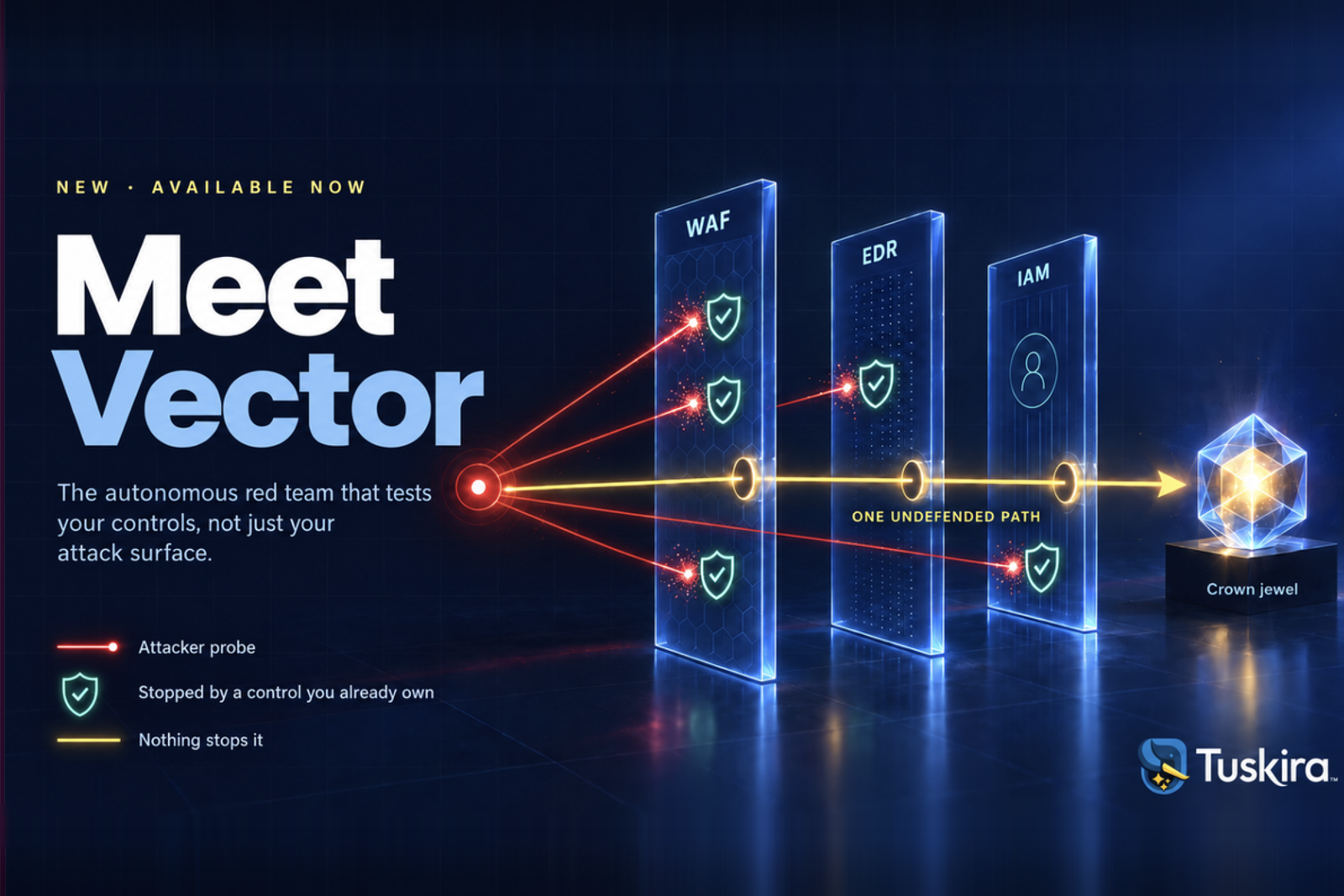
Meet Vector: Autonomous Red Teaming That Doesn't Stop at Exposed
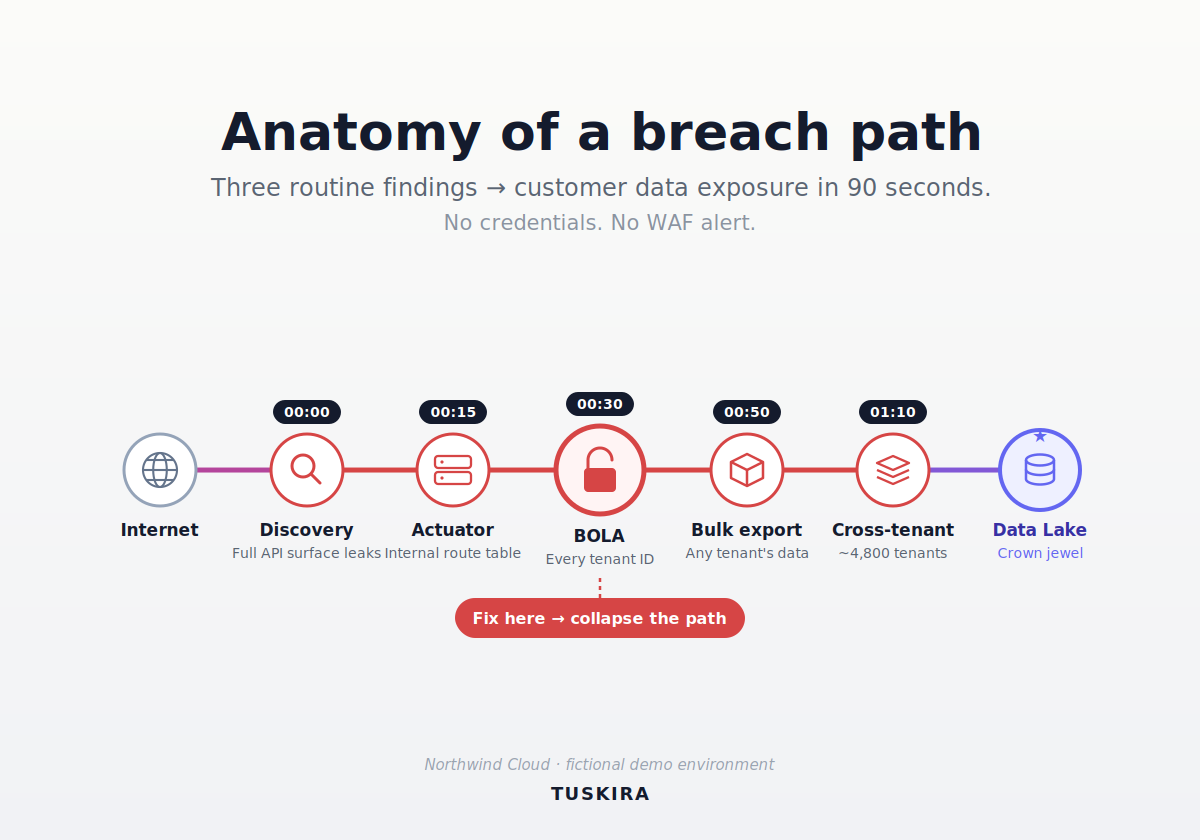
Anatomy of a Breach Path: How Three Boring Bugs Become a 90-Second Data Breach
