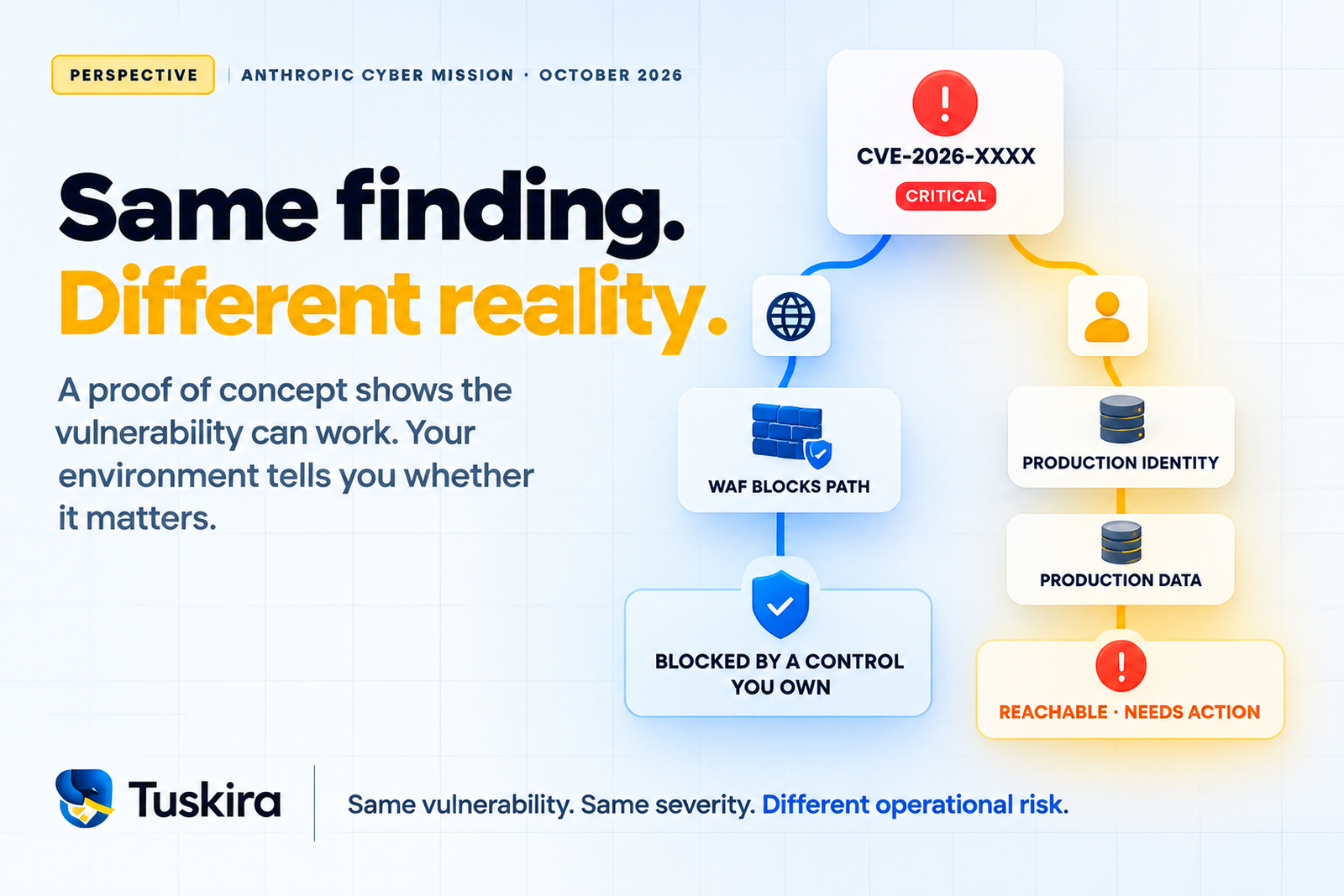
Anatomy of a Breach Path: How Three Boring Bugs Become a 90-Second Data Breach
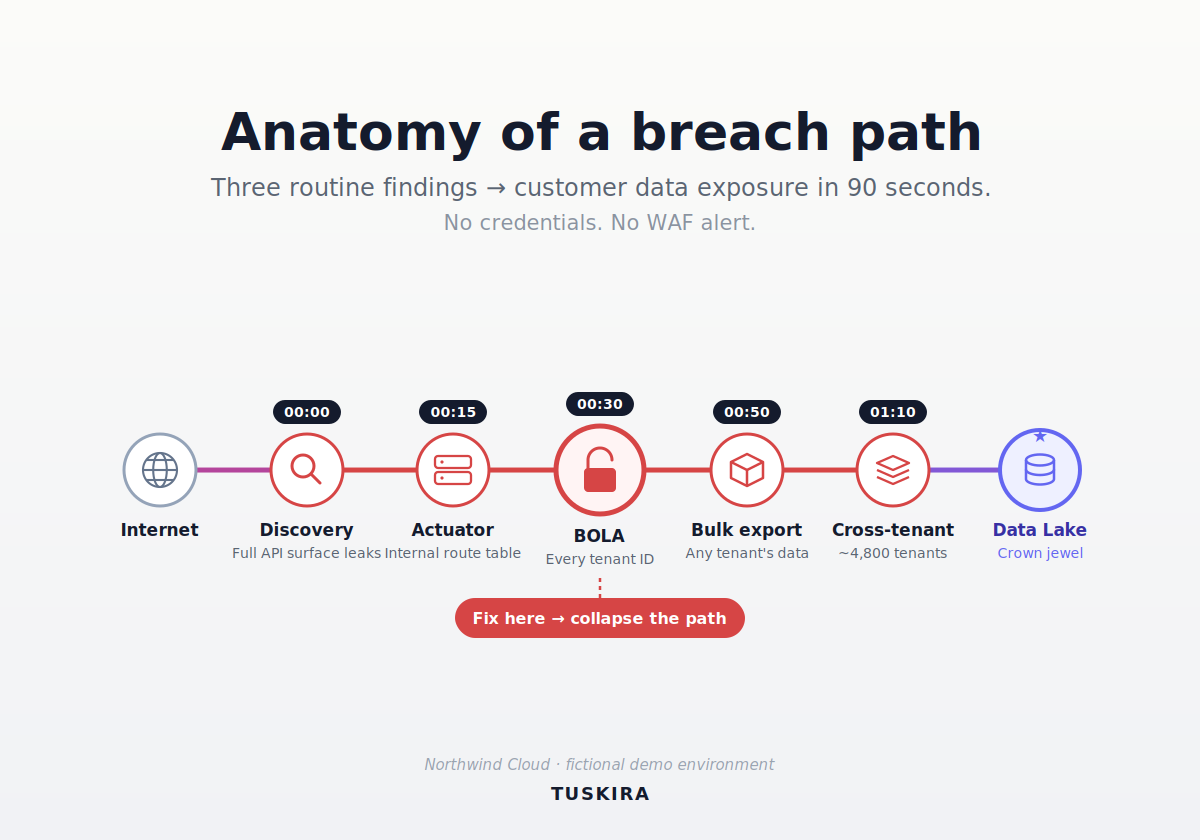
The walkthrough below uses Northwind Cloud, a fictional environment we built for demonstration. Every hostname sits under northwind.example, which is reserved for documentation and resolves to nothing. The defects are real patterns. The company is not.
Pull up any vulnerability scanner and you’ll find hundreds of findings that never get fixed. Not because anyone’s negligent. Because each one, read on its own, looks survivable.
An API documentation endpoint that’s exposed without auth? Information disclosure. Medium, maybe. A management endpoint that answers anonymous requests? Annoying, worth a ticket eventually. A cloud role scoped a little too broadly? Every cloud estate has a hundred of those.
Here’s the problem with reading findings one at a time: attackers don’t. They read them as a graph. And on that graph, three findings that each earned a shrug can chain into a path that walks an outsider from the public internet to your customer data lake before your coffee gets cold.
Let’s take three boring bugs and watch them stop being boring.
The three defects
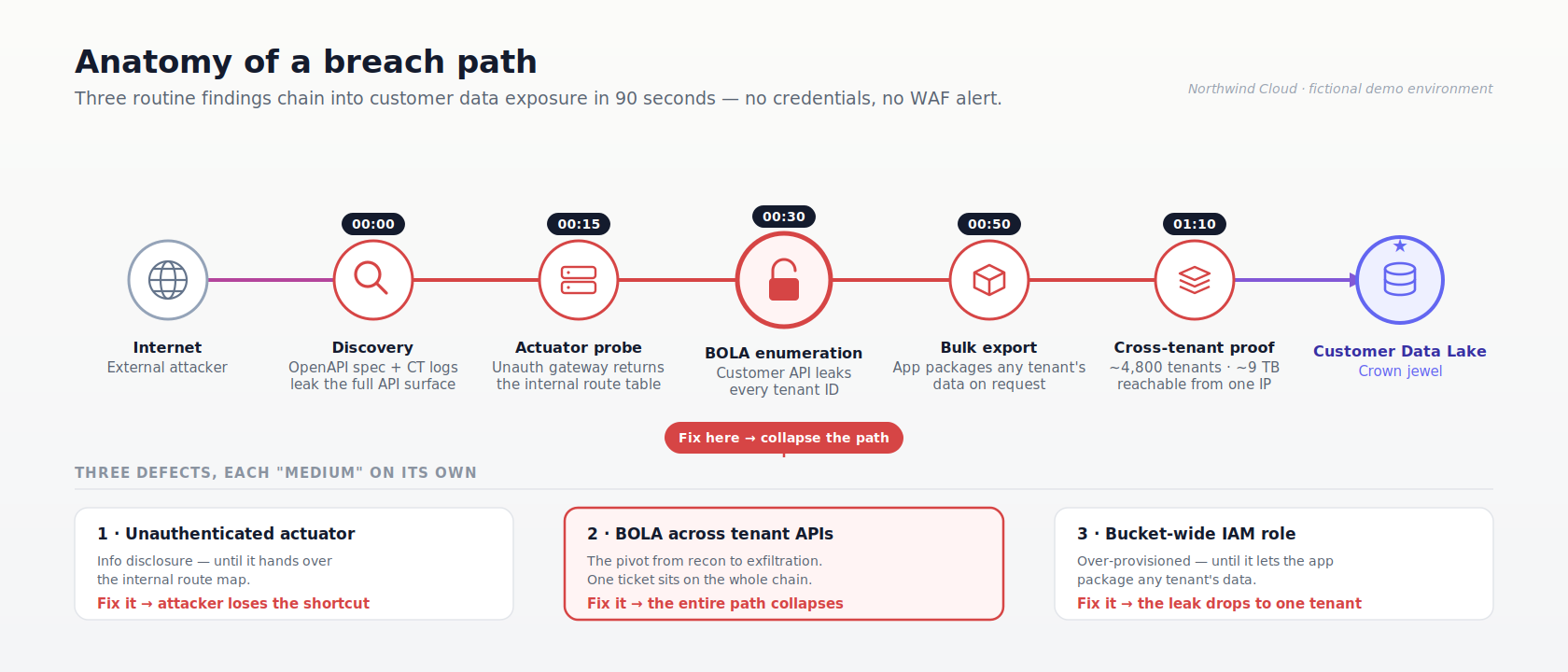
Defect one: an unauthenticated Spring Cloud Gateway actuator. Northwind’s api.northwind.example serves its full OpenAPI spec without a login, and its gateway actuator answers anonymous GETs with the internal route table. On its own, this is information disclosure — no code execution, no data — so a scanner flags it, it lands in a queue, and someone reasonably decides it can wait. What’s the worst that happens when an attacker learns your route names?
Defect two: broken object-level authorization across tenant-scoped APIs. Northwind’s customer lookup and dataset export routes both trust tenant IDs supplied in the request. Ask for another tenant’s record and the API returns it; ask the export service for another tenant’s dataset and it packages the data. It’s API1:2023, the number-one risk on the OWASP API Security Top 10, and most teams treat a single instance as bounded — it leaks one object at a time, patch it eventually. Contained, though. Right?
Defect three: a bucket-wide IAM role. The service that signs those export requests, datasets-svc-export-role, can read the entire data-lake bucket, not just the slice the export feature needs. The most forgivable of the three — over-provisioned roles are the background radiation of cloud infrastructure, and least privilege is a goal, not a state anyone’s actually in. A CSPM tool notes it and moves on.
Three defensible decisions to defer — here’s what each one becomes once the attacker chains it:
Now watch them shake hands.
The chain
An attacker starts with nothing. No credentials, no API key, no foothold. Just an internet connection and Northwind’s public domain.
Second zero — discovery. They pull the OpenAPI spec from the public docs endpoint. It lists 142 routes. A quick check of certificate transparency logs shows every sibling hostname sharing Northwind’s wildcard cert. The attacker now knows the entire API surface and every neighbor it has. Defect one just stopped being information disclosure and became a map.
Fifteen seconds — the actuator. They hit the gateway actuator. It returns the internal route table, which spells out the upstream service URIs, including the customer service and the dataset export service. The attacker didn’t guess the endpoints that matter. The platform handed them over.
Thirty seconds — enumeration. They sweep /api/v1/customers/{id} for a range of integer IDs. Ten requests, ten complete customer records: company name, contact email, plan tier, and, critically, the internal tenant GUID for each. No authentication is sent, because none is required. Defect two, the one that only leaks “one object at a time,” just handed over the exact tenant IDs needed to weaponize the export route.
Fifty seconds — the export. They POST a harvested tenant ID to the export endpoint. It returns HTTP 202 and a presigned S3 URL, valid for an hour. This is where defect three earns its keep. Because the export service role can read any tenant prefix, the broken authorization check lets the attacker request exports for tenants they don’t own. The presigned URL isn’t magic access to the bucket. It’s proof that the application will package and hand over data the caller should never have been able to request. And because the check is broken for every tenant, the attacker can repeat it one at a time, or in bulk.
Seventy seconds — cross-tenant proof. They repeat the export for five different tenants and confirm real data comes back for all five. The full corpus projects to roughly 4,800 tenants and several terabytes of customer analytics, all reachable from one IP, with no credentials, and no interaction with the WAF beyond the public edge.
Ninety seconds, start to finish. The WAF never saw an attack it recognized, and the cloud audit log only recorded the service role doing its job. The caller’s IP is invisible, because access logging was off on that stage. The breach doesn’t just happen fast. It happens quietly.
Why any single fix changes the math
Here’s what matters for how you spend Monday: each of those three defects, patched in isolation, breaks the chain — that’s the structure of the attack, not a flourish.
Lock down the public docs and actuator exposure, and the attacker loses the route map. They might find the export endpoint another way, but you’ve removed the shortcut. Scope the export service to the caller’s authorized tenant prefix, and it can no longer package another tenant’s data. The BOLA still leaks, but it leaks one tenant instead of all of them. Fix the BOLA, and the whole thing collapses. Without valid object authorization on the export route, harvesting tenant IDs buys the attacker nothing.
So which fix do you pick? Not by severity score — all three read “medium.” Not by EPSS. By the graph: one of them is the highest-leverage fix in your environment this week, and the other two are follow-ups.
The BOLA on the export endpoint is the answer. It sits at the pivot point where reconnaissance turns into exfiltration. Patch it and one engineering ticket collapses a critical path to a crown jewel. The actuator and the IAM role become defense-in-depth rather than emergencies. You reach that by walking the path, not by ranking findings.
What it takes to see this
The reason breach paths hide is that no single tool owns the whole chain. The scanner that flags the actuator doesn’t know about the IAM role. The CSPM that flags the role doesn’t know about the BOLA. The API tool that might catch the BOLA doesn’t know any of it reaches a data lake.
Seeing the chain takes two things at once: an outside-in view of what an attacker can reach, and an inside-out view of what your own configuration says is true. This is where the Tuskira platform works.
Kairo builds and validates the path. It walks the route from an internet-facing entry point to the crown jewel and proves reachability at each hop, using non-destructive validation: it confirms a vulnerability is present and reachable without ever running the destructive payload. The output is a narrated, timestamped attack with the defenses it crossed marked in red.
Lattice supplies the ground truth the attacker can’t see. While the attack view probes from outside, Lattice reads your AWS, Cloudflare, Okta, and EDR from the inside, on privileged credentials, and confirms what’s really deployed. The attacker sees an open door. Lattice confirms from your own config that there’s no WAF rule and no sensor behind it. Most point-in-time engagements don’t continuously pair outside-in reachability with inside-out control context — they sample it once and move on. The pairing of both views in one pass, refreshed every run, is what changes the economics, and it’s why a full run can land in under an hour.
Then the loop closes. The path becomes a prioritized remediation with the leverage already calculated: the single fix that collapses the chain, routed to the owning team as a ticket. When the fix ships, the same path gets re-tested. A closed ticket and a closed attack path are different claims, and only the second one is worth trusting.
The takeaway
The uncomfortable truth in most exposure programs: the finding count is a distraction. A team can burn a quarter closing a thousand mediums and never touch the three that chain into a breach — the path sits open, invisible on any single dashboard.
Stop reading findings one at a time. Start reading them the way an attacker does, as a graph with an entry point and a destination. When you do, the pile of hundreds resolves into a handful of paths that matter, each with a pressure point where one fix changes everything.
That shift, from what’s theoretically wrong to what’s provably exploitable, and from a severity score to a validated path, is the whole game. The rest is just knowing which ticket to write first.
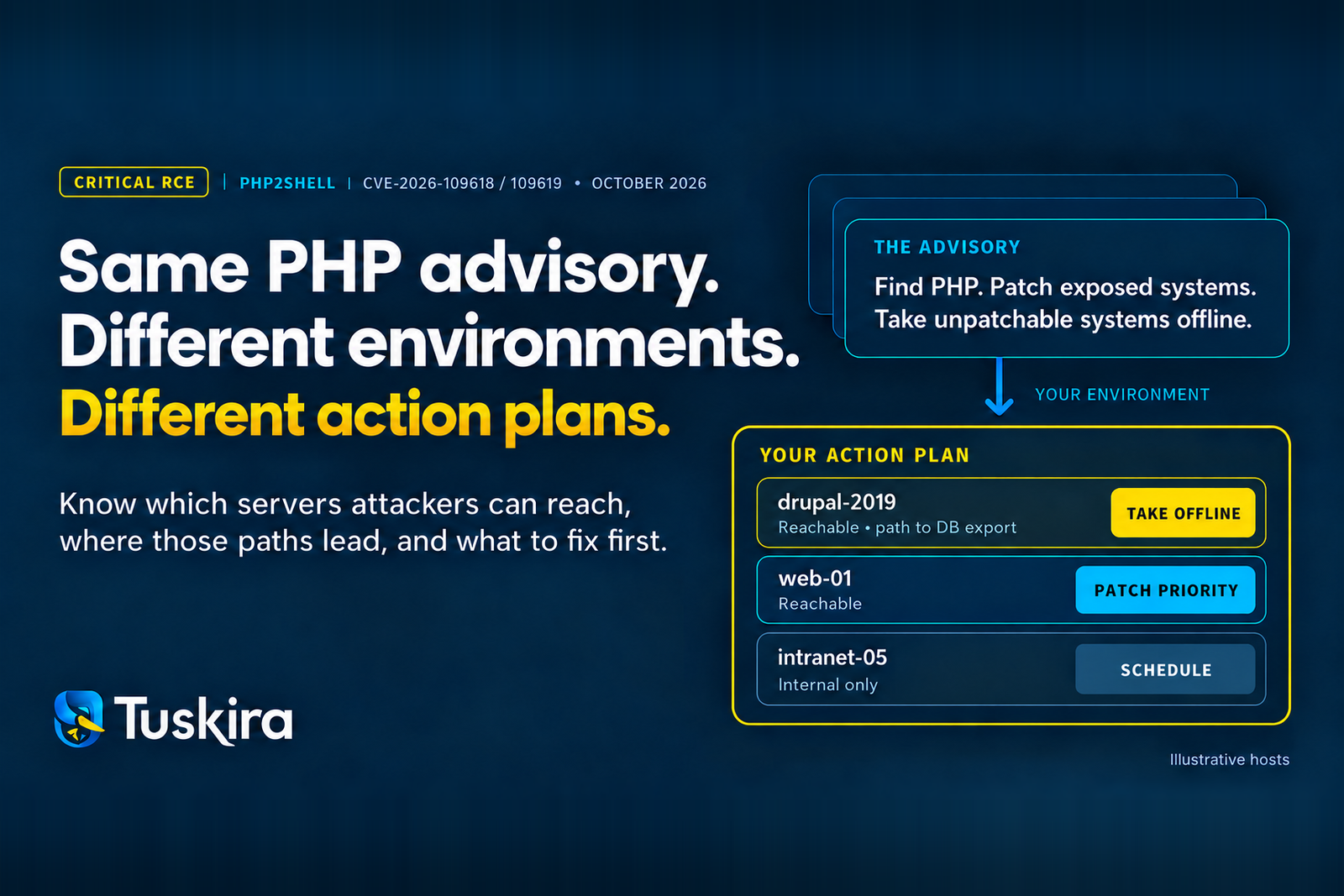
How to Find and Prioritize Exposed PHP Servers After PHP2Shell (CVE-2026-109618, CVE-2026-109619)

Attackers Are Using AI. Should Your AI Agents Be Auto-Approving Their Next Move?