The Best CTEM Tools for Enterprise Security Teams in 2026
By David Mundy, VP of Marketing, Tuskira
Let's get the disclosure out of the way first. Tuskira is one of the vendors on this list, so you should read our entry with the same skepticism you'd bring to any vendor ranking its own market. What we can offer in exchange is honesty about everyone else. The vendors below are genuinely good at what they do, several of them would be the right choice for certain programs, and we'll tell you which programs those are.
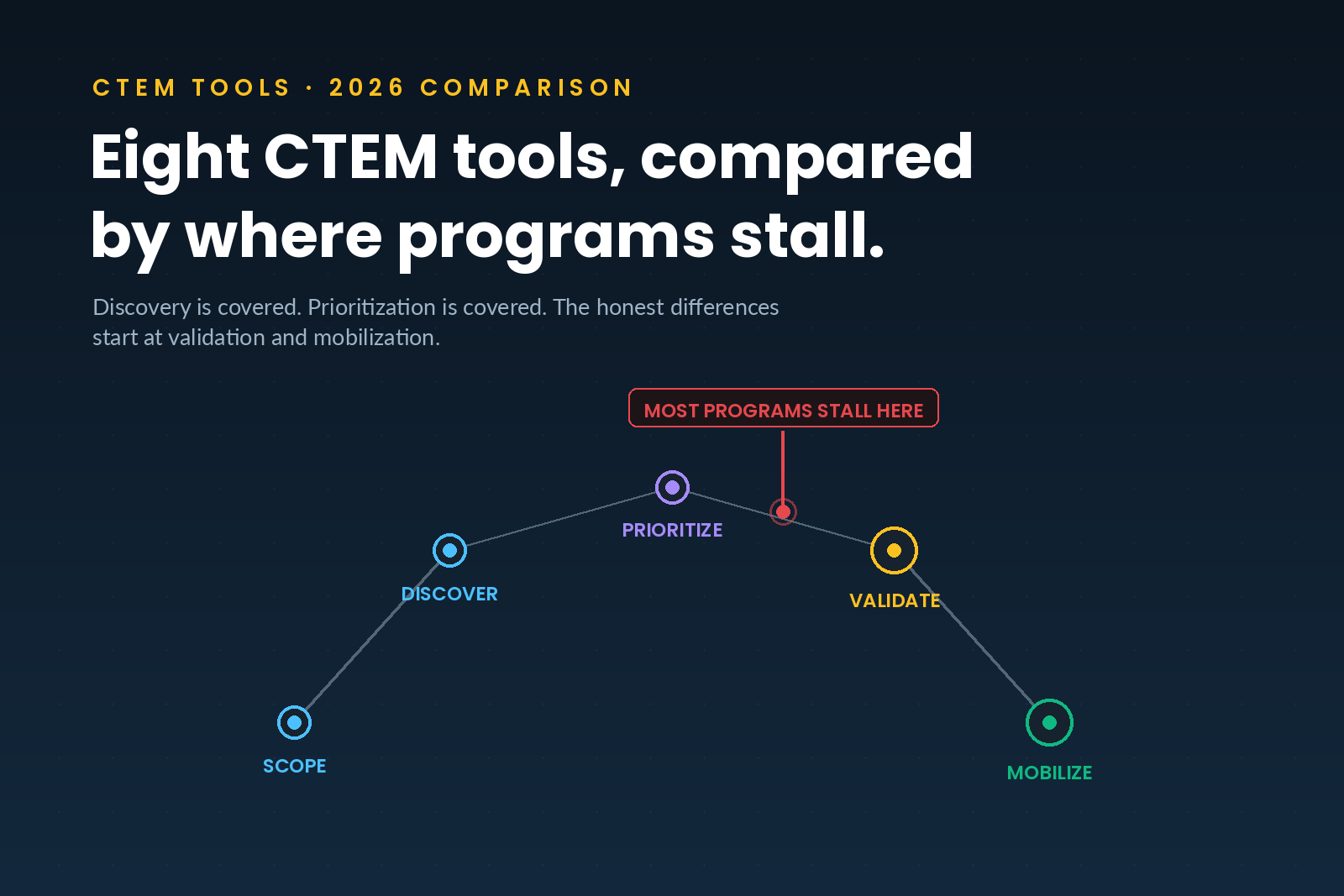
One more thing worth saying before the list. Continuous threat exposure management is a program, a five-stage loop of scoping, discovery, prioritization, validation, and mobilization, and no tool runs the program for you. What tools differ on is which stages they emphasize and how they execute them. Nearly every major platform now claims some form of validation and remediation, so the useful comparison isn't who claims a stage; it's how each one validates, what closure actually looks like, and whose stack it works across. Keep that lens as you read, because the right question isn't which tool is best. It's which stage your program is stuck at, and whose model of that stage matches your environment.
Key takeaways
- CTEM tools cluster by center of gravity: exposure assessment platforms that find and rank, validation platforms that prove exploitability, and platforms oriented around closing exposures through security controls.
- Validation models differ more than marketing suggests: some prove exploitability by safely attacking, others by modeling exposures against your deployed defenses. Both are legitimate; they answer different questions.
- Mobilization models differ just as much: remediation tickets, one-click fixes within a platform's own surfaces, or control changes deployed across the multi-vendor stack you already own.
- Match the tool to your stall point, and demand evidence at the stage you're buying for.
The comparison at a glance
Descriptions reflect public vendor positioning as of August 2026; this market moves quickly, so verify current capabilities directly with each vendor.
| Vendor | Strongest stages | Validation model | Mobilization model | Best fit | Main caveat |
|---|---|---|---|---|---|
| Tenable One | Discovery, prioritization | Exposure scoring, attack path context, and exploitability checks | Remediation workflows; one-click fixes for cloud/IAM surfaces | Broad exposure foundation across VM, cloud, identity | Closure is strongest within its own surfaces and ticketing |
| Qualys ETM | Discovery, prioritization, validation | TruRisk quantification plus TruConfirm automated exposure validation | Patch workflows plus TruRisk Eliminate patchless mitigations | Teams already standardized on Qualys agents | Strongest inside the Qualys ETM, agent, and remediation ecosystem |
| XM Cyber | Prioritization, validation (attack side) | Graph-based attack path and choke-point analysis | Prioritized fixes at choke points | Attack path visibility to crown jewels in hybrid AD/cloud | Defensive-control context and cross-stack closure are narrower |
| Pentera | Validation | Continuous and on-demand execution of real attack techniques | Remediation workflows, ticket routing, and retesting | Teams that require exploit-level proof | Center of gravity is adversarial validation rather than cross-stack exposure-to-response |
| Cymulate | Validation, mobilization (control-side) | Continuous control testing against known techniques (BAS) | Auto Mitigation and direct control updates via Mitigation Hub | Continuous evidence of control efficacy | Closure model is control-engineering and BAS-led, not full exposure-to-investigation-and-response |
| Zafran | Prioritization, validation (defense-aware) | Maps exposures against deployed controls to find what's effectively mitigated | Mitigation-first plans plus consolidated remediation tickets | Backlog reduction through control-aware prioritization | SOC investigation and response is not the main reason buyers choose it |
| CrowdStrike Falcon EM | Discovery, prioritization, mobilization (in-platform) | Exposure context enriched by Falcon telemetry and threat intel | Automated response and remediation through Falcon Fusion | Falcon-committed shops wanting exposure management without another agent | Strongest where Falcon's sensors and ecosystem reach |
| Tuskira | Validation, mobilization (cross-stack) | Simulates exposures against deployed controls on a live context graph | Compensating controls deployed through your existing multi-vendor tools, then revalidated | Teams with mature discovery whose programs stall between list and closure | Consumes your existing discovery tools rather than replacing them |
The eight platforms
1. Tenable One
- Best at: breadth of exposure discovery. Tenable One unifies vulnerability management, cloud, identity, and attack surface data into a single exposure view with mature scoring, attack path context, and exploitability checks, and it's a widely adopted platform in the category.
- Worth knowing: its remediation story has grown, including one-click fixes for cloud and IAM exposures and workflow integrations. Closure is strongest within Tenable's own surfaces and ticketing paths; validating exposures against third-party controls across your wider stack is less its center of gravity.
- Pick it if: you want a broad, proven foundation for the first three CTEM stages with growing fix workflows, and your team carries cross-stack closure.
2. Qualys Enterprise TruRisk Management
- Best at: unified risk quantification across a very large sensor network, now extended with TruConfirm for automated exposure validation and TruRisk Eliminate for remediation including patchless mitigations, all tightly integrated for teams that already run Qualys agents.
- Worth knowing: the validation and closure story has grown meaningfully, and it's strongest inside the Qualys ETM, agent, and remediation ecosystem; exposure-to-closure across a heterogeneous multi-vendor control stack is less its center of gravity.
- Pick it if: you're a Qualys shop wanting exposure management, validation, and remediation layered onto instrumentation you already deploy.
3. XM Cyber
- Best at: attack path analysis. XM Cyber pioneered chaining exposures, identities, and misconfigurations into graph-based paths to critical assets, and its choke-point analysis (finding the one fix that severs many paths) remains a reference point for the category.
- Worth knowing: it models the attack side deeply. Defensive-control context, whether your deployed defenses would interrupt a path, and closure through your existing multi-vendor stack are narrower parts of the story.
- Pick it if: attack path visibility to crown jewels is your primary gap, especially in hybrid AD and cloud environments.
4. Pentera
- Best at: automated security validation. Pentera safely runs real attack techniques against production, continuously or on demand, to prove what's actually exploitable, which makes it a common shortlist answer for teams that want exploit-level proof rather than theoretical severity. Remediation workflows, ticket routing, and retesting round out the loop.
- Worth knowing: its center of gravity is adversarial validation, proving exploitability by attacking. Turning cross-domain exposure context into defensive action across the operating stack is a different model, and the one this list's later entries organize around.
- Pick it if: your board or your engineers demand attack-proven evidence, with workflows to route and retest what's found.
5. Cymulate
- Best at: breach and attack simulation run as an exposure validation program: continuous control testing against a broad technique library, with clear scoring of how your defenses perform, and a mobilization layer that now includes Auto Mitigation and direct control updates through its Mitigation Hub.
- Worth knowing: its closure model is control-engineering and BAS-led, tuning and updating the security controls it tests. Full exposure management connected to investigation and response across the operating stack sits outside that model.
- Pick it if: control efficacy is the gap, and you want continuous evidence plus direct tuning of whether EDR, email, and web defenses catch what they claim.
6. Zafran
- Best at: defense-aware prioritization. Zafran maps whether your existing defenses already mitigate a given exposure, then produces mitigation-first plans and consolidated remediation tickets, a control-aware philosophy we have obvious sympathy for.
- Worth knowing: the platform positions across the exposure lifecycle, with its center of gravity in mitigation-aware prioritization and remediation planning; the SOC investigation and response motion is not the main reason buyers choose it.
- Pick it if: vulnerability backlog reduction through control-aware prioritization and faster mitigation is the immediate pain.
7. CrowdStrike Falcon Exposure Management
- Best at: exposure management woven into the endpoint and identity telemetry you already collect through Falcon, with attack path visibility enriched by CrowdStrike's threat intelligence, and automated response and remediation actions through Falcon Fusion.
- Worth knowing: the mobilization story is real and strongest inside the Falcon ecosystem, where its sensors and orchestration reach; coverage and closure across non-CrowdStrike controls depend on integrations.
- Pick it if: you're committed to the Falcon platform and want exposure management plus automated response without another agent.
8. Tuskira
- Best at: turning exposure context into defensive action across the whole stack. Where most platforms on this list help you find, rank, or validate exposures, Tuskira connects exposure, control state, detection, investigation, and response through one security data fabric, so the same live model that validates a finding also closes it. AI agents validate each exposure four ways (deployed, reachable, defended, blast radius) by simulating attacks against a digital twin of your environment, then close exposure through compensating controls in the multi-vendor tools you already own, revalidate that the path is actually shut, and carry an evidence trail on every verdict. The same graph also powers AI SOC alert triage and investigation, so exposure context and alert context stay connected instead of living in separate tools. In one financial-services deployment, 12.3M raw findings validated down to 0.46% actionable, with triage that took three weeks running in about thirty minutes.
- Worth knowing: Tuskira is purpose-built for validation, closure, and revalidation rather than net-new discovery; it consumes your existing scanners, EASM, and cloud tools through 150+ native integrations and adds the decision and action layer they were never built to provide.
- Pick it if: you already own plenty of discovery and your program stalls between "here's the prioritized list" and "the exposure is actually closed," or you want exposure management connected to detection and response rather than running beside them.
The stage coverage picture
Reading the list by stage: discovery and prioritization are well covered across the board. Validation is where models genuinely diverge, and most vendors now offer some form of it. To pick two ends of the spectrum, Pentera and Cymulate prove exploitability by safely attacking, while Zafran and Tuskira prove it by modeling exposures against deployed defenses; Tenable, Qualys, and CrowdStrike each blend exploitability checks into their assessment platforms as well. Mobilization has become the marketing battleground, and nearly everyone now claims it, so the questions that separate platforms are narrower and more useful: closure through whose stack, validated how, and revalidated by whom? Fixes confined to a platform's own surfaces suit single-vendor shops; closure across a multi-vendor stack, applied and then re-checked, is less common and matters more as attackers get faster than patch cycles.
How to actually choose
Run the evaluation on your data, not a demo environment. Ask every vendor, including us, the fifteen questions in our AI cyber defense buyer's guide, and pay closest attention to the validation pair: show me a low-severity finding you escalated, and a critical one you deprioritized, with evidence. A platform that only moves findings in one direction is re-ranking, and re-ranking is what you already have.
Frequently asked questions
Is CTEM a tool you can buy?
No. CTEM is a program framework, a continuous loop of scoping, discovery, prioritization, validation, and mobilization. Tools cover stages of it with different models, and this list exists because those models differ more than the marketing does. The framework and its stall points are covered in depth on our CTEM page.
Do CTEM tools replace vulnerability scanners?
Mostly no. Assessment platforms like Tenable and Qualys include their own scanning; validation and mobilization platforms, including Tuskira, consume scanner output and add exploitability and closure context on top. Keep the scanners either way, and see how validation changes vulnerability management once they're connected.
What is agentic CTEM?
Agentic CTEM is the CTEM loop executed by AI agents rather than manual workflows: agents continuously validate reachability and control coverage, recommend or apply mitigations within human-defined boundaries, and revalidate closure. Several vendors on this list are adding agentic features to individual stages; Tuskira runs the full loop this way, which is covered in depth on our agentic CTEM page.
What's the difference between CTEM tools and breach and attack simulation?
BAS platforms like Cymulate test whether your controls stop known techniques, which maps to CTEM's validation stage. A full CTEM program also needs the discovery, prioritization, and mobilization stages around it, so BAS is a component rather than a substitute.
What should a CTEM tool cost?
Pricing models vary too much across this list for a useful number here: per-asset, per-sensor, platform tiers, and module bundles all appear. The better budgeting question is total cost against the stage you're fixing; a validation layer that cuts your actionable queue by an order of magnitude changes the economics of every downstream tool and analyst hour.
See Tuskira validate, close, and re-check exposure paths in your own stack, or start with how Tuskira runs the full CTEM loop.
Attackers Are Using AI. Should Your AI Agents Be Auto-Approving Their Next Move?
Anthropic on Finding Vulnerabilities Becoming the Easy Part