How to Evaluate AI Cyber Defense Platforms in 2026
By David Mundy, VP of Marketing, Tuskira
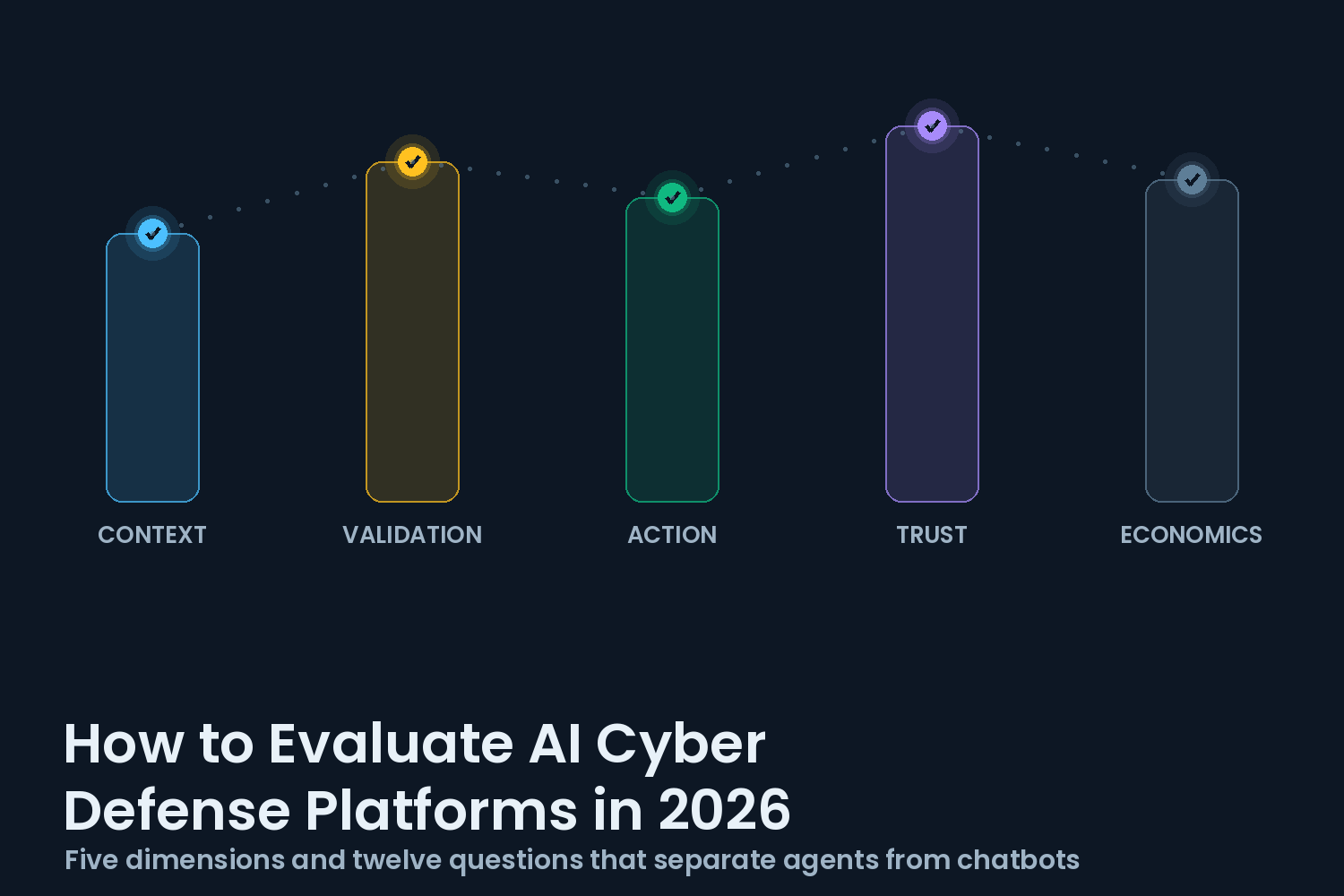
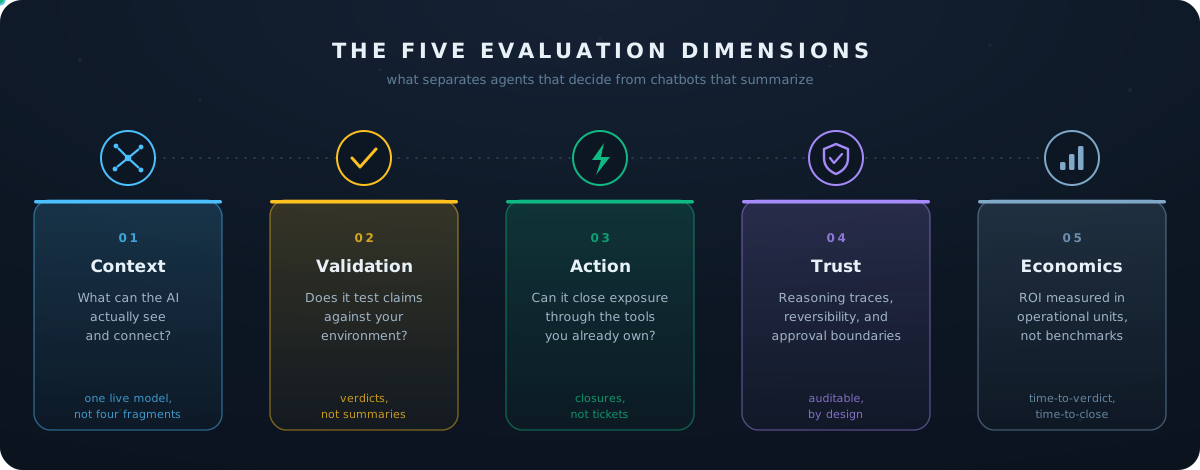
Evaluating an AI cyber defense platform comes down to five dimensions: the context the AI reasons over, whether it validates findings or just summarizes them, whether it can act through the tools you already own, whether you can trust and audit its decisions, and whether the economics actually change your operation. Vendors differ wildly on all five while using identical language, which is why this guide is organized around questions, not features.
Key takeaways
- Every platform now claims "agentic AI." The differences show up in five dimensions: context, validation, action, trust, and economics.
- The single most revealing question: what context does the AI actually reason over when it makes a decision?
- Demand outcome metrics from reference customers, findings-to-actionable ratio, time-to-verdict, time-to-close, not model benchmarks.
- A good evaluation framework should be capable of disqualifying any vendor, including the one who wrote it.
The five dimensions at a glance
- Context: what does the AI know when it decides?
- Validation: does it prove, or merely summarize?
- Action: can it change the security outcome?
- Trust: can you govern, audit, and reverse it?
- Economics: does your operating model actually improve?
Why this evaluation is harder in 2026
Two things changed. First, attackers went machine-speed: AI-driven research disclosed 1,596 verified vulnerabilities across 281 open-source projects in 63 days, roughly 25 per day against a remediation rate near 1.5 per day (data in our Patch Gap report), and exploitation windows collapsed from weeks to minutes.
Second, every vendor re-labeled. Copilots, chatbots, and rule-based automation all now ship under the word "agentic." The market gives you no vocabulary to separate an AI that investigates and closes threats from an AI that writes summaries of your alert queue. The five dimensions below are that vocabulary.
Dimension 1: What context does the AI reason over?
An AI agent's decisions are bounded by what it can see. If the platform only sees alerts, it can only re-rank alerts. If it sees your assets, identities, exposures, controls, and detections as one connected model, a security data fabric, it can answer the questions that matter: is this reachable, what's downstream, is anything blocking it?
Ask: What sources feed the AI's context, and how current is it? Does it resolve entities across tools (does it know your EDR's hostname and your cloud's instance ID are the same machine)? Does context include your defenses, control state and detection coverage, or just your exposures?
Dimension 2: Does it validate, or summarize?
Summarizing is reading your data back to you in better prose. Validation is testing claims against your environment, four checks per finding: Is it deployed? Is it reachable? Is it already defended? What does it reach next? Validation is what cuts millions of findings to the handful that demand action, and it's what makes continuous threat exposure management run as a loop instead of a quarterly project.
Ask: Show me a finding your platform marked as critical that scanners scored low, and one it deprioritized that scanners scored critical. Both directions matter; a platform that only inflates or only suppresses isn't validating.
Dimension 3: Can it act, and through what?
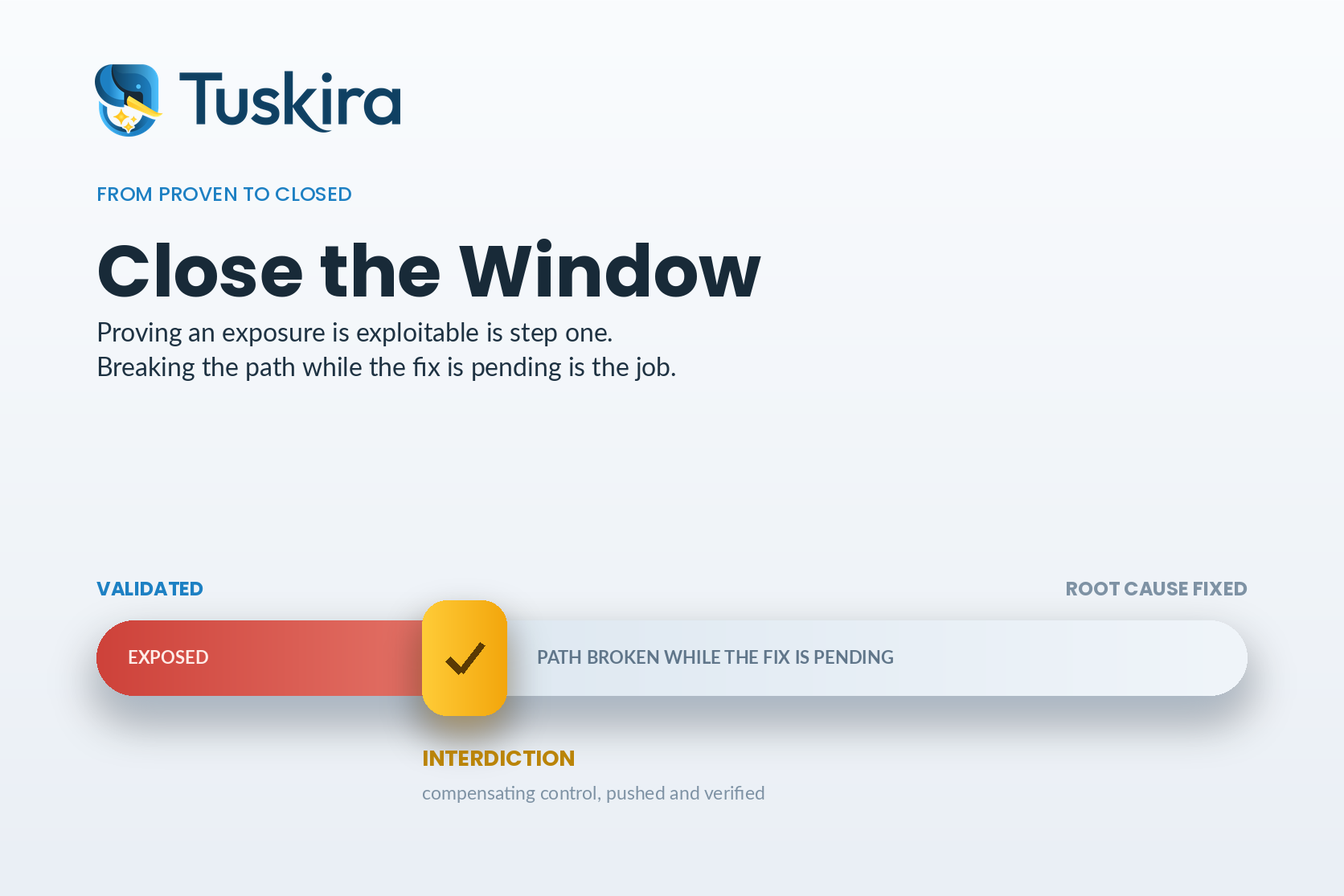
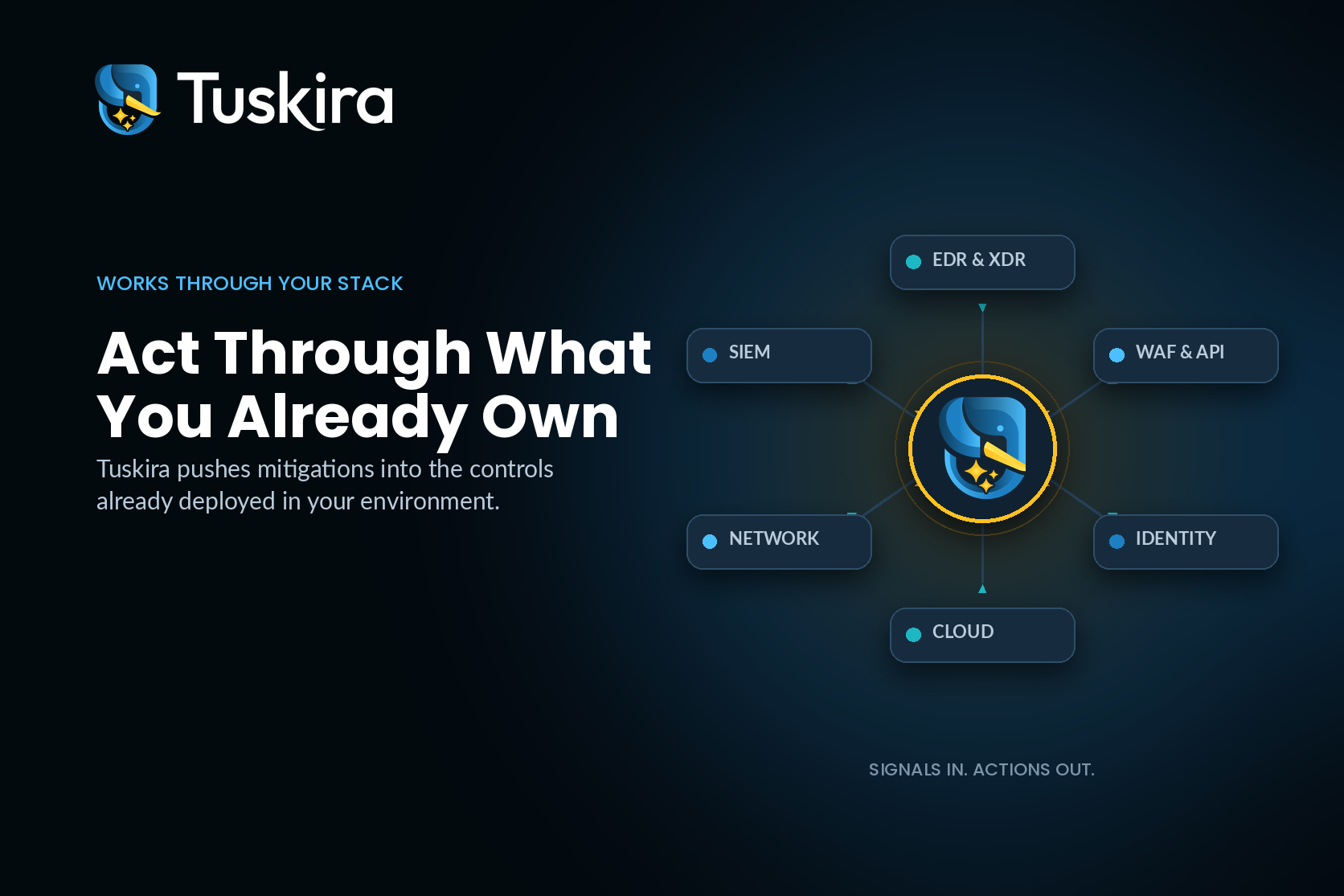
The evaluation should eventually reach action. Ask whether the platform changes the security outcome, a closed exposure, a contained threat, or improves how work is presented to analysts. Both have value; only one changes your risk. The practical questions: does it execute through the controls you already own, your EDR, firewall, WAF, identity provider, or does it require re-plumbing your stack? Can it apply a compensating control today while the patch waits for a safe window?
Ask: Walk me through your last zero-day response end to end, from CVE disclosure to closed exposure, and show me which systems executed each step.
Dimension 4: Can you trust it, and prove it?
This is where most AI security deployments quietly die. If the SOC doesn't trust the AI's decisions, it re-reviews everything, and you've added a layer instead of removing one. Trust is built from specific, checkable features: an evidence-backed decision trail on every verdict, the evidence considered, sources queried, relationships used, confidence, policy applied, and action taken, plus reversibility of actions and approval boundaries you define, so high-impact moves always wait for a human. Accountability for autonomous actions shouldn't be a philosophy discussion; it should be a product screen you can look at.
Ask: Show me the decision trail for a real verdict, and show me what happens when the AI was wrong: how the mistake is detected, corrected, reversed where applicable, and incorporated into future policy or workflow.
Dimension 5: Do the economics change the operation?
Measure ROI in operational units, not model benchmarks. The test that matters: if your alert volume currently consumes your analysts' entire week, does the platform change that number, or just re-sort it?
- Findings-to-actionable ratio. What percentage of raw findings genuinely demands action? (In one financial-services deployment, 12.3M findings reduced to 0.46%.)
- Time-to-verdict. From signal to evidence-backed decision, minutes or weeks?
- Time-to-close. From verdict to closed exposure, including compensating controls when patches wait.
- Analyst leverage. Hours returned to the team per week, and where those hours go.
- Infrastructure cost. Does it require centralizing more data (a growing ingestion bill), or does it work against the stack in place?
- Time-to-value. Weeks of connector setup, or days to first validated verdicts?
The twelve questions to ask every vendor
- What context does your AI reason over when it makes a decision, and how current is it?
- Do you resolve entities across tools, or operate on each tool's data separately?
- Does your context include our control state and detection coverage, or only exposures?
- Show me a low-severity finding you escalated and a critical one you deprioritized, with the reasoning.
- Do you validate exploitability in our environment, or score based on threat intel alone?
- What actions can you execute, and through which of our existing tools?
- Can you close exposure with a compensating control before a patch ships?
- What runs autonomously, what requires approval, and who defines that boundary?
- Show me the full evidence trail and audit log for one real verdict.
- What happens when the AI is wrong, and which actions are reversible?
- What are your reference customers' findings-to-actionable ratio, time-to-verdict, and time-to-close?
- What does deployment require from my team, and when do we see the first validated result?
And three questions about the AI itself
These deserve their own section because they apply to every vendor equally, and the answers vary more than you'd expect:
- Which model providers do you depend on, can we change them, and what happens if a model degrades or becomes unavailable?
- Exactly what data leaves our environment, to which providers, and under what controls?
- How is the AI system itself secured, prompts, credentials, agent identities, and where does it explicitly refuse to make a decision?
A vendor who answers all fifteen crisply is showing you an operating model. A vendor who redirects to model quality, parameter counts, or a demo of a chat window is showing you a chatbot.
And one thing worth saying plainly: a good evaluation framework should be capable of disqualifying us too. Ask every vendor, including Tuskira, to demonstrate these capabilities against your environment and your data, and don't accept an architecture diagram where you asked for evidence.
Download the Vendor Scorecard (PDF)
All fifteen questions as a one-pager to bring into your next vendor call. No email required.
On adoption: start where trust is cheap
The biggest adoption barriers aren't technical, they're organizational: trust in autonomous decisions, fear of irreversible actions, and change management for analysts whose jobs shift from queue processing to decision review. The answer is sequencing, not faith. Start the AI in investigate-and-recommend mode, verify its verdicts against your team's for a few weeks, then expand autonomy boundary by boundary, the crawl-walk-run path to autonomous AI. Platforms built for it make each expansion a config change, not a re-deployment.
Frequently asked questions
What's the difference between an AI copilot and an agentic AI platform?
A copilot assists a human who does the work: it drafts, summarizes, and answers questions. An agentic platform does the work under human governance: it investigates to a verdict, validates exposures, and executes approved actions, with an evidence-backed decision trail for review.
What's the most important evaluation criterion?
Context. Every other capability is downstream of what the AI can see. A platform with excellent models and thin context produces confident, wrong answers at scale.
How long should an AI cyber defense POC run?
Long enough to compare AI verdicts against your analysts' on live traffic, typically 2-4 weeks, and to measure findings-to-actionable ratio and time-to-verdict against your baseline. Insist on your data, not a demo environment.
Should the AI replace our SIEM or scanners?
No. The stronger pattern is a decision layer that consumes what your existing tools see and adds validation, prioritization, and action. Rip-and-replace multiplies both cost and risk.
Put the fifteen questions to Tuskira on your own stack, or start with how the platform works.
Tuskira Open Sources the AI Agent Gateway
Tuskira Named in the 2026 Gartner® Emerging Tech Impact Radar: CSP Infrastructure and Operations