The Best AI Vulnerability Prioritization Tools in 2026
By David Mundy, VP of Marketing, Tuskira · Last updated November 16, 2026
Tuskira is on this list, so read our entry with the skepticism you'd bring to any vendor writing about its own market. What we can offer in return is an evidence-based account of everyone else, drawn from public product materials. Every tool below solves a real problem, several would be the right pick for programs that look nothing like ours, and we'll say which programs those are.
The problem they all go after is the same. Scanners produce far more findings than any team can fix, and severity scores alone don't tell you which ones an attacker can use against you. AI vulnerability prioritization tools try to answer that question for your environment. They differ in the evidence they use. Some predict which CVEs attackers will exploit next, some trace whether vulnerable code ever runs, and some check whether your deployed controls would stop the exploit. They differ just as much in what happens after the ranking, which is where most backlogs stall.
Key takeaways
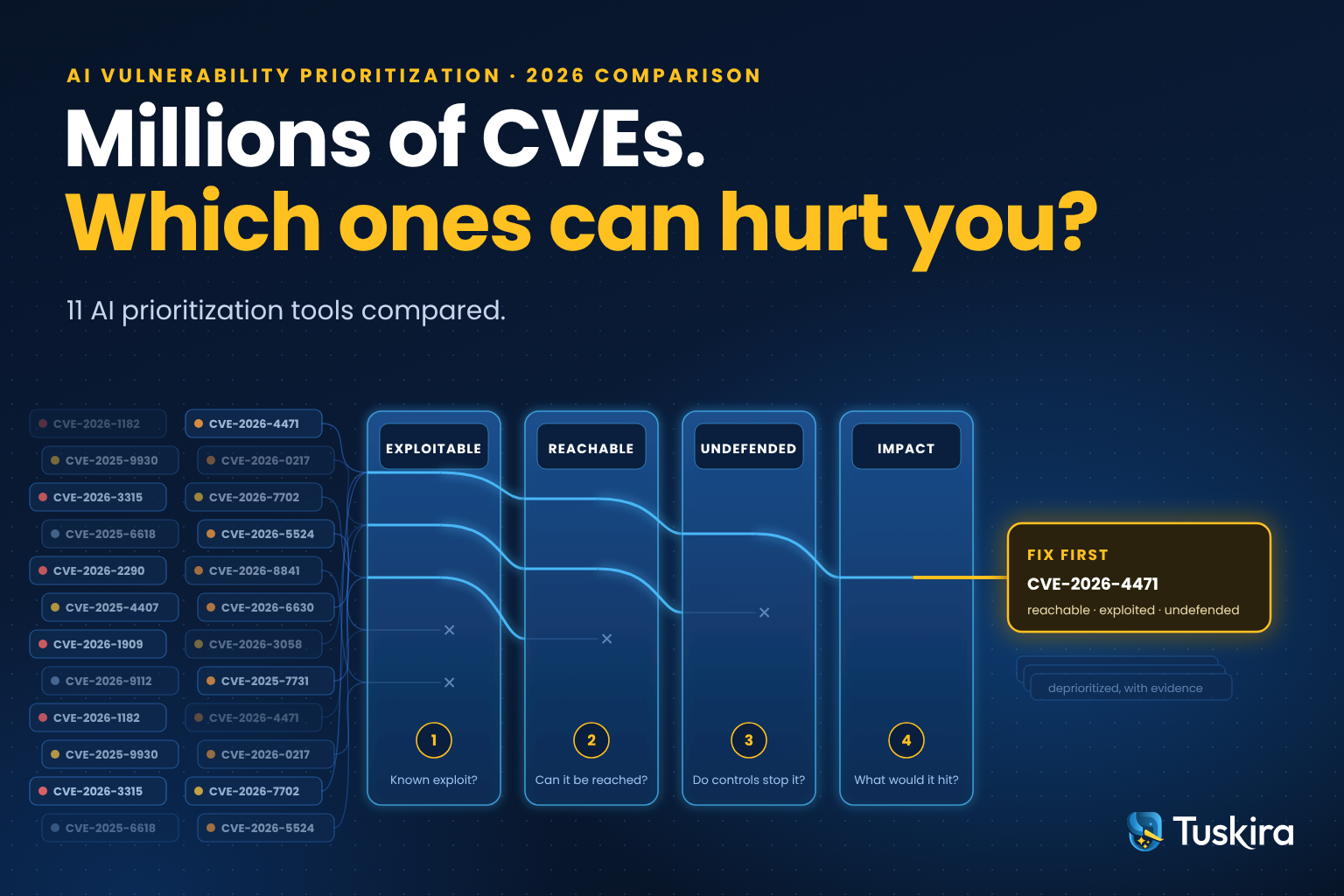
- Every tool here ranks findings on some mix of four signals, which are exploitability, reachability, deployed-control coverage and business context.
- CVSS and EPSS describe a CVE in general. Neither knows your network, your controls or your critical assets.
- Tools that only predict exploitation re-rank your queue. Tools that check reachability or control coverage can defensibly deprioritize findings or remove them from the active remediation queue, and that's what shrinks a backlog.
- AI does different jobs across these tools, from predictive scoring to agent-led investigation and remediation orchestration.
- Look hard at what happens after ranking. Tickets, compensating controls, code fixes and revalidation are very different outcomes.
How we selected these tools
We included generally available platforms that use machine learning or AI agents as a material part of vulnerability prioritization. Each one publishes enough product detail for us to evaluate its signals and workflows, and each helps teams act on findings from vulnerability, application or cloud-security sources. This is a representative comparison. It doesn't try to be an exhaustive market ranking, and it reflects public vendor information as of November 2026.
We excluded products that were no longer sold as standalone offerings as of November 2026; details appear in the FAQ.
The comparison at a glance
Descriptions reflect public vendor information as of November 2026, and performance figures are vendor-reported. This market moves quickly, so verify current capabilities directly with each vendor.
| Vendor | How AI is used | Signals used to prioritize | Reachability or exploit validation | What it does after ranking | Best fit | Main caveat |
|---|---|---|---|---|---|---|
| Tuskira | AI agents for risk correlation, control validation and remediation orchestration | Findings from your existing scanners, reachability, exploitability, deployed control coverage, blast radius, business context | Yes. Validates findings and breach paths against your deployed controls, modeled on a live Digital Twin | Closes breach paths through supported integrations with your existing controls, then revalidates | Teams with large multi-scanner backlogs and a mixed security stack | Needs integrations with the scanners and controls that supply its context, so a team that only wants a standalone scoring feed will get less from it |
| Bitsight | Predictive scoring from AI analysis of underground and dark web activity | Dynamic Vulnerability Exploit (DVE) score built from threat intelligence, underground activity, exploit publication and ATT&CK mapping | Predicts exploitation likelihood; its pages don't describe in-environment exploit validation | Routes re-scored findings back to scanner, patching and ticketing workflows | Teams that want earlier, intelligence-led scoring on top of their scanners, plus third-party exposure | Outside-in intelligence, so it doesn't check your own controls |
| Brinqa | AI layer that merges duplicates, fills data gaps and enriches findings; bring-your-own AI agents | Aggregated, deduplicated findings ranked by exploitability, asset ownership and business services | Yes, through PlexTrac, which Brinqa acquired in August 2026 to validate fixes | Maps risk to owners and business services, orchestrates remediation, validates before closure | Large enterprises consolidating many scanners into one program of record | The PlexTrac validation workflow is new, so check its maturity |
| Endor Labs | Call-graph reachability analysis; AI agents for SAST triage and dependency remediation | Function-level and dependency-level reachability in application code and containers | Yes. Static call-graph reachability from your code to the vulnerable function | Dependency remediation workflows and upgrade guidance for developers | AppSec teams buried in open-source dependency alerts | Scope is application code, dependencies and containers |
| Maze | Agent-led investigation of each finding, then root-cause fixes | Code, runtime, cloud, network, IAM, control and business context gathered per finding | Yes. Agent-led exploitability investigation per finding | Root-cause fixes, verified and sent to coding agents, engineers or tickets | Cloud-native and product security teams | Stated scope is code, containers and cloud VMs |
| Nucleus Security | Agentic threat intelligence feed; Helix reasoning agents and conversational assistant | Asset criticality, data sensitivity, internet exposure, active exploitation, EPSS, CISA KEV, ransomware links, Nucleus Insights threat intel | Threat-intel exploitability; its prioritization page doesn't describe reachability analysis | Automated remediation workflows, ownership and ticketing at scale | Programs that want transparent, tunable scoring across many tools | Control-aware and reachability analysis aren't described on its prioritization page |
| Qualys | Agent-led exploit validation (Agent Val); AI patch reliability scoring and agent-orchestrated patching (Agent Sara) | TruRisk score from severity, exploitability, threat intel, asset criticality and business context | Yes. TruConfirm safe exploit validation on network and host | TruRisk Eliminate 2.0 patches, credits existing controls, applies mitigations, monitors health | Teams standardized on Qualys scanners and agents | Validation runs through Qualys scanners and the Qualys Cloud Agent |
| Rapid7 | AI-driven risk insights and AI-powered remediation guidance; method not detailed publicly | Exploit likelihood, reachability, severity, business context, toxic combinations, threat feeds | Runtime validation for cloud workloads | Remediation projects, SLAs, ticketing and no-code automation | Rapid7 customers extending VM into cloud exposure | Runtime validation is focused on cloud workloads |
| Seemplicity | Agent-led investigation by five AI analysts, one per finding type | Exploit conditions and reachability checked per finding type | Yes. Evidence-backed exploit-condition checks that lower priority when conditions are absent | Routes fixes to owners, tracks progress, generates audit-ready proof | Teams whose bottleneck is getting fixes to the right owner | Its pages don't detail how deployed network or endpoint controls factor in |
| Tenable | Predictive scoring (machine-learning threat score, generative AI news analysis); Hexa AI agents for remediation orchestration | Vulnerability Priority Rating (VPR) from CVSS impact plus threat data; Tenable One asset, identity and attack path context | Exploitability verification and attack path context in Tenable One | Hexa AI agents create tickets, connect patch tools and trigger rescans | Tenable shops that want prioritization inside their exposure platform | Deepest context comes from Tenable's own sensors and modules |
| Zafran | Zero Day Agent inventory matching, AI mitigation and remediation, conversational assistant for reporting | Exposure Graph combining runtime status, network reachability, threat intel, business criticality and live control configuration | Yes. Control-aware analysis of what your existing defenses already block | Mitigation through your firewall, WAF and EDR, plus consolidated remediation tickets | Backlog reduction for teams with many scanners and mature controls | Control credit depends on which of your controls it connects to |
How AI prioritization decides what matters
For each finding, these tools ask whether an attacker can use it against you and what happens if they do. They answer with some mix of four signals.
- Exploitability: is there a working exploit, and is it being used in the wild? Threat intelligence, CISA's Known Exploited Vulnerabilities catalog and EPSS all feed this signal, and it's the one most tools cover.
- Reachability: for code, does your application ever call the vulnerable function? For infrastructure, is there a network path from where an attacker would start to the vulnerable service?
- Deployed-control coverage: would a firewall rule, WAF, EDR prevention policy, segmentation boundary or identity policy already deployed in the environment stop the exploit? It's the hardest signal to get right because it needs live configuration from many vendors' tools. If the path stays open, the platform may recommend or apply a compensating control while the permanent fix waits.
- Business context: what is the asset, who owns it, what data does it hold, and what else can an attacker reach from it? The same finding on a test box and a payment server shouldn't get the same priority.
Some vendors use machine learning to predict exploitation from threat data. Others use AI agents to do the investigation a security engineer would do by hand, pulling configuration, checking paths and writing up a verdict with evidence.
CVSS vs EPSS vs reachability vs control-aware prioritization
Vendor marketing blends these four methods together, but each one answers a different question.
CVSS
CVSS rates how severe a vulnerability is in general. FIRST, which maintains the standard, says Base scores are designed to measure severity and shouldn't be used alone to assess risk. A CVSS 9.8 is a 9.8 on every system, exposed or not, which is why CVSS-driven queues are so long. Tenable's July 2025 analysis found CVSSv3 marked almost 160,000 CVEs as high or critical.
EPSS
EPSS, also from FIRST, estimates the probability that a CVE will be exploited in the wild in the next 30 days, and it's updated daily. That's a big improvement on severity alone. It still describes the internet as a whole, so it can't tell you whether a CVE can be exploited in your environment.
Reachability
Reachability asks whether the vulnerable code or service can be reached. AppSec tools like Endor Labs build a call graph to see whether your code ever calls the vulnerable function, and infrastructure tools trace network paths and runtime state. It often clears a large share of findings, because many vulnerable packages are installed and never loaded, and many vulnerable services are never exposed.
Control-aware prioritization
A finding can be reachable and still be blocked by a control you already run. Control-aware prioritization checks the live configuration of your firewalls, WAFs, EDR and identity policies against each exploit path. If the path is blocked, the finding can be deprioritized with evidence. If it's open, the tool can recommend or apply a compensating control while the patch waits. Tuskira, Zafran and Qualys (through TruConfidence) each describe some form of this, with different depth.
Taken in order, CVSS and EPSS say what's dangerous in general, reachability says what's exposed in your environment, and control coverage says what's still open after your defenses do their job.
The eleven tools
Tuskira is listed first because it's ours. The others follow in alphabetical order. This isn't a ranking.
Tuskira
- Best at: cutting a multi-scanner backlog down to the findings that are reachable and undefended in your environment, then closing them. Lattice, Tuskira's vulnerability prioritization agent, scores every finding for reachability, exploitability and defense coverage. Kairo joins those findings into the breach paths an attacker could follow inside your environment and validates each one against the controls you've already deployed, modeled on a live Digital Twin that the Security Data Fabric keeps current. When a path is open and a patch can't ship today, Tuskira closes the breach path through supported integrations with your existing controls, such as a firewall rule, an EDR setting or an identity policy, and then revalidates that it's shut. In one financial-services deployment, Tuskira reduced 12.3 million ingested findings to 0.46% requiring action after deduplication, suppression and known-exploit correlation. Internet exposure then set which findings were fixed first, and control validation showed which paths stayed undefended. Triage that had taken three weeks ran in about thirty minutes.
- How it uses AI: Lattice and Kairo are AI agents. Lattice correlates exploitability, reachability, control coverage and business context into a priority for each finding. Kairo runs the validation, orchestrates the control change and records the evidence behind every verdict.
- Worth knowing: Tuskira needs integrations with the scanners and controls that supply its context. It doesn't scan. It reads findings and control configuration from the tools you already run through 200+ integrations, so it's strongest in mixed, multi-tool environments, and teams that only want a standalone scoring feed will get less from it. It's also a broader platform that includes AI SOC alert triage.
- Pick it if: you have several scanners, a backlog in the hundreds of thousands or millions, and a security stack from many vendors whose controls you want credited and used. See how Tuskira runs vulnerability management.
Bitsight
- Best at: early, intelligence-led scoring. Bitsight Vulnerability Intelligence uses its Dynamic Vulnerability Exploit (DVE) score, which Bitsight says predicts the likelihood of exploitation over a 90-day window and is available within hours of a CVE's publication. Bitsight builds the score from threat intelligence across clear, deep and dark web sources, including exploit publication and ransomware and APT activity, and maps each CVE to MITRE ATT&CK.
- How it uses AI: predictive scoring. Bitsight says DVE is derived from AI analysis of underground discussion and models exploitation activity from threat intelligence. It doesn't publish the details of the model.
- Worth knowing: Bitsight describes DVE as layering on top of scanners like Tenable, Qualys and Rapid7, with re-scored findings routed back to patching and ticketing. Bitsight says it scores CVEs on what adversaries are doing, and its pages don't describe testing findings against the controls inside your environment.
- Pick it if: your scanners are working, you want a sharper threat-likelihood signal earlier than NVD enrichment, and vendor exposure matters to your program.
Brinqa
- Best at: serving as the program of record for very large environments. Brinqa says it ingests and correlates exposure data from across your tools into one foundation that's deduplicated, attributed and prioritized by what's exploitable in your environment, and it maps risk to asset owners, teams and business services.
- How it uses AI: Brinqa describes an AI layer that fills data gaps, merges duplicate findings and enriches exposure intelligence. It also lets you bring your own AI agents or use Brinqa's.
- Worth knowing: Brinqa acquired PlexTrac, an offensive security and pentest platform, in August 2026. Brinqa says the combination lets it validate exposures before and after a fix so issues are confirmed before they're marked resolved. Because the deal is recent, ask how much of that workflow ships today and how much is on the roadmap.
- Pick it if: your main problem is fragmentation across dozens of tools and teams, and you want one governed system for ownership, SLAs and reporting.
Endor Labs
- Best at: code-level reachability for open-source dependencies. Endor Labs offers dependency-level reachability, which checks whether an imported package is used, and function-level reachability, which uses program analysis to trace whether a path exists from your code to the vulnerable function. Endor Labs calls function-level analysis the most accurate way to determine exploitability in the context of your application, and it extends reachability from code into container images.
- How it uses AI: the reachability itself comes from call-graph analysis of your code. Endor Labs uses AI agents around it. Its agents trace data flow across repositories to cut SAST false positives, and its AURI agent workflows triage findings and remediate dependencies, read-only by default with approval required for each change.
- Worth knowing: Endor Labs reports a 97% reduction in SCA noise in a Zebra Technologies case study. Function-level reachability needs a successful build and call graph, and results fall back to "potentially reachable" where that analysis isn't supported. Its scope is application code, dependencies and containers, so host, network and cloud infrastructure findings need another tool.
- Pick it if: the backlog you most need to cut is open-source dependency alerts, and developers are the ones doing the fixing.
Maze
- Best at: investigating every finding across code and cloud. Maze says its agents check exploitation requirements, network configuration and IAM permissions for each vulnerability, and Maze reports that 90% of the vulnerabilities it analyzes aren't exploitable when investigated.
- How it uses AI: agent-led investigation. Maze says its AI agents assemble context from your code, runtime, cloud, controls and business, then reason over that evidence the way a security engineer would. After triage, the agents trace a vulnerability to its root cause and verify the fix.
- Worth knowing: Maze deploys with a read-only role and a scanner integration, and it sends verified fixes to a coding agent, an engineer or a ticket. Its stated scope is cloud vulnerabilities in containers and VMs, open-source dependencies and first-party code, so teams with large on-premises estates should ask how coverage extends there.
- Pick it if: you're a cloud-native or product security team and your backlog lives in containers, cloud workloads and code.
Nucleus Security
- Best at: transparent, configurable risk scoring at very large scale. Nucleus lists the factors it uses, including asset and business criticality, data sensitivity, internet exposure, compliance scope, active exploitation, public exploit availability, ransomware association, EPSS and CISA KEV inclusion, and you can adjust their weight. Nucleus says it processes 9 billion findings daily across 200+ connectors.
- How it uses AI: Nucleus describes Nucleus Insights as an agentic intelligence feed that validates exploit and malware evidence as it's collected. Its Nucleus Helix AI engine runs reasoning agents across the program and includes an agent you can question in plain language about findings, exposure and ownership. The scoring model itself is factor-based and tunable.
- Worth knowing: its prioritization page doesn't describe reachability or deployed-control coverage, so exploitability comes mainly from threat intelligence. Its strength is the operations around the score. Nucleus says it can take a newly exploitable vulnerability to an owned ticket in 15 minutes.
- Pick it if: you want a scoring model your team can see and tune, plus heavy automation for routing and reporting across many tools.
Qualys
- Best at: prioritization, exploit validation and remediation from one vendor. Qualys TruRisk combines the Qualys Detection Score (severity, exploitability and threat intelligence) with asset criticality and business context. TruConfirm safely validates exploitability on the network through Qualys scanners and on endpoints through the Qualys Cloud Agent, and Qualys says confirmed exploits rise in TruRisk priority. TruRisk Eliminate 2.0, launched in October 2026, adds TruConfidence, which Qualys says first credits what existing controls already protect, then applies patches or compensating mitigations through tools you already run.
- How it uses AI: Qualys calls Agent Val its agentic AI for safe exploit validation. It picks out high-risk and trending CVEs, runs the validation, orchestrates remediation and revalidates the exploit path, while Qualys says the proof itself is deterministic. In TruRisk Eliminate 2.0, an AI-powered Patch Reliability Score and an agent called Agent Sara orchestrate patching in waves.
- Worth knowing: Enterprise TruRisk Management ingests third-party findings, but validation and remediation run through Qualys scanners, agents and patching. The fit is strongest where Qualys is already deployed widely.
- Pick it if: you're standardized on Qualys and want validation and remediation inside the same platform that scans.
Rapid7
- Best at: extending vulnerability management into cloud exposure for Rapid7 customers. Rapid7 says Exposure Command prioritizes using exploit likelihood, reachability, severity and business context, with a risk score that flags toxic combinations. Its Active Risk scoring combines CVSS with threat feeds such as AttackerKB, Metasploit, Exploit Database and CISA KEV, and Exposure Command can pull in third-party data.
- How it uses AI: Rapid7's Exposure Command page lists AI-driven risk insights and AI-powered remediation guidance. It doesn't describe the method, so ask how much of the score and the guidance comes from AI.
- Worth knowing: Rapid7 added runtime validation in March 2026, which checks live cloud workloads to confirm which vulnerabilities and misconfigurations are exploitable. That validation is focused on cloud workloads. Remediation runs through projects, SLAs, ticketing and no-code automation.
- Pick it if: you already run Rapid7 for vulnerability management or detection and want cloud exposure and prioritization in the same place.
Seemplicity
- Best at: turning prioritized findings into finished fixes. Seemplicity says its SCA and Host VM analysts check exploitability and reachability and lower priority when exploit conditions are absent, and the platform normalizes and deduplicates findings before they're routed.
- How it uses AI: agent-led investigation. Seemplicity runs five AI Exposure Response analysts, one each for Host VM, SAST, SCA, Web and Container findings, and says each returns a verdict, the evidence behind it, fix options and an owner.
- Worth knowing: the platform routes fixes to owners in existing workflows, tracks progress and generates audit-ready proof. Its pages don't detail how deployed network or endpoint controls factor into a verdict, so ask if that matters to you.
- Pick it if: you know what to fix and the stall point is getting the right owner to fix it and proving it was done.
Tenable
- Best at: prioritization built into a broad exposure platform. Tenable says the enhanced Vulnerability Priority Rating, released in July 2025, flags about 1.6% of vulnerabilities as critical. Tenable One adds asset, identity and attack path context, and Tenable's 2025 acquisition of Vulcan Cyber brought in third-party data flows.
- How it uses AI: predictive scoring plus agents. VPR combines CVSS impact with a machine-learning threat score drawn from Tenable Research, generative AI analysis of news coverage, malware data and NVD and CISA metadata. Tenable Hexa AI, the agentic layer in Tenable One, reasons through risks, creates tickets, connects with patch tools and triggers a rescan when a ticket closes.
- Worth knowing: its deepest context comes from Tenable's own sensors and modules, so the most complete picture assumes Tenable is doing most of your scanning.
- Pick it if: Tenable is already your scanning foundation and you want prioritization and remediation workflows in the same platform.
Zafran
- Best at: control-aware backlog reduction. Zafran says its Exposure Graph connects every finding to its asset, network path, runtime status and threat activity, then reads the live configuration of your existing controls to see what's protecting the asset. Zafran's homepage describes finding the 1% of exposures that matter.
- How it uses AI: Zafran calls itself AI-native. Its Zero Day Agent matches newly announced vulnerabilities to your live software inventory, its workflow includes AI-generated mitigations such as WAF rules and AI remediation, and Zafran AI builds reports and scheduled report agents from plain-language prompts.
- Worth knowing: Zafran leans toward mitigation, using the firewall, WAF and EDR you already own to reduce risk before a patch exists, and it groups overlapping findings into consolidated remediation tickets. Control credit depends on which of your controls are connected. We compare the two platforms directly in Tuskira vs Zafran.
- Pick it if: you have many scanners, a mature set of network and endpoint controls, and want prioritization that credits them.
How to choose
If you have a huge scanner backlog, start by counting where it lives. A backlog that's mostly open-source dependencies is a different problem from one that's mostly hosts and network devices. Then run every vendor, including us, through these checks on your own data.
- Show the evidence: for any finding the tool deprioritizes, ask to see why. A probability score is a prediction. A reachability trace or a control check is evidence you can hand an auditor.
- Test both directions: ask for examples in both directions, a critical finding the product deprioritized and a lower-severity finding it escalated because of environmental context. Have the vendor walk you through the evidence for each.
- Ask what the AI does: find out whether the AI predicts, investigates, or acts, and what it records when it does. An agent that writes up its reasoning is easier to audit than a score with no trail.
- Check control coverage: list the firewalls, WAFs, EDR and identity tools you run, and ask which ones the vendor reads live configuration from. Control credit is only as good as that list.
- Ask what happens next: a ranked list still needs someone to act. Find out whether the tool opens tickets, applies a compensating control, ships a code fix, or all three, and whether it revalidates afterward. That last step matters more each year as attackers move faster than patch cycles.
- Measure the queue: run a proof of concept on a real slice of your backlog. Track the before and after count, the time to triage, and how many deprioritized findings your team agrees with. Ask how it deduplicates across your scanners while you're at it.
The fifteen questions in our AI cyber defense buyer's guide go deeper, and if your main gap is closing exposures once they're ranked, our CTEM tools comparison covers that stage.
Frequently asked questions
What are the best AI vulnerability prioritization tools in 2026?
Tools often evaluated for AI-driven vulnerability prioritization in 2026 include Tuskira, Bitsight, Brinqa, Endor Labs, Maze, Nucleus Security, Qualys, Rapid7, Seemplicity, Tenable and Zafran. Endor Labs and Maze are strong for code and cloud, Qualys, Rapid7 and Tenable fit teams already on their scanners, and Tuskira and Zafran credit the controls you've deployed.
How is AI-driven prioritization different from CVSS and EPSS?
CVSS rates general severity, and EPSS estimates how likely a CVE is to be exploited somewhere in the next 30 days. Neither knows your environment. AI-driven prioritization adds reachability, control coverage and asset context, often with AI agents that investigate each finding and record the evidence.
Why does deployed-control coverage matter for prioritization?
A reachable vulnerability can still be blocked by a WAF rule, EDR policy, segmentation or identity control you already run. Tools that read deployed control configuration can defensibly deprioritize the findings those controls cover and point to the change that closes the rest. Our zero-day response platforms list covers the zero-day version of this problem.
Do AI prioritization tools replace vulnerability scanners?
Mostly no. Qualys, Rapid7 and Tenable include their own scanning, and Endor Labs runs its own dependency and container analysis. The rest consume findings from scanners you already run, and Maze can use its own scanning or yours.
How much can these tools shrink a backlog?
Vendor-reported results vary widely. Maze says 90% of the findings it analyzes aren't exploitable, Endor Labs cites a 97% cut in SCA noise for one customer, Tenable says enhanced VPR flags about 1.6% of vulnerabilities as critical, and in one financial-services deployment Tuskira reduced 12.3 million ingested findings to 0.46% requiring action after deduplication, suppression and known-exploit correlation. Measure on your own data before you trust any of these numbers.
Why aren't Cisco Vulnerability Management (Kenna) or Balbix on this list?
Cisco set end of sale for Cisco Vulnerability Management on March 10, 2026, with support ending June 30, 2028. SAFE acquired Balbix in November 2025 and folded it into SAFE's CTEM AI Co-Worker, so there's no standalone Balbix product to compare.
See Tuskira validate your scanner backlog against the controls you already own, or start with how Tuskira runs vulnerability management.

Open Offensive AI Is Compressing the Exploit Window. CVE Counts Won't Tell You What's Exposed.

Your security AI shouldn’t guess which breach paths are real