The Best Zero-Day Response Platforms in 2026
By David Mundy, VP of Marketing, Tuskira
Disclosure first. Tuskira is one of the platforms on this list, so read our entry with the same skepticism you'd bring to any vendor writing about its own market. We've stuck to what the other vendors say publicly about their own products.
Zero-day response used to mean waiting for a patch and hoping. That's no longer good enough. AI tools are finding vulnerabilities faster than vendors can ship fixes, and Tuskira Research found discovery outpacing remediation by about 16.5 times. The question every team faces on disclosure day is now the same. Is this in our environment, can an attacker reach it, would our controls stop it, and what can we do before the patch?
Key takeaways
- A good zero-day response platform answers four questions fast. Is it present, is it reachable, do our controls stop it, and how do we close it before a patch.
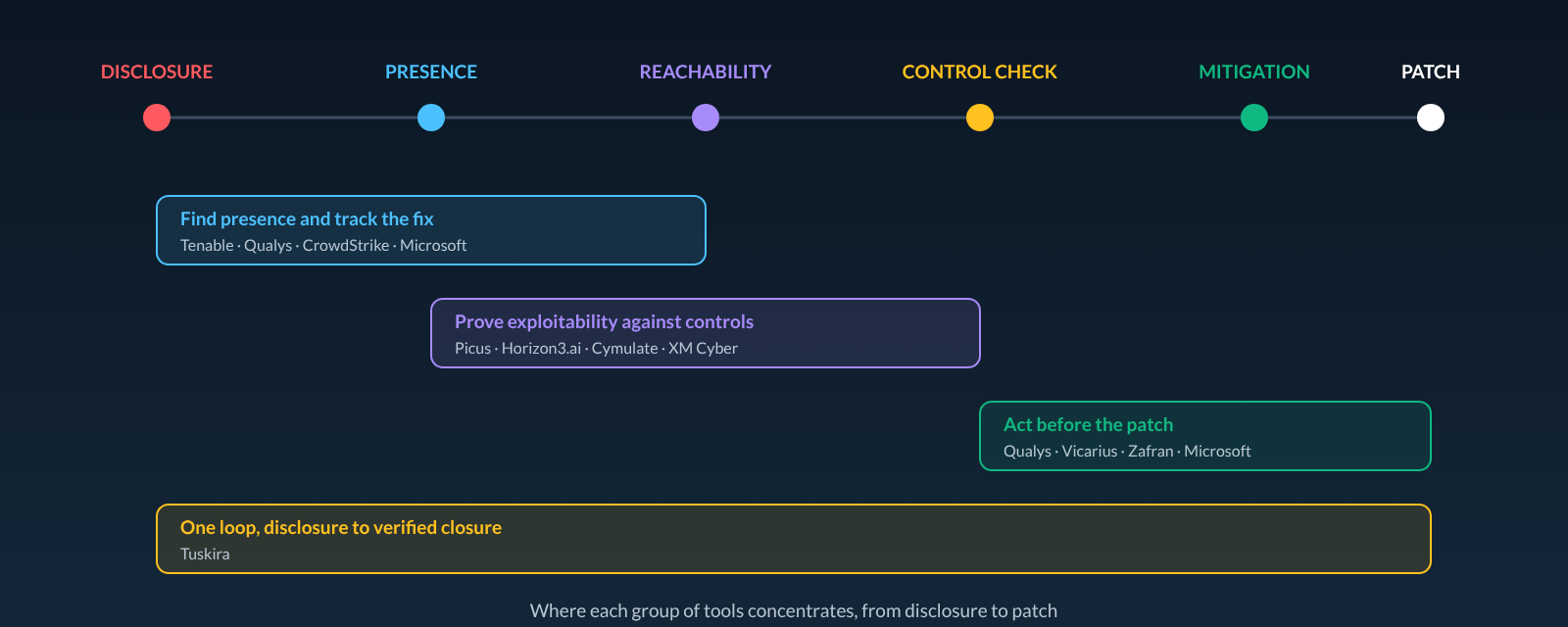
- Tools split into three groups. Some find presence and track the fix, some prove exploitability against your controls, and some apply a mitigation before the patch.
- Very few cover all four steps. Most teams combine a scanner, a validation tool and a mitigation tool, and lose time in the handoffs.
- A compensating control in a tool you already run is often the fastest safe fix. Re-test it, and track it until the real patch lands.
- Every speed claim in this market is vendor-reported. Test it on your own environment.
The comparison at a glance
Descriptions reflect public vendor information as of October 2026. Performance figures are vendor-reported. Platforms are listed alphabetically after Tuskira, not ranked.
| Platform | Finds presence by | Reachability and exploitability | Checks your controls | Acts before the patch | Best fit |
|---|---|---|---|---|---|
| Tuskira | Your existing scanners and tools, 200+ integrations | Reachable breach paths on a live model of your environment | Yes, against deployed controls, then re-tests | Recommends and applies a compensating control through tools you own, within limits you set | Teams that want one loop from disclosure to verified closure |
| CrowdStrike Falcon Exposure Management | Falcon sensor plus network scanning for unmanaged devices | ExPRT rating and attack path analysis | Falcon prevention context | Containment through Falcon response tools | Falcon-committed estates |
| Cymulate | Threat research mapped to your environment | Simulates new threats against your controls | Yes, breach and attack simulation | Pushes detection rules and IoCs to controls, then retests | Teams focused on control efficacy |
| Horizon3.ai NodeZero | Autonomous testing of your environment | Production-safe exploit tests for emerging CVEs | Classifies assets as exploitable, at risk or mitigated | No, retests after you fix | Teams that want exploit-level proof |
| Microsoft Defender Vulnerability Management | Defender for Endpoint | Exposure scoring | No | Blocks vulnerable application versions on Windows | Microsoft-centric Windows estates |
| Picus Security | Threat library and agents | Checks exploitability against your controls on disclosure day | Yes, step by step | Recommends a compensating control per step, then re-validates | Teams that want fast control-level validation |
| Qualys TruRisk Eliminate | Qualys agents, scanners and integrations | TruRisk scoring | Credits controls you already have | Patchless mitigation, isolation or custom fixes it deploys | Qualys-agent estates |
| Tenable One | Broad scanning across IT, cloud and OT | Exposure scoring and attack paths | Control validation added in 2026 | Ticket and campaign-driven remediation | Teams that want the broadest detection |
| Vicarius vRx | Vicarius agent | Vulnerability prioritization | No | vShield blocks exploitation in memory without a patch | Mid-market teams with apps they can't patch |
| XM Cyber | Exposure data in its attack graph | Attack-graph context, with expert-reviewed CVE research | Models controls in its digital twin | Remediation plans to Jira and ServiceNow | Hybrid AD and cloud attack path visibility |
| Zafran | SBOM and connected tools | Runtime presence, internet reachability and threat intel | Checks how existing defenses are configured | Recommends mitigations through EDR, firewall and WAF | Vulnerability teams cutting backlog |
The platforms
Tuskira is listed first because it's ours. The others follow in alphabetical order.
Tuskira
- Best at: closing the gap from disclosure to verified closure in one loop. When a new vulnerability lands, Quell, Tuskira's zero-day agent, checks whether it creates a reachable path to something that matters in your environment, often before a patch exists. If it does, Quell recommends the compensating control that closes the path, applies it through the tools you already run within limits you set, re-tests to confirm the path is shut, and tracks the temporary control until the real patch lands. In production, Tuskira has confirmed zero-day impact and identified a closing control in 15 minutes.
- Worth knowing: Tuskira uses your existing scanners and tools for presence, through 200+ integrations, rather than shipping its own agent. The same model also runs breach path validation, autonomous red teaming and Tuskira's AI SOC, so it's more than a zero-day point tool.
- Pick it if: you want presence, reachability, control validation, mitigation and re-test in one place, across the multi-vendor stack you already own.
CrowdStrike Falcon Exposure Management
- Best at: zero-day exposure on the Falcon sensor you already run. It prioritizes with CrowdStrike's ExPRT rating, auto-prioritizes known-exploited vulnerabilities, includes attack path analysis, and uses network scanning to reach unmanaged devices. Containment runs through Charlotte Agentic SOAR and Real Time Response.
- Worth knowing: there's no public patchless mitigation feature or exploit validation, and coverage depends on a Falcon estate.
- Pick it if: you're standardized on Falcon and want zero-day prioritization without another agent.
Cymulate
- Best at: testing whether your controls stop a new threat quickly. Cymulate's research team ships daily updates and says new threats can be tested in under an hour. Auto Mitigation pushes detection rules and IoCs to your controls, then retests.
- Worth knowing: it validates control efficacy rather than asset-level presence, and its mitigations are detection and prevention rules, not fixes to the vulnerable system.
- Pick it if: your main question on disclosure day is whether your EDR, email and web controls would catch the attack.
Horizon3.ai NodeZero
- Best at: proving exploitability with real attacks. Horizon3's Rapid Response team builds production-safe tests for emerging CVEs, often within hours by its own account, and classifies your assets as exploitable, at risk, mitigated or not exploitable. It retests after fixes.
- Worth knowing: coverage depends on which CVEs Horizon3 builds tests for, and it doesn't deploy mitigations itself. It raised a $250M Series E in August 2026 and has said it plans to move into remediation.
- Pick it if: your team or board needs exploit-level proof before acting.
Microsoft Defender Vulnerability Management
- Best at: a fast baseline block on Windows. It can block or warn on vulnerable application versions using file-hash indicators, and Microsoft documents using it against an active zero-day. Enforcement takes from minutes to a few hours.
- Worth knowing: it's Windows only, it can't block Microsoft's own apps or OS issues, it blocks the whole application rather than the exploit, and it needs the right Defender licensing.
- Pick it if: you're a Microsoft shop and want a stopgap you may already be licensed for.
Picus Security
- Best at: step-by-step validation against your controls on disclosure day. Picus says its platform checks whether a CVE is exploitable in your environment against your controls, shows which control stops each step, recommends a compensating control, and re-validates afterward.
- Worth knowing: it doesn't deploy mitigations itself and isn't a scanner for presence.
- Pick it if: you want fast evidence of exactly where your defenses would and wouldn't hold.
Qualys TruRisk Eliminate
- Best at: applying a fix before the patch, on systems Qualys manages. TruRisk Eliminate 2.0 can mitigate without a patch, uninstall, isolate or apply a custom fix, and TruConfidence credits controls you already have before applying compensating controls through your perimeter and endpoint tools.
- Worth knowing: there's no reachability or exploit validation, mitigations can affect features, and it works best where the Qualys agent is deployed.
- Pick it if: you run Qualys agents and want patchless mitigation from the same platform.
Tenable One
- Best at: the broadest detection. Tenable's coverage across IT, cloud and OT means you'll usually know quickly where a new vulnerability is present. Exposure Response tracks remediation initiatives with owners and SLAs, and 2026 updates added AI orchestration and control validation.
- Worth knowing: response is ticket and campaign driven, and its public materials don't describe zero-day-specific compensating controls.
- Pick it if: finding every instance fast is your biggest gap and your team handles mitigation.
Vicarius vRx
- Best at: protecting apps you can't patch. vShield wraps vulnerable executables and blocks exploitation in memory, in monitor or block mode, on Windows, Linux and macOS.
- Worth knowing: there's no reachability or control validation, and there's no published list of supported applications.
- Pick it if: you have legacy or vendor-locked software that can't be updated.
XM Cyber
- Best at: putting a new CVE in attack path context. XM Cyber says its AI-assisted research, reviewed by its experts, cuts CVE analysis from a day or two to one or two hours, and its attack graph shows whether the vulnerability sits on a path to critical assets.
- Worth knowing: it produces remediation plans rather than deploying mitigations, and its agentic remediation planning is still in early availability. CrowdStrike agreed in July 2026 to acquire XM Cyber's intellectual property, with XM Cyber continuing under license.
- Pick it if: you already use XM Cyber for attack paths and want zero-days in the same view.
Zafran
- Best at: a dedicated zero-day workflow for vulnerability teams. Zafran's Zero Day Agent, launched in May 2026, runs daily against public sources, matches new threats to your SBOM, checks runtime presence and reachability, and recommends mitigations through your EDR, firewall and WAF while routing tickets and tracking the patch.
- Worth knowing: results depend on accurate SBOM data and control integrations, and it checks control configuration rather than testing controls under attack.
- Pick it if: your vulnerability team owns zero-day response and wants it inside its existing backlog tool.
A disclosure-day checklist
Whatever tools you use, the same technical steps decide how fast you close the gap.
- Confirm the advisory. Read the vendor advisory and CVE record for affected versions, configurations and prerequisites.
- Find presence. Match affected versions against scanner results, SBOMs and asset inventory, including containers and internet-facing assets.
- Check exploit conditions. Is the vulnerable component or function used, is it reachable from where an attacker would start, and does it need authentication or a specific configuration?
- Check exploit activity. Look for a public proof of concept, a CISA KEV listing and the EPSS score, and watch threat intelligence for active campaigns.
- Map your controls. Would a WAF virtual patch, IPS signature, EDR rule, network segmentation or disabling the vulnerable feature stop the attack?
- Apply and re-test. Put the compensating control in place and re-test the path to prove it's closed.
- Track to the patch. Patch when a fix ships, then retire the temporary control so it doesn't become permanent drift.
How to choose
Run the next real disclosure as your test. Give each vendor the same CVE on the day it drops and time how long it takes to answer four questions. Is it present, is it reachable, would our controls stop it, and what's the fix before the patch? Then ask each one to show the re-test that proves the fix worked. Our zero-day response guide walks through the process step by step.
Frequently asked questions
What is a zero-day response platform?
A platform that helps you respond to a newly disclosed vulnerability before a patch is available, by finding where it's present, judging whether it's reachable and exploitable, checking your controls, and applying a mitigation until the real fix lands.
What is virtual patching?
Virtual patching blocks exploitation of a vulnerability at a control in front of it, usually a WAF or IPS rule, without changing the vulnerable software. It's one of the most common compensating controls for zero-days in web-facing applications.
What is a compensating control?
A temporary change in a control you already run, such as a WAF rule, firewall policy, EDR block or identity restriction, that closes the path to a vulnerability until it can be patched.
Can I respond to a zero-day without a patch?
Often, yes. If you know the vulnerable component and how an attacker would reach it, a compensating control can close that path. The key is to re-test that it works and to remove it once the patch is applied.
How is this different from vulnerability management?
Vulnerability management tracks known vulnerabilities to patching on a normal cycle. Zero-day response works on the days before a patch exists, when speed and compensating controls matter most. See what threat exposure management is for how the two fit together.
How fast should zero-day response be?
Fast enough to confirm reachability and close the path before exploitation starts, which for widely targeted vulnerabilities can be days or less. Measure time from disclosure to a verified closing control, not time to ticket.
See Quell check a new zero-day against your own environment, or compare more platforms in the best CTEM tools for 2026.
How AI Alert Triage Helps a Lean SOC
What Is Threat Exposure Management? A 2026 Guide