
Quell: Zero-Day Defense
Quell determines whether a newly disclosed zero-day creates a reachable path in your environment, then orchestrates the compensating control change that closes it before exploitation.
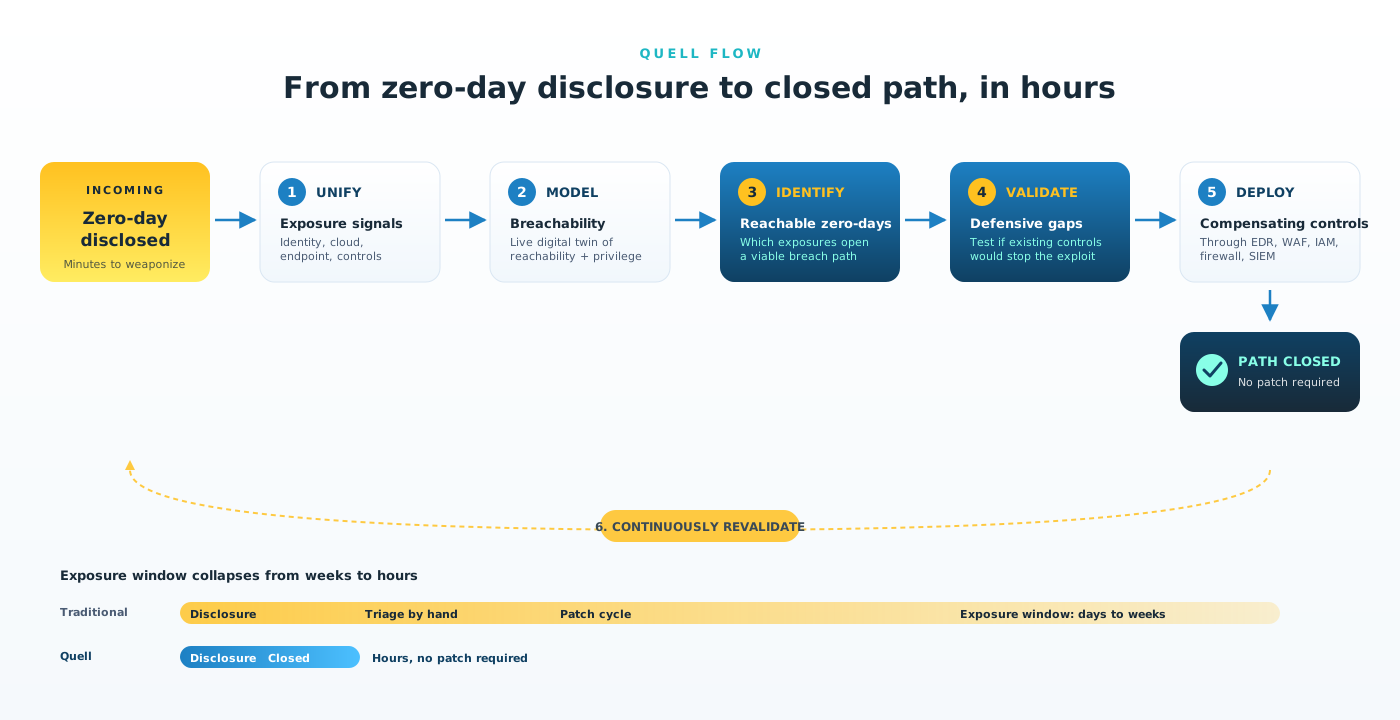
Quell intercepts every newly disclosed zero-day by determining reachability, validating whether your existing controls would stop it, and deploying the compensating control change that closes the path. No patch required.
Why current approaches miss zero-day exposure
- Scanners rank CVEs by severity. They cannot tell you whether the vulnerability is reachable, chainable, or stoppable by controls you already run.
- Patch cycles assume you have weeks. The disclosure-to-weaponization window for AI-discovered exploits is now measured in minutes.
- Exposure tools score risk on paper. They credit you for “covered by EDR” or “behind a WAF” without testing whether the control would actually stop this exploit.
The Inflection PointWhy this matters right now
In the first month of Anthropic’s Project Glasswing, a single Mythos-class AI model helped partners uncover more than 10,000 high- and critical-severity flaws in widely used code. The disclosure-to-weaponization window for AI-discovered exploits is no longer measured in weeks. It is measured in minutes.
Any defense that still depends on a patch cycle is already behind. What survives the window is not faster patching but faster mitigation through the controls you already run. Quell is the layer that converts new exposure into a closed path in hours, not after the next patch window.
How Quell works
1Unify
Normalize exposure, identity, cloud, endpoint, and control telemetry into the Security Data Fabric.
2Model
Build a continuously updated digital twin of reachability and exploitability, grounded in business context.
3Identify Reachable
Surface the disclosed zero-days that open a reachable path to compromise, not just CVEs in your inventory.
4Validate Controls
Test whether the controls you already run would stop exploitation, or are bypassed undetected.
5Deploy
Orchestrate the compensating control change through existing tools (EDR, firewall, IAM, WAF, SIEM). No patch required.
6Revalidate
Confirm the exploit can no longer reach a target, not that a ticket was marked done.
Works across 150+ integrations →
Common zero-day exposures Quell defends against
Internet-Exposed Appliance Zero-Day
Kill chain: edge VPN zero-day → reachable to production → WAF/EDR gap → virtual-patch rule deployed → exploit blocked.
What Quell determines: whether the appliance opens a reachable path to production, and whether your WAF and EDR controls would actually block the exploit.
How Quell breaks it: orchestrates a virtual-patch WAF rule and EDR block through existing controls in hours, before a patch exists.
AI-Discovered Zero-Day
Kill chain: Mythos-class discovery → weaponized pre-patch → affected component identified → control check → compensating control deployed.
What Quell determines: which assets run the affected component, and which are undefended versus already covered by an existing control.
How Quell breaks it: orchestrates the compensating control change that closes the path before any patch guidance lands.
Exposure Behind a Bypassed Control
Kill chain: high-impact CVE → host with misconfigured EDR → silently unblocked → control gap detected → policy corrected.
What Quell determines: that the control would not stop exploitation. Covered on paper, breachable in practice.
How Quell breaks it: corrects the control gap and revalidates that exploitation is blocked.
Identity-Amplified Attack Path
Kill chain: exploitable workload → over-privileged identity → reachable crown-jewel data → IAM chokepoint identified → propagation broken.
What Quell determines: that the exposure sits on a reachable path amplified by identity, not an isolated finding.
How Quell breaks it: closes the highest-leverage IAM or segmentation chokepoint that breaks propagation.
Every exposure tested against the live state of your compensating controls, not a scoring model that credits controls without checking them.
Competitive Landscape: The Three Camps
Vulnerability scanners (VM category)
Rank CVEs by CVSS severity, with no view of what is reachable or whether existing controls would stop it.
Quell scores each exposure by whether it opens a reachable path, whether existing controls would stop it, and which compensating control change closes the path.
Exposure management tools
Score “behind existing controls” as a factor that reduces risk, without testing whether the control would stop this specific exploit.
Quell tests every modeled attack path against the live state of your compensating controls, surfacing silent bypasses any static scoring model would miss.
Threat intel and manual zero-day response
Produce indicators and advisories that teams operationalize by hand, on incident-response timelines.
Quell continuously converts live attack-path intelligence into compensating control changes that disrupt exploitation, without a manual handoff.
Tuskira (Quell)
A live digital twin built from real assets, identities, controls, and exposures. Quell determines reachability and validates control coverage against actual conditions, not configurations.
Quell closes the loop. It orchestrates the highest-leverage compensating control change through tools you already own, with analyst approval where policy requires. No patch required.
What our customers say
“2026 is the year cyber defenses are seeing the shift from AI-assisted attacks to AI-enabled attacks, and defenders need to adapt. That’s why Intrado partnered with Tuskira.”
Charles Gifford, CISO, Intrado
Close the zero-day exposure window before exploitation
See which zero-days are reachable, whether the controls you already own would stop them, and which compensating control change closes the path before exploitation.
See Agentic Cyber Defense in Action
Surface signals across the tools you already run, connect them through shared context, and accelerate triage and response across the SOC.


Watch the video
See how Tuskira helps security teams validate threats, uncover breach paths, and move faster from signal to action.