The Best AI SOC Platforms in 2026: An Honest Comparison
By David Mundy, VP of Marketing, Tuskira
Disclosure first. Tuskira is one of the platforms on this list, so read our entry with the same skepticism you'd bring to any vendor ranking its own market. In exchange, we'll be straight about everyone else. Most of the tools below are good at what they do, several are the right choice for certain teams, and we'll say which teams those are.
One more thing before the list. "AI SOC" now covers very different products. Some are investigation layers that sit on top of the tools you already run. Some are automation platforms that added agents. Some replace the SIEM. Some are assistants built into one vendor's platform. They can all triage an alert, so "can it triage?" isn't a useful question anymore. The useful questions are whose data it can reason over, what it's allowed to do on its own, how you check its work, and what it costs as alert volume grows.
Key takeaways
- AI SOC platforms fall into four groups. There are standalone investigation layers, automation platforms with agents, SIEM replacements and platform-native assistants.
- Triage is table stakes. The differences are in data reach, autonomy controls, auditability and pricing.
- Platform-native assistants are strongest on their own vendor's telemetry. Standalone layers are built for mixed stacks.
- Almost every AI SOC tool only works after an alert fires. Ask whether the platform also knows what an incident could reach.
- Run every evaluation on your own alerts, and ask to see verdicts the agent got wrong as well as right.
The comparison at a glance
Descriptions reflect public vendor positioning as of October 2026. This market moves quickly, so verify current capabilities directly with each vendor. Performance figures are vendor-reported.
| Platform | Type | Data reach | Response model | Best fit | Main caveat |
|---|---|---|---|---|---|
| Dropzone AI | Standalone investigation layer | 90+ integrations queried by API | Analyst-authorized, or handed to SOAR | Teams that want every alert investigated without changing their stack | Response is mostly left to analysts or SOAR |
| Prophet Security | Standalone agent platform | 200+ integrations | Scoped Agent Actions, autonomous or with sign-off | Teams that want analyst, hunter and detection engineer agents in one place | Specific response actions aren't documented publicly |
| 7AI | Standalone agent platform | Federated SIEM that queries data in place | Agents across cloud, email, identity and EDR | Teams that want whole-SOC coverage sold as a service | Autonomy levels aren't specified publicly |
| Torq HyperSOC | Automation platform with agents | 300 integrations | Agent-run cases plus hyperautomation steps | Teams with SOAR maturity that want agents on top | Value assumes investment in building workflows |
| Exaforce | SIEM replacement with agents | Its own data platform, 100+ sources | Agents across detect, triage, investigate and respond | Cloud and SaaS-heavy teams ready to replace the SIEM | A bigger commitment than an overlay |
| Conifers.ai | Standalone agent platform | 90+ integrations | Graduated autonomy with an Act function | MSSPs and multi-tenant operations | Built first for providers, not single enterprises |
| D3 Morpheus | Automation platform with agents | 800+ integrations | Four autonomy modes, approval gates and rollback | Teams that want governed, deterministic autonomy | Onboarding is a scoped project, with a 60 to 90 day ramp |
| CrowdStrike Charlotte AI | Platform-native | Falcon telemetry, third-party data through Next-Gen SIEM | Recommends by default, actions need approval | Falcon-committed shops | Strongest where Falcon's data reaches |
| Microsoft Security Copilot | Platform-native | Microsoft security products | Prebuilt agents per Microsoft product | Microsoft-centric estates, especially on E5 | Agents are tied to individual Microsoft products |
| Google SecOps | Platform-native | Google SecOps data | Triage agent generally available, response agents in preview | Teams already running Google SecOps | Response capabilities are still in preview |
| Tuskira | AI SOC plus exposure management | 200+ integrations, queried in place | Proposes containment through existing controls, inside autonomy limits you set | Teams that want investigations to see breach paths and exposure | More platform than you need if alert triage is the only goal |
The eleven platforms
1. Dropzone AI
- Best at: autonomous investigation of every alert. Dropzone's AI SOC Analyst works each alert end to end and shows the evidence behind every verdict, and it pulls from 90+ integrations across SIEM, EDR, cloud, identity and email without moving data. It's often the reference point buyers use for the category.
- Worth knowing: it's an investigation layer first. Containment is authorized by analysts, and deeper response usually runs through a SOAR tool like Tines, Torq or Swimlane. Its Standard plan is an annual subscription sized in AI investigations, with EU data residency available.
- Pick it if: your queue is the problem, you want every alert investigated quickly, and you're happy to keep response where it is today.
2. Prophet Security
- Best at: a broad set of SOC agents. Prophet offers an AI SOC Analyst, an AI Threat Hunter and an AI Detection Engineer that backtests new detections and submits them for approval, plus Watchtower, a 24x7 human review service. It connects to 200+ tools and runs as a dedicated single-tenant instance with bring-your-own-key.
- Worth knowing: "Scoped Agent Actions" can run on their own or with sign-off, but the specific response actions aren't spelled out publicly. Ask for them in the evaluation.
- Pick it if: you want triage, hunting and detection work covered by agents in one product, with strong tenant isolation.
3. 7AI
- Best at: whole-SOC scope. 7AI uses "swarming" agents across cloud, email, identity and EDR, a federated SIEM that queries data where it lives, and "Skills" that teach agents a team's own workflows. It's sold as "Service as Software," with a managed tier for teams that want more hands-off coverage.
- Worth knowing: it raised a $130M Series A in December 2025, so expect fast product movement. Autonomy levels and specific response actions aren't detailed publicly.
- Pick it if: you want an agent platform that aims to run most of the SOC, and you like a service-style buying model.
4. Torq HyperSOC
- Best at: combining agents with hyperautomation. Torq's coordinator agent, Socrates, runs cases end to end, backed by 300 integrations and 4,000+ pre-built workflow steps. Torq says HyperSOC closes over 90% of security cases autonomously.
- Worth knowing: its roots are in SOAR and automation, so you get the most from it if you're willing to build and maintain workflows. It raised a $140M Series D in January 2026.
- Pick it if: you already think in playbooks and want agents layered onto a strong automation engine.
5. Exaforce
- Best at: agentic operations on its own data platform. Exaforce's Exabots cover detect, triage, investigate and respond on top of its own knowledge graph, with particular strength in identity, IaaS and SaaS. It's available self-managed or as MDR.
- Worth knowing: it's positioned as a SIEM replacement, which is a bigger decision than adding an overlay. It raised a $125M Series B in May 2026.
- Pick it if: you're cloud and SaaS heavy and ready to rethink the SIEM along with triage.
6. Conifers.ai
- Best at: multi-tenant AI SOC for providers. CognitiveSOC offers graduated autonomy, from human-in-the-loop to human-on-the-loop, with an "Act" function for remediation and 90+ integrations. Conifers says it's live in 2 to 4 hours, with a deploy-in-your-own-cloud option. IDC named it a Leader in its 2026 MarketScape for standalone AI SOC platforms.
- Worth knowing: its design center is MSSPs and multi-tenant operations. Single-enterprise teams should check that the workflow fits a one-tenant SOC.
- Pick it if: you're an MSSP or run security for many business units.
7. D3 Morpheus
- Best at: governed autonomy. Morpheus offers four autonomy modes from deterministic to autonomous, deterministic playbooks with approval gates and rollback, and 800+ integrations. It also runs read-only attack path discovery across identity, endpoint, cloud and email. Pricing is an annual subscription sized to alert volume, with no token charges.
- Worth knowing: onboarding is a scoped implementation, and D3 says accuracy builds over 60 to 90 days.
- Pick it if: you need tight control over what agents can do and a clear audit story for every action.
8. CrowdStrike Charlotte AI
- Best at: agentic triage of Falcon detections. Charlotte AI triages first-party detections, and CrowdStrike reports 98% accuracy measured against its Falcon Complete MDR analysts. Charlotte Agentic SOAR and AgentWorks extend it into response and custom agents.
- Worth knowing: prebuilt agents recommend by default, and actions need configuration and approval. It's strongest on Falcon telemetry. Third-party data generally needs to flow through Falcon Next-Gen SIEM.
- Pick it if: you're committed to Falcon and want AI triage without adding another vendor.
9. Microsoft Security Copilot
- Best at: prebuilt agents inside Microsoft security products, such as phishing triage in Defender, Conditional Access optimization in Entra, vulnerability remediation in Intune and data security in Purview.
- Worth knowing: pricing is $4 per Security Compute Unit per hour, and Microsoft 365 E5 now includes 400 SCUs a month per 1,000 licenses, up to 10,000, with no rollover. That bundle is why buyers ask about it. The agents are tied to individual Microsoft products rather than working as one cross-tool analyst.
- Pick it if: your estate is mostly Microsoft and you want to use capacity you may already be paying for.
10. Google SecOps
- Best at: triage inside Google SecOps. Its Triage and Investigation agent became generally available in June 2026, and Google says it has handled more than 5 million alerts, cutting review from about 30 minutes to 60 seconds.
- Worth knowing: it works on Google SecOps detections and data. Detection engineering, agentic containment and threat hunting agents are still in preview.
- Pick it if: Google SecOps is already your SIEM and you want triage built in.
11. Tuskira
- Best at: investigations that know what's at risk. Tuskira's AI SOC agent, Iris, triages and investigates L1 and L2 alerts across the tools you already run and returns a verdict of true positive, false positive or escalate, with a confidence score and the full reasoning. Benign alerts close. Real ones move to investigation, which maps the timeline and blast radius, and a response agent proposes containment through your existing controls. The difference is that Iris reasons over the same model of your environment that Tuskira uses for breach paths, vulnerability prioritization and zero-day response, so an investigation can see what an incident could reach, not just what fired. Tuskira connects to 200+ tools out of the box and queries them in place. Every agent run is logged with its reasoning and its cost, and you set where agents stop for a human.
- Worth knowing: Tuskira is a broader platform than a triage layer. If alert triage is the only problem you want solved, a standalone investigation tool is a simpler purchase.
- Pick it if: you want the SOC and exposure management working from one model, so what you learn in an investigation feeds back into closing the paths that made it possible.
What separates them
Every tool here can triage. Four things separate them in practice. Data reach decides whether the agent sees the whole incident or one vendor's slice of it. Autonomy controls decide what the agent can do without a person, and whether you can undo it. Auditability decides whether an analyst can open a verdict and check the reasoning. Pricing decides whether the tool gets more expensive every time alert volume grows, and models here range from investigation counts to compute units to alert volume to endpoints.
There's a fifth question most comparisons skip. Almost every AI SOC tool starts when an alert fires. Ask whether the platform also knows your exposure, which assets are reachable, and which controls would stop an attacker. An agent that knows a compromised laptop has a path to a payment system will triage that alert differently from one that only sees the alert.
How to choose
Run a bake-off on your own alerts, not a demo tenant. Give every vendor, including us, the same week of real alerts and compare verdicts against what your analysts decided. Ask each one to show a false positive it closed and the evidence it used, an escalation it got right that a person missed, and a verdict it got wrong. Then check the audit trail, the autonomy settings and the bill at your real alert volume. Our AI cyber defense buyer's guide has fifteen questions to bring.
Frequently asked questions
What is an AI SOC platform?
An AI SOC platform uses AI agents to do the work of SOC analysts, mainly triaging and investigating alerts, and increasingly hunting, writing detections and proposing response. Good ones show their reasoning and let you decide what they can do without approval. Read more on Tuskira Answers.
Will an AI SOC replace my analysts?
No. It takes the repetitive L1 and L2 work off the queue so analysts spend time on the cases that need judgment. Every serious platform on this list keeps a human in the loop for high-impact actions.
Do I need to replace my SIEM to use an AI SOC?
Usually not. Most standalone platforms, including Tuskira, query the tools you already run. Exaforce is the exception on this list, since it's designed to replace the SIEM. Platform-native assistants work best with their own vendor's SIEM.
How are AI SOC platforms priced?
It varies widely. You'll see annual subscriptions sized by investigation count, compute units billed by the hour, subscriptions sized by alert volume, and per-endpoint pricing. Model your real alert volume for the next two years before comparing quotes.
What happened to Radiant Security?
Cribl bought Radiant Security's AI SOC technology in August 2026 and plans to build it into Cribl's telemetry platform, so we've left it off this list. Check with Cribl for the current roadmap.
See Iris investigate alerts from your own stack, or read Tuskira Answers for how the platform works.
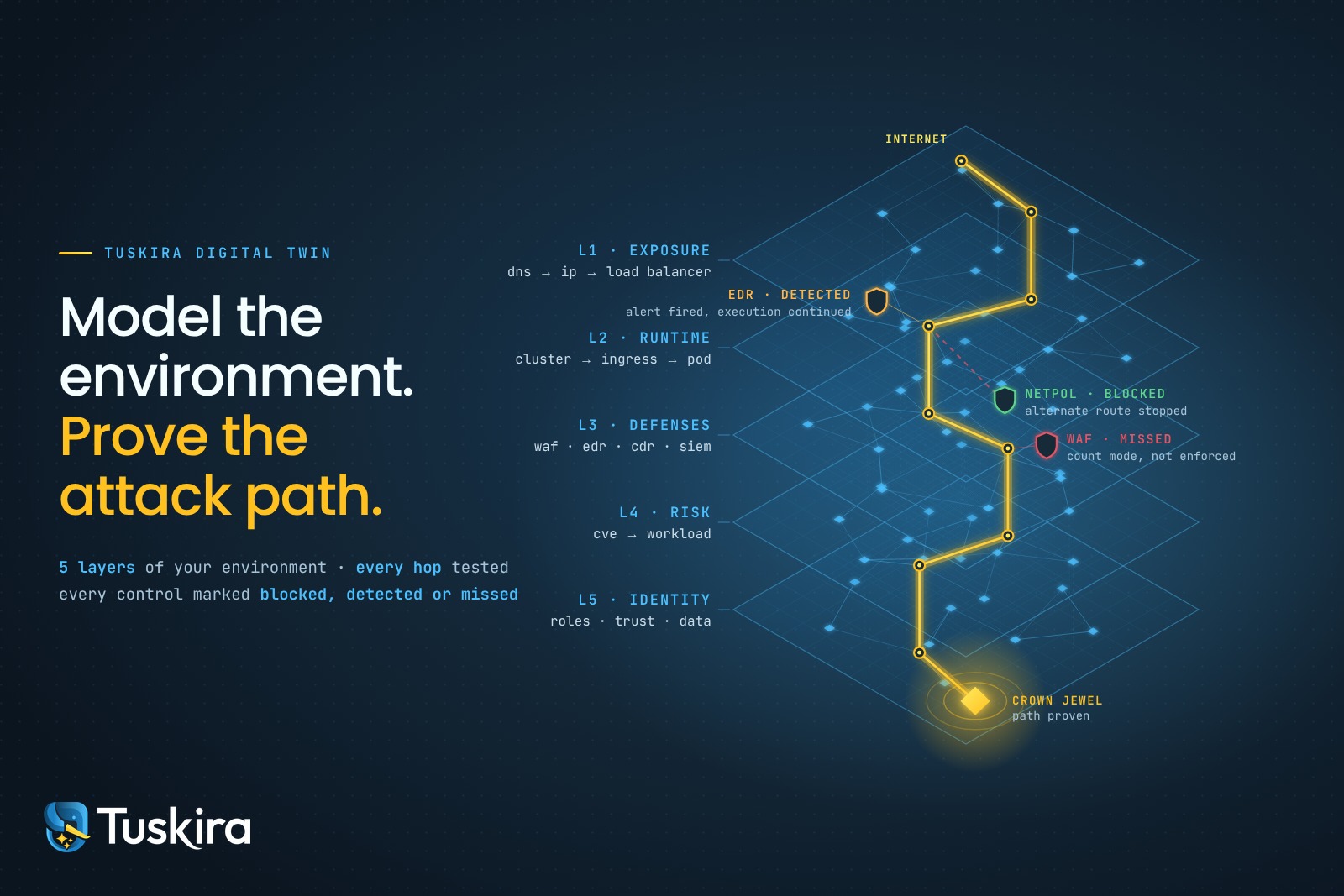
How Tuskira's Digital Twin Validates Breach Paths
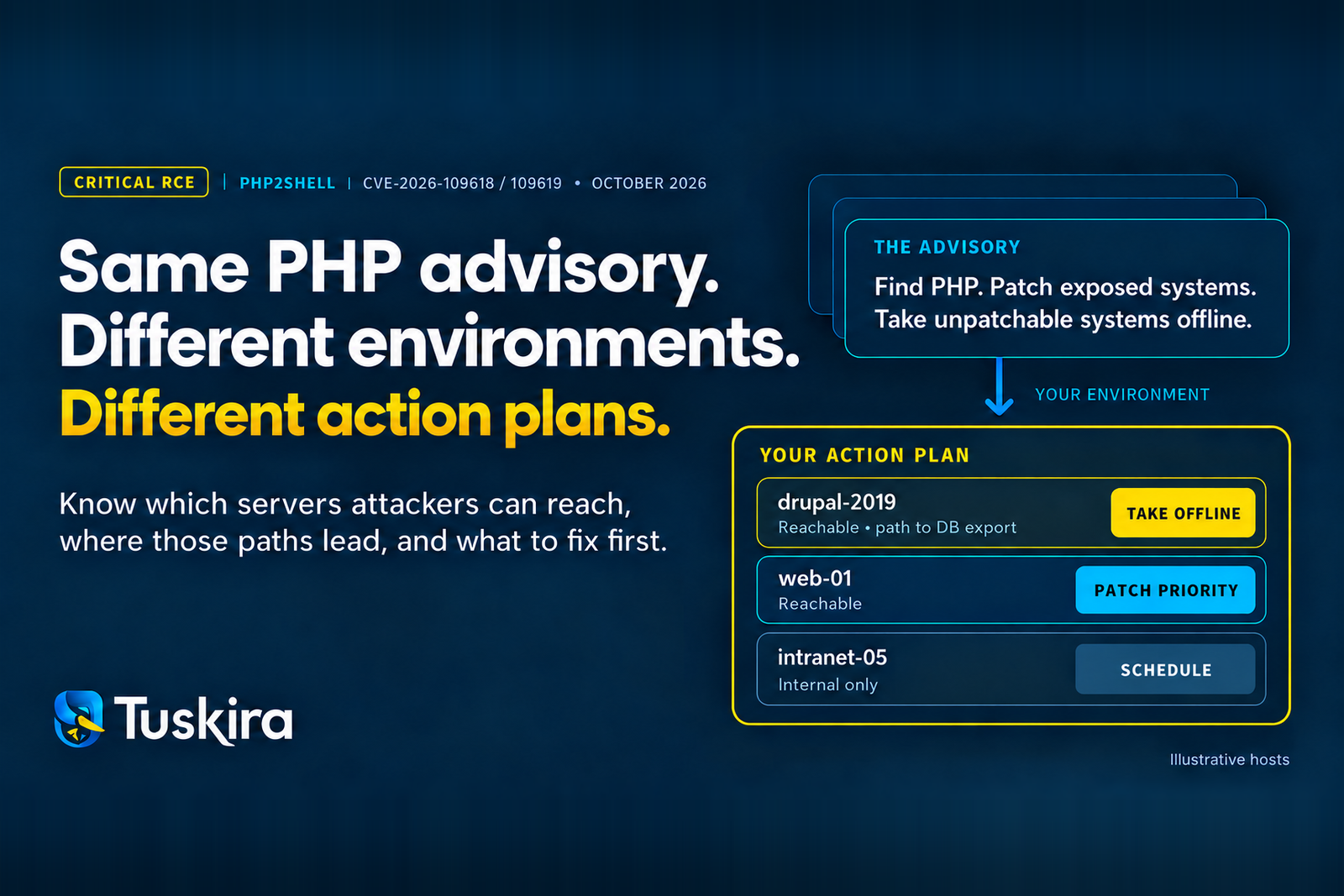
How to Find and Prioritize Exposed PHP Servers After PHP2Shell (CVE-2026-109618, CVE-2026-109619)