How Tuskira's Digital Twin Validates Breach Paths
By the Tuskira Engineering Team
Your scanner can tell you a pod has a critical CVE. Tuskira’s digital twin tells you whether anyone on the internet can reach that pod, what they could get to from there, and which of your controls would stop them, see them or miss them.
This post covers how Tuskira’s twin is built, how a breach path goes from a projection to a proven finding, and where the AI stops. If you want the short version first, start with What is a digital twin in cybersecurity?
What comes out is a short list of proven paths, the controls that held or failed on each one, and the control change that closes it.
That focus is what changes the workload. In one global financial-services deployment, checking reachability, exploitability and deployed controls this way cut 12.3 million raw findings to 0.46% actionable. The scope and method are in the published case study.
Build order
Topology first. Findings last.
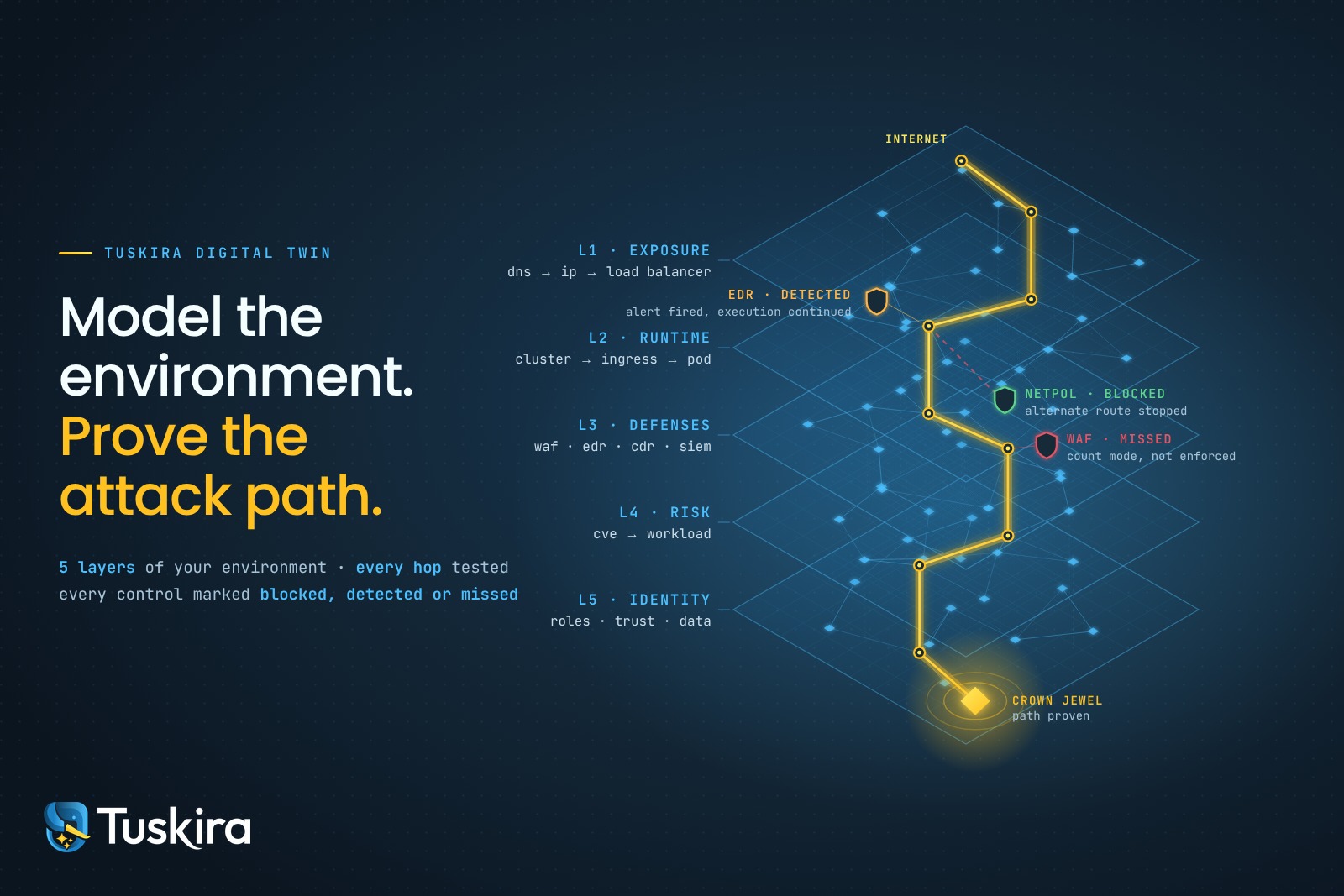
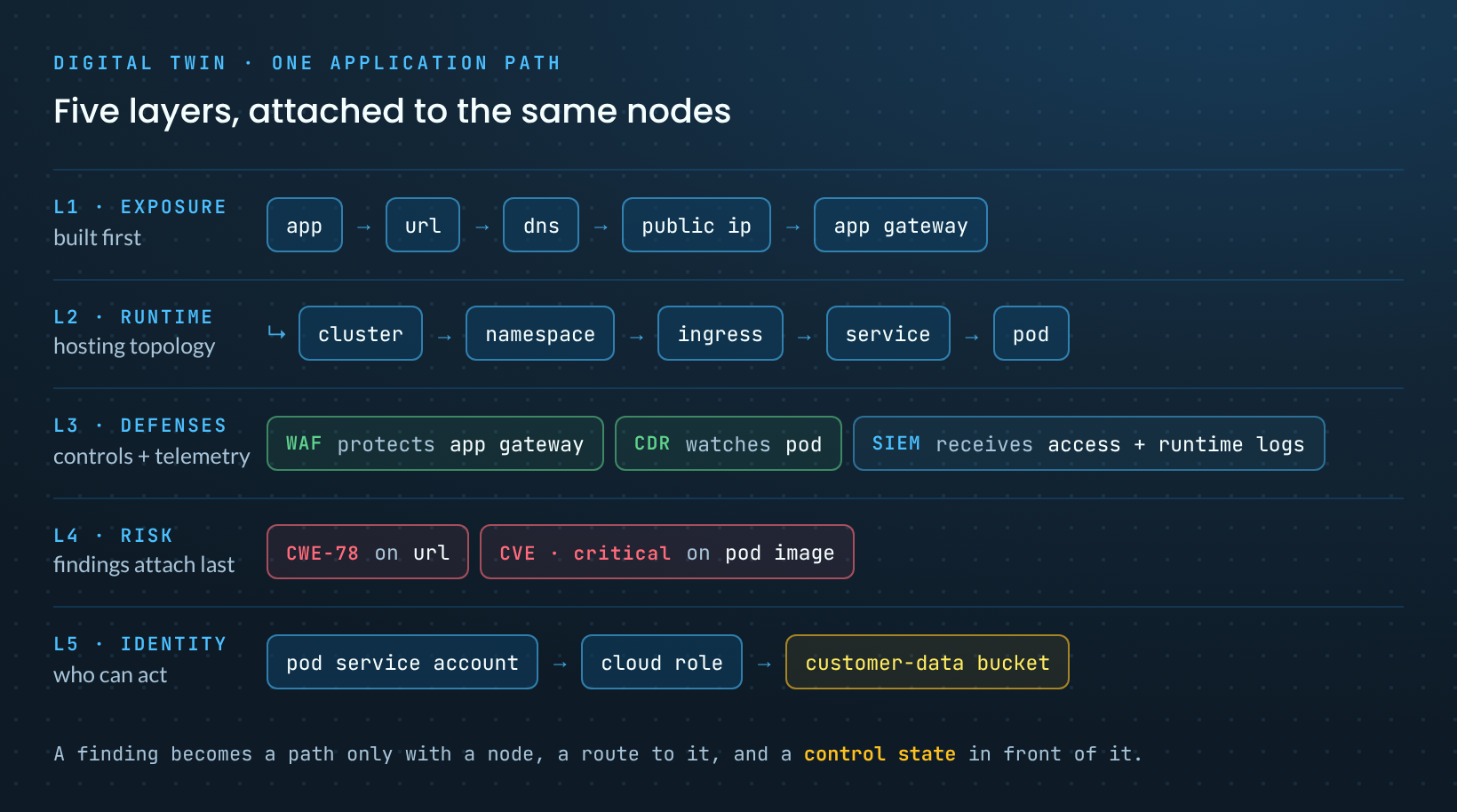
The twin is built in five layers, in a fixed order. Findings come last on purpose. A CVE means very little until you know which workload it sits on, what can reach that workload, and which controls stand in front of it.
| Layer | What we connect | What it adds to the twin |
|---|---|---|
| 1 · Exposure | DNS (Route 53, Azure DNS, Cloud DNS, Cloudflare), cloud networking, load balancers, security groups, routes | app → url → dns → ip → load balancer |
| 2 · Runtime | Kubernetes (EKS, AKS, GKE), API gateways, service mesh | cluster → namespace → ingress → service → pod |
| 3 · Defenses | WAF (Cloudflare, AWS WAF, Akamai, F5), runtime and endpoint (Falco, CrowdStrike, Defender), SIEM (Sentinel, Splunk, Elastic, Chronicle) | Which control protects which asset, and which logs can see it |
| 4 · Risk | Vulnerability and cloud scanners (Tenable, Qualys, Rapid7, Wiz, Prisma), exploit intelligence (CISA KEV, VulnCheck, Exploit-DB) | Each finding attached to the pod, image or service it affects |
| 5 · Identity | Entra ID, Okta, AWS IAM, CMDB, data security posture tools, ticketing | Who and what can act on each asset, and where sensitive data lives |
Entities are resolved against the topology rather than matched to each other. DNS resolution decides which cloud resources belong to an application, and every later layer attaches to nodes that already exist. Connectors query your tools in place, so your logs stay in your SIEM.
Around sensitive data
The path to the data is rarely direct.
A public application rarely connects straight to sensitive data. The route usually crosses an API gateway, a workload, a service identity, a cloud role and a network boundary first.
Because the twin holds those relationships together, it can test whether compromising the application gives an attacker the identity and permissions needed to reach the data. It also checks whether the WAF, endpoint, identity, network and detection controls you already run would stop that path or see it.
Validation
A projected path is a lead. A proven path is a finding.
Every path in the twin starts as a projection. It becomes a finding only when each hop is proven.
Project
Kairo, Tuskira’s breach path agent, walks the graph from an entry point to a crown-jewel asset, either outside-in from the internet or from an assumed-breach foothold, and maps each hop to an ATT&CK technique.
Validate each hop
A validator tests every hop inside the scope you approve and marks it proven or not proven. The path carries a confidence level until it is.
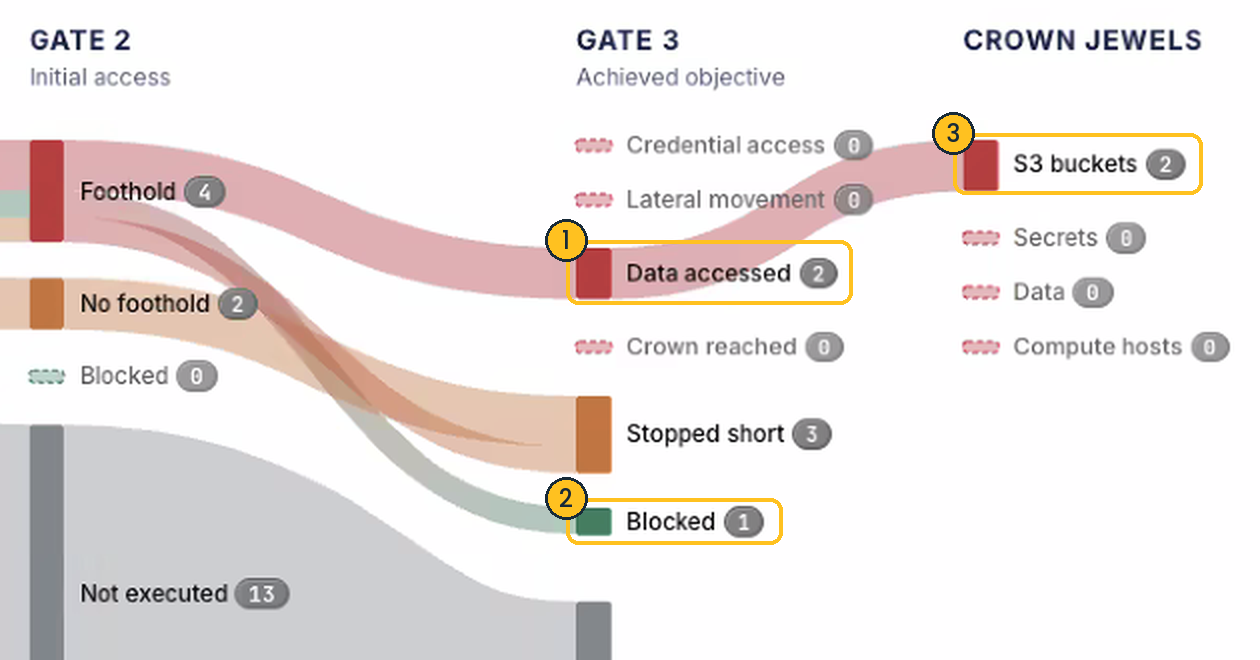
Pass three gates
Reachability, initial access, and achieved objective. A path that stops at a gate is recorded as stopped short or blocked, not discarded.
Record every control
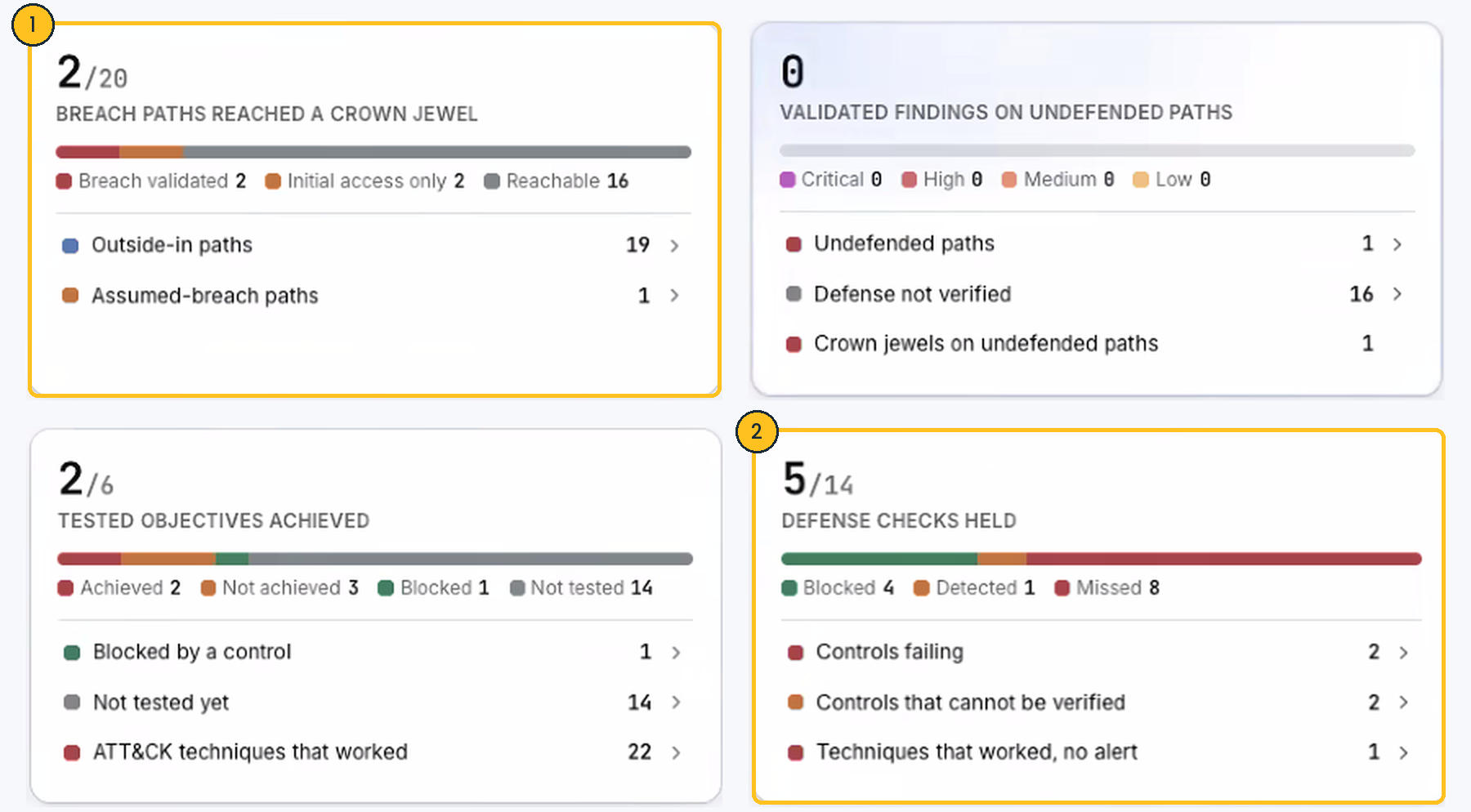
Each defense on the path is recorded as blocked, detected or missed. A WAF rule left in count mode shows as missed, not as protection.
Keep the evidence
Each path keeps its replay, findings, assets, control results, ATT&CK matrix and an audit of what ran and what deliberately did not.
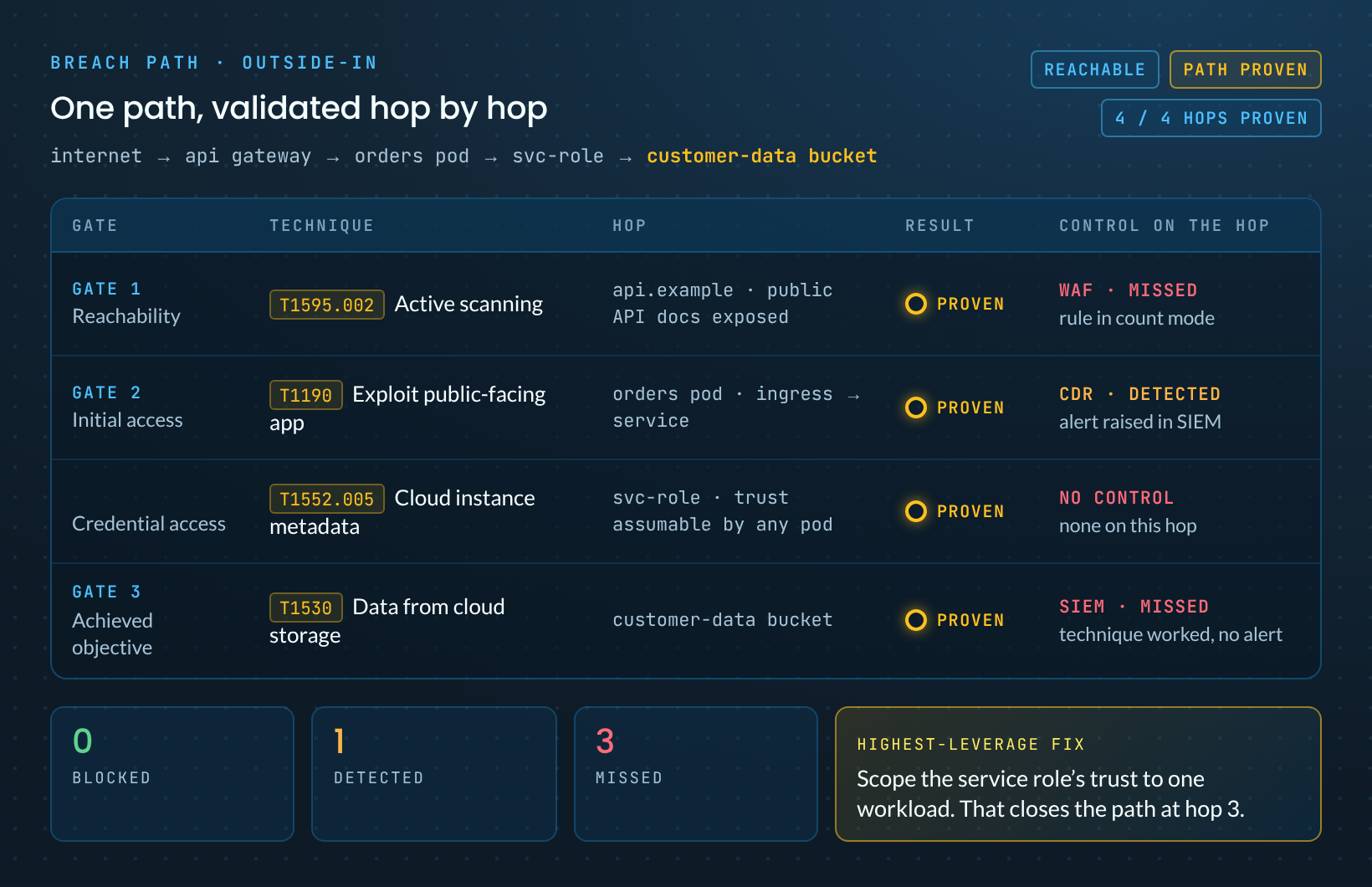
Each hop is checked from two sides. The attacker’s view is what an unauthenticated adversary can run from the internet. The defender’s view is a privileged read of your own configuration, the WAF rules, identity policies and endpoint coverage that an attacker can’t see. Pairing the two is what turns “this looks exposed” into “this is reachable, and nothing stands in the way.”
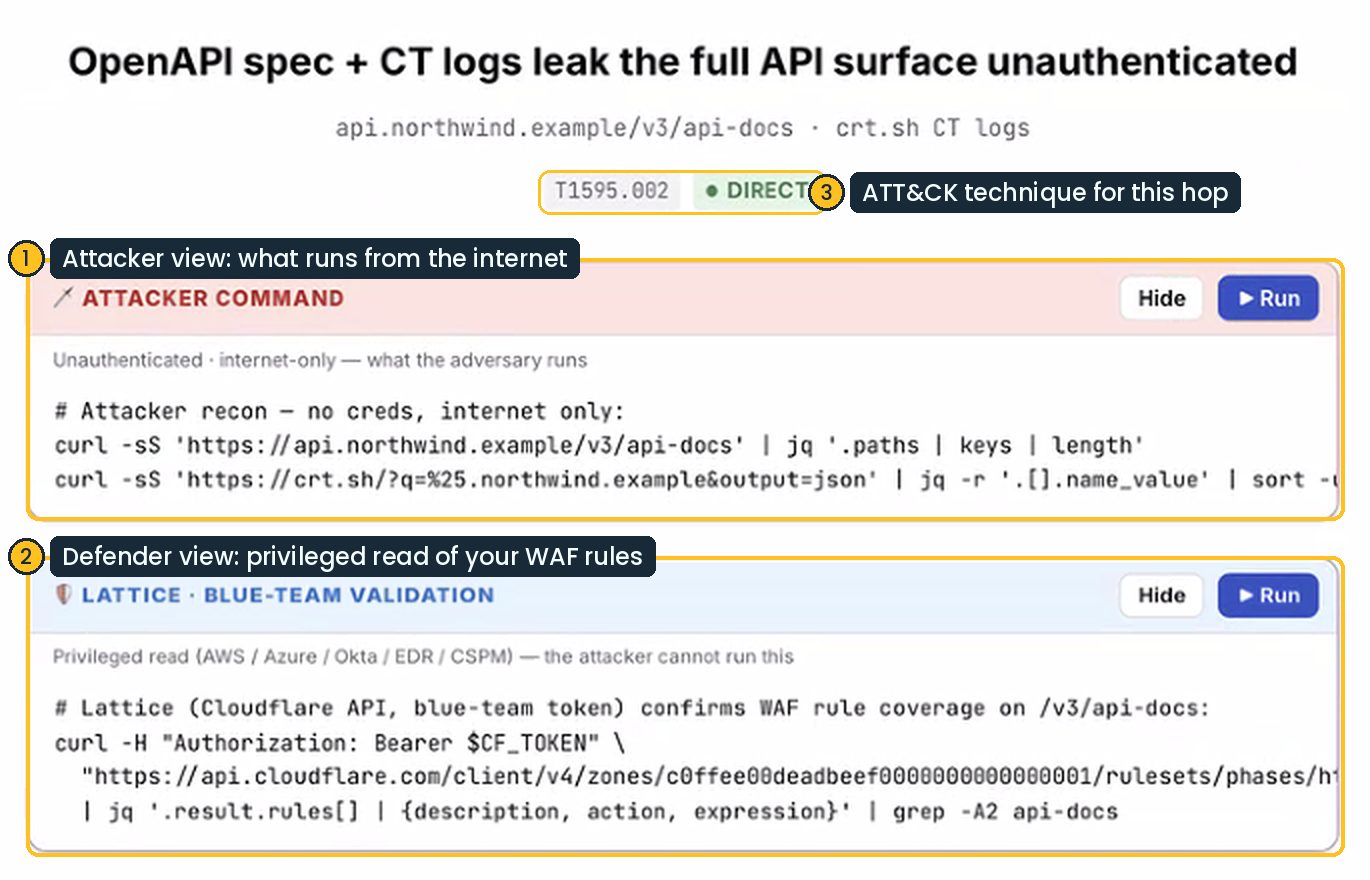
The output is a short list of proven paths and the specific control that breaks each one. Not a ranked list of findings.
Agents
Five agents, one twin
Tuskira runs five AI agents on the same twin. Each answers one question, and a finding from one is context for the others.
The same twin carries through the whole incident lifecycle.
Before
Prove which paths can reach critical systems and data, then close them through controls you already own.
During
Iris investigates alerts against the same assets, identities, controls and paths, so blast radius starts from what is already known.
After
Apply the approved control change. Vector tests again from outside, so closure is confirmed by an attempted attack instead of assumed.
Compared
Alert-centric operations start from a signal. The twin starts from the environment.
AI SOC tools have moved well past triage. Many now hunt and tune detections, and they do it well. The difference is where the work starts and what evidence it rests on.
| Question | Alert-centric operations | Environment-led defense with a digital twin |
|---|---|---|
| Starting point | An alert, a hunt or an analyst question | A continuously modeled environment |
| Primary evidence | Telemetry gathered during an investigation | Topology, identity, exposures, deployed controls and validation results |
| Breach paths | Reconstructed while investigating suspicious activity | Projected and validated before an incident |
| Control assessment | What observed or responded to the activity | Whether each control interrupts the path as configured |
| Exposure management | Often a separate workflow | Exposure and SOC agents share the same model |
| Closure | Respond, remediate and document | Change the control, retest the path, verify it is closed |
Guardrails
Where the AI stops
The model doesn’t decide reachability
The language model forms hypotheses, selects evidence and writes explanations. Reachability comes from the graph and Kairo. What is allowed to run comes from your policy.
Mapping touches nothing
Projecting and ranking every route to a crown jewel runs against the model, not against production.
Validation is scoped
Techniques run only inside the scope you approve, and every run records what it did and what it deliberately did not do.
Targeted context, not bulk data
Connectors query your tools in place and pull only the context a decision needs. Logs stay in your SIEM, and application and user data is not copied.
Tenant isolation
Each customer’s twin, connector credentials and agent learning stay inside that tenant.
Human approval and a full audit trail
Control changes go through your existing tools and wait for approval where your policy requires it. Every agent run is logged with its reasoning chain, tool calls, evidence and token cost.
See the twin on your own stack.
Pick a crown-jewel system and a scope. We connect the layers in order and show you the proven paths, the controls that held, and the ones that didn’t.
New to the concept? Start with What is a digital twin in cybersecurity?
The Best AI SOC Platforms in 2026: An Honest Comparison
How to Find and Prioritize Exposed PHP Servers After PHP2Shell (CVE-2026-109618, CVE-2026-109619)