What Is Threat Exposure Management? A 2026 Guide
By David Mundy, VP of Marketing, Tuskira
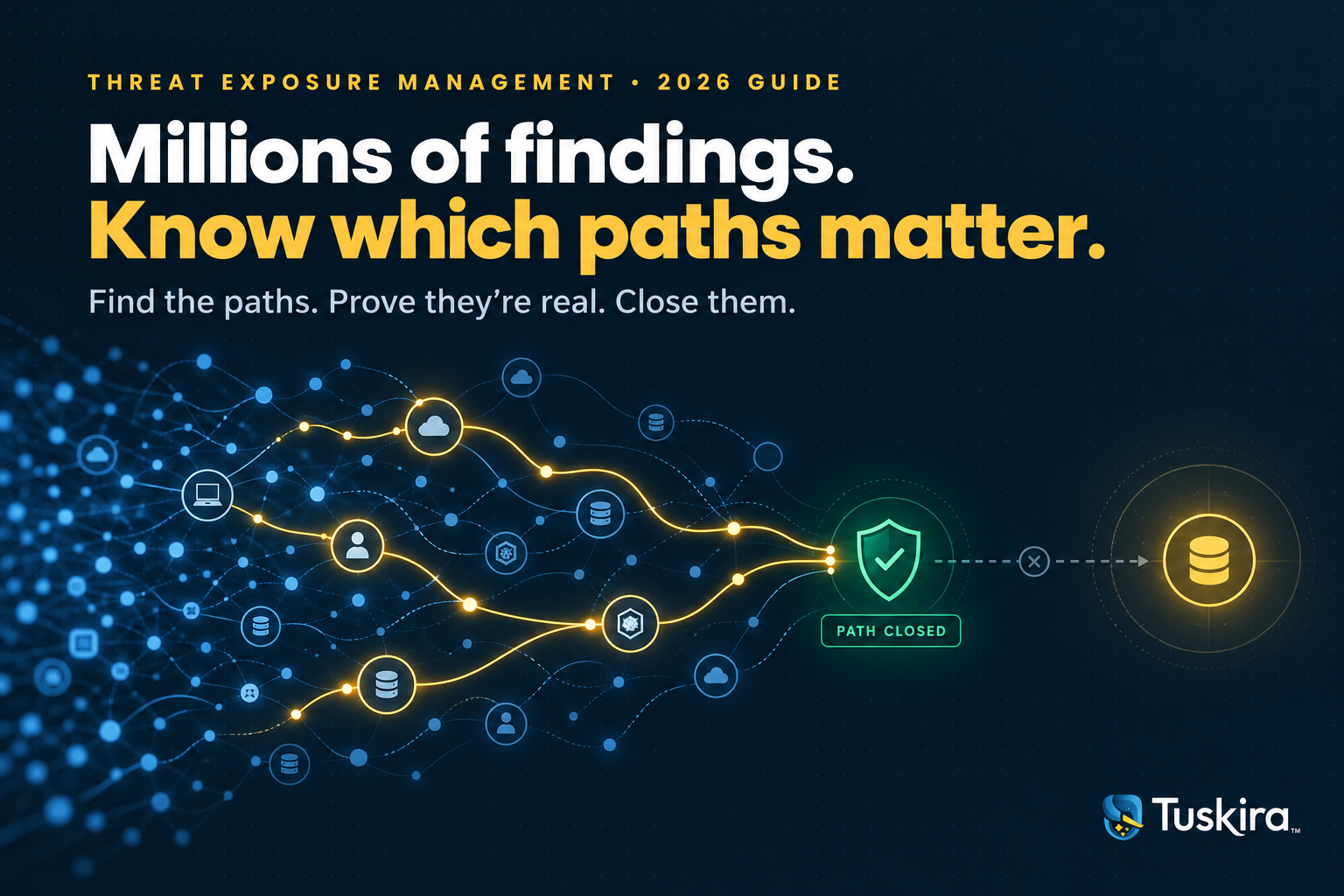
Threat exposure management is the ongoing practice of finding every way an attacker could reach something that matters in your environment, proving which of those paths are real, and closing them before they're used. It covers vulnerabilities, but also misconfigurations, identity risk, exposed services and gaps in your security controls. The goal isn't a shorter vulnerability list. It's fewer paths to a breach.
This guide explains what threat exposure management covers, how it differs from vulnerability management, how it works step by step in 2026, and what to measure.
Key takeaways
- Threat exposure management looks at attack paths, not individual findings. A medium-severity flaw on an open path to a critical system matters more than a critical one behind a working control.
- It covers more than CVEs. Misconfigurations, over-privileged identities, exposed services and control gaps are all exposures.
- Validation is the step most programs skip. Without it, you're ranking guesses.
- The fastest way to close an exposure is often a compensating control in a tool you already run, not a patch.
- Measure paths closed and time to close, not findings counted.
Threat exposure management vs vulnerability management
Vulnerability management asks which software flaws exist and how severe they are. Threat exposure management asks which weaknesses, of any kind, an attacker could chain together to reach something you care about, and whether your defenses would stop them.
| Vulnerability management | Threat exposure management | |
|---|---|---|
| Scope | Software vulnerabilities (CVEs) | Vulnerabilities, misconfigurations, identities, exposed services, control gaps |
| Unit of work | A finding | An attack path to a critical asset |
| How it prioritizes | Severity scores such as CVSS, sometimes exploit likelihood | Reachability, exploitability, whether controls block it, and business impact |
| Main output | A ranked list of patches | The smallest set of fixes that closes the most paths |
| How it closes risk | Patching | Patching, configuration changes or compensating controls, then re-testing |
| Success metric | Findings remediated, SLA compliance | Breach paths closed and time to close them |
Vulnerability management doesn't go away. Your scanners still feed the program. Threat exposure management decides which of their findings matter, and adds the exposures scanners don't see. See how this changes vulnerability management.
Threat exposure management vs CTEM
Threat exposure management is the discipline. Continuous threat exposure management (CTEM) is the five-stage program most security teams use to run it, a repeating loop of scoping, discovery, prioritization, validation and mobilization. In practice the terms are used almost interchangeably. When people say "CTEM," they usually mean running threat exposure management as a continuous cycle rather than a quarterly project. Our CTEM page covers the five stages in depth.
What counts as an exposure
- Vulnerabilities. Known flaws in operating systems, applications, containers and open-source packages.
- Misconfigurations. Open storage, permissive security groups, weak cloud policies and default settings.
- Identity risk. Over-privileged accounts, stale credentials, risky role chains and paths through Active Directory or your identity provider.
- External attack surface. Internet-facing services, forgotten subdomains, exposed APIs and shadow IT.
- Control gaps. Places where your EDR, WAF, firewall or email security is missing, misconfigured or wouldn't stop a known technique.
- AI and agent exposure. AI agents, MCP servers and model endpoints that can reach data or systems, a fast-growing category in 2026.
How threat exposure management works in 2026
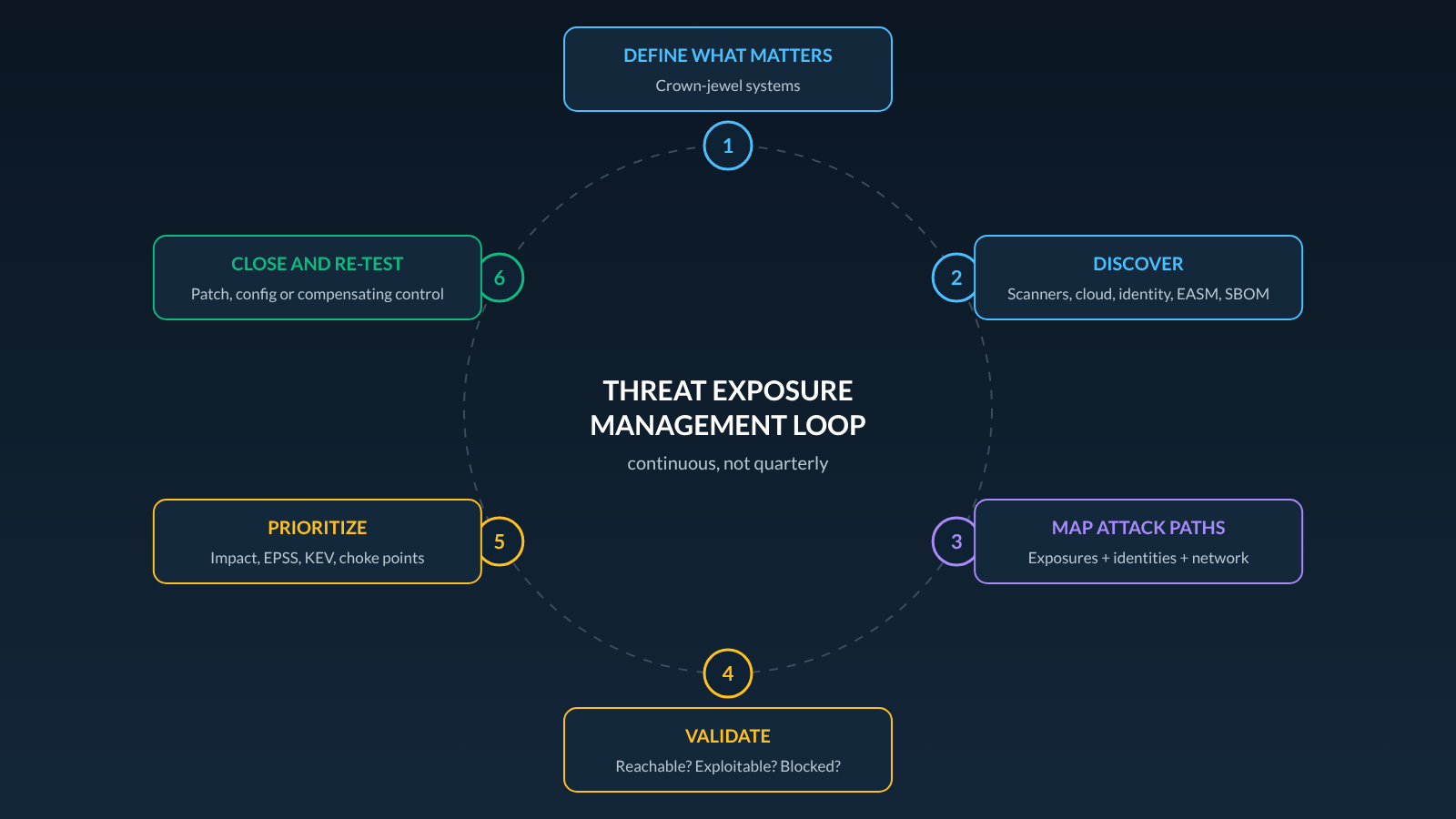
1. Define what matters
Start with the systems whose compromise would hurt the business most, such as payment systems, customer data, production infrastructure or plant controls. Everything else is prioritized by whether it leads there.
2. Discover exposures across the stack
Pull findings from the tools you already run, including vulnerability scanners, cloud security, identity, external attack surface and endpoint tools. That usually means vulnerability scanners, software bills of materials (SBOMs) for code and container components, CSPM and CIEM data for cloud configuration and permissions, and EASM for internet-facing assets. The point is one normalized view, so an asset that shows up in five tools is one asset.
3. Map attack paths
Connect exposures, identities, network reachability and controls into paths from an entry point to a critical asset. This is where a list of findings becomes a picture of how a breach would happen.
4. Validate what's real
Check each path three ways. Is the asset reachable? Is the weakness exploitable in your environment? Would the controls you've deployed stop it? Breach and attack simulation (BAS) tests whether controls stop known techniques. Adversarial exposure validation (AEV) goes further and tests whether a specific path is exploitable end to end. Validation is what separates the few exposures that matter from the thousands that don't. In one financial services environment, Tuskira validated 12.3 million raw findings down to the 0.46% that were exploitable and reachable.
5. Prioritize by impact
Rank paths by what they lead to and how easy they are to use. Use exploit intelligence, such as the CISA Known Exploited Vulnerabilities (KEV) catalog and EPSS scores, alongside asset criticality, rather than CVSS severity alone. Then look for choke points, where a single fix closes many paths at once.
6. Close the path and prove it
Fix through whatever is fastest and safest, whether that's a patch, a configuration change or a compensating control in a tool you already own. Then re-test to confirm the path is closed. A ticket marked "done" isn't proof.
Why threat exposure management matters more in 2026
Attackers and AI tools are finding vulnerabilities faster than teams can patch them. Tuskira Research analyzed 1,596 verified vulnerabilities across 281 open-source projects disclosed in 63 days and found discovery outpacing remediation by about 16.5 times. Read The Emerging Patch Gap for the full analysis.
When patching can't keep up, the question changes from "what should we patch first" to "which paths are open right now, and what's the fastest way to close them." That's the question threat exposure management answers. It's also why zero-day response has become part of the same program. A new vulnerability is just a new exposure that needs to be checked for reachability and closed before a patch exists.
What to measure
- Validated exposures. How many findings are exploitable and reachable, not how many exist.
- Open breach paths to critical assets, and whether that number is going down.
- Mean time to close a validated path, including compensating controls.
- Control coverage. The share of critical paths where a deployed control would stop the attack.
- Re-test pass rate. How often a "fixed" path is closed when it's checked again.
Common mistakes
- Treating it as a bigger scanner. More findings isn't the goal. Fewer validated paths is.
- Skipping validation. Ranking by severity with better visuals is still ranking by severity.
- Ignoring the controls you own. Many critical findings are already blocked. Many medium ones aren't.
- Ending at the ticket. If nobody re-tests, you don't know the path is closed.
- Running it apart from the SOC. The same context that says a path is open tells the SOC what an incident could reach.
Where Tuskira fits
Tuskira runs threat exposure management with AI agents on one live model of your environment. It connects to 200+ tools out of the box, maps breach paths, validates each one against the controls you've deployed, recommends the one change that closes the most paths, and re-tests to prove it worked. Vector adds autonomous red teaming from the outside, and the same model powers Tuskira's AI SOC, so exposure and investigation work from the same picture. For a side-by-side look at the market, see the best CTEM tools for 2026.
Key terms
- Attack path. A chain of exposures, identities and network access an attacker could use to get from an entry point to a critical asset.
- Choke point. A single asset, identity or control on many attack paths, where one fix closes several paths at once.
- Compensating control. A change in a security control you already run, such as a WAF rule, firewall policy or EDR block, that closes a path until a permanent fix lands.
- CVSS. A severity score for a vulnerability in the abstract. It says nothing about your environment.
- EPSS. A daily estimate of how likely a vulnerability is to be exploited in the wild.
- KEV. CISA's catalog of vulnerabilities known to be exploited in real attacks.
- BAS and AEV. Breach and attack simulation tests controls against known techniques. Adversarial exposure validation tests whether specific paths are exploitable end to end.
Frequently asked questions
What is threat exposure management in simple terms?
It's finding every way an attacker could reach your most important systems, proving which of those ways are real, and closing them, continuously rather than once a quarter.
Is threat exposure management the same as CTEM?
Nearly. Threat exposure management is the practice. CTEM is the five-stage program (scope, discover, prioritize, validate, mobilize) used to run it continuously.
Does threat exposure management replace vulnerability scanners?
No. Scanners are one of its main inputs. Threat exposure management adds context from cloud, identity, network and control data, then decides which scanner findings matter.
What is the difference between exposure validation and penetration testing?
A penetration test is a point-in-time exercise by people. Exposure validation runs continuously and checks reachability, exploitability and control coverage for every exposure as the environment changes. Many teams use both.
How long does it take to see results?
Teams usually see the first change in prioritization within weeks, once findings are validated against reachability and controls. The bigger result, fewer open paths to critical systems, builds over the following months.
See Tuskira find, validate and close breach paths in your own stack, or browse Tuskira Answers for more.
The Best Zero-Day Response Platforms in 2026
How AI Alert Triage Helps a Lean SOC