Tuskira vs XM Cyber: Platform Comparison
By David Mundy, VP of Marketing, Tuskira
This comparison is written by Tuskira, so we've stuck to what XM Cyber says publicly about its own product, as of October 2026.
The short answer
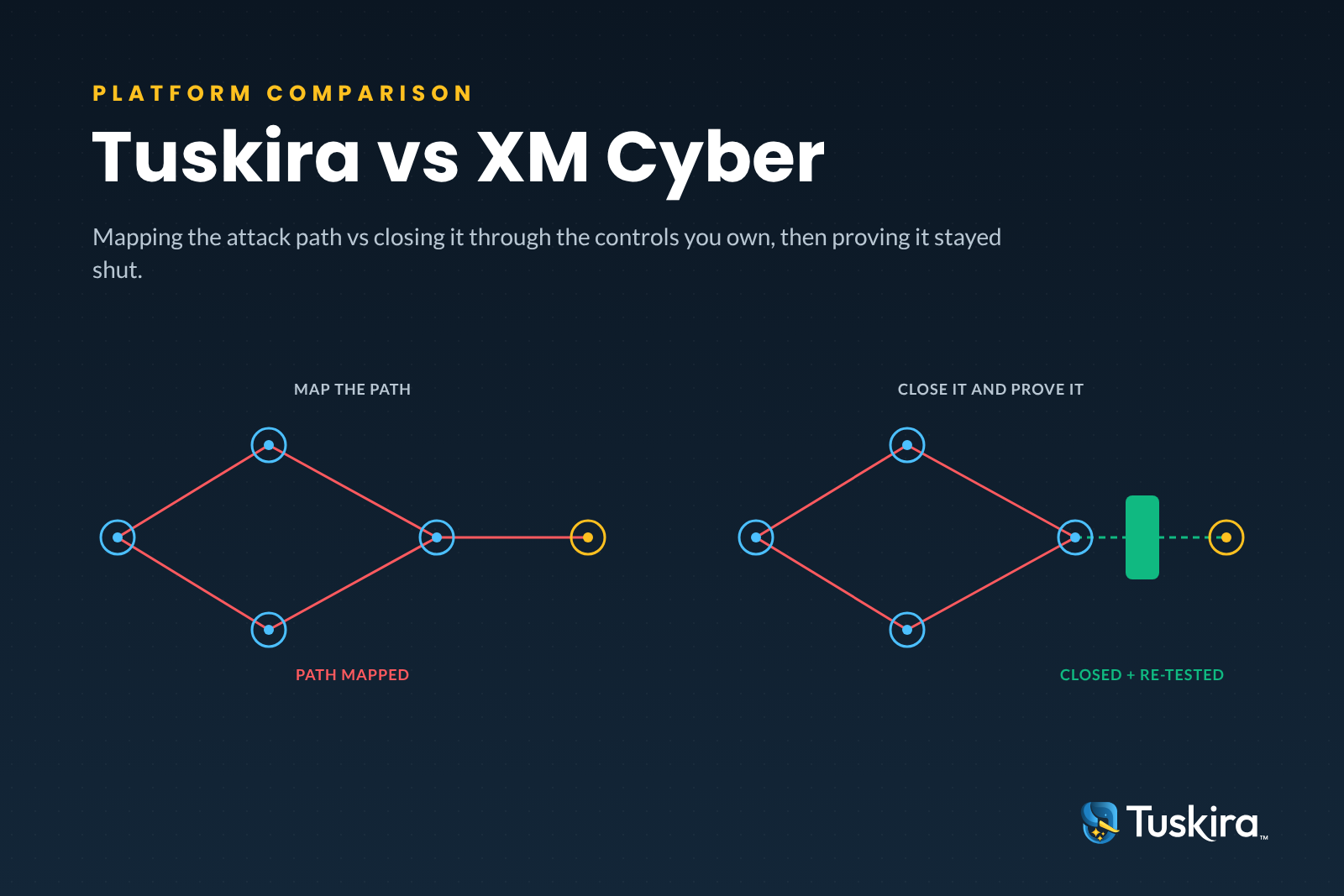
XM Cyber maps how attackers could move through your environment and tells you where to fix. Tuskira goes further. It finds the exposed asset, the critical asset, the path between them and the one fix to make first. Then it tests your deployed controls against that path, changes the control that fails, and re-runs the attack to prove the path is closed. The same context carries into AI-led alert triage, threat hunting and response.
XM Cyber doesn't natively span red teaming, breach path validation, AI SOC and IOC/IOA threat hunting. Tuskira runs all four on one shared context.
Tuskira vs XM Cyber, capability by capability
| Capability | Tuskira | XM Cyber |
|---|---|---|
| Reachability-based prioritization | Native. Code-to-runtime reachability, normalized across every scanner you run | Partial. Attack-graph reachability and exploit-condition testing. No code-to-runtime reachability |
| Control validation | Native. Tests whether your EDR, WAF and firewall, as configured, stop the attack | Partial. Tests control efficacy along mapped attack paths |
| Path closure and re-test | Native. Changes the control through tools you own, then re-runs the attack to confirm the path is closed | Partial. Choke-point remediation guidance. No native control change through deployed controls |
| Red, blue and purple teaming | Native. Full loop. Attack, detect, tune the control, attack again | Partial. Red-team simulation and detection verification |
| AI-led alert triage and investigation | Native. Signal to verdict, with breach-path and control context attached | Partial. Exposure context for analyst-led triage. No autonomous signal-to-verdict |
| IOC/IOA threat hunting | Native. Hunts across your telemetry where it already lives | Partial. Attack-path context for hunters. No native IOC/IOA hunting |
| OT exposure management | Native. OT in the digital twin. Red and blue on OT without touching production | Partial. IoT and OT in attack-path mapping |
| Deployment options | Native. SaaS, private cloud or on-premises, with your choice of model | Not offered. Public cloud SaaS on AWS only |
| Agents that learn | Native. Agents learn from analyst feedback. Every lesson is versioned and reversible | Not offered. No agents that learn from feedback |
Based on publicly available vendor information as of October 2026. Verify current capabilities with each vendor.
Why teams choose Tuskira
One platform for exposure and SecOps
CTEM, vulnerability prioritization, breach and attack simulation, red teaming, zero-day response, alert triage and threat hunting are deployed once and run on one shared model of your environment. You don't buy an exposure tool and then wire it to a separate SOC tool. What the SOC learns feeds straight back into closing paths.
Controls proven under attack, not inferred
Tuskira runs the attack against a digital twin of your live configuration and checks whether the EDR, WAF and firewall you deployed stop it. When a control fails, Tuskira recommends the change, applies it through the tools you already own within limits you set, and re-runs the attack to confirm the path is closed. That works across IT, cloud and OT, without touching production.
Investigations that start with the breach path
Exposure, control state and alerts live in one Security Data Fabric. When an exposure turns into an alert, Tuskira's AI SOC agent investigates with the breach path and control context already attached, and its threat hunting runs across your telemetry where it already lives.
Runs where you need it, and gets better with your team
Tuskira runs as SaaS, in your private cloud or on-premises, with your choice of model. Its agents learn from analyst feedback, and every lesson is versioned and reversible, so you can see what changed and roll it back.
Results from production deployments
- 12.3M findings to 0.46%. In one global financial services deployment, Tuskira cut 12.3 million raw findings to the 0.46% that were exploitable and reachable.
- Three weeks to 30 minutes. The same team's exposure triage went from three weeks to about thirty minutes.
- 15 minutes to a closing control. For a new zero-day, Tuskira confirmed impact and identified a control that closes the path in 15 minutes.
- 200+ integrations. Tuskira connects to the tools you already run out of the box and queries them where the data lives.
Tuskira's founders built and sold Accurics to Tenable. The company is backed by Intel Capital and SYN Ventures.
Where XM Cyber fits
XM Cyber is an established attack path analysis product with deep Active Directory and hybrid cloud coverage and a large European customer base. If you only need attack path mapping and your team will own remediation from the plans it produces, it's a reasonable choice. XM Cyber says autonomous remediation isn't available yet, and it doesn't triage or investigate alerts.
A note on ownership
In July 2026, CrowdStrike signed an agreement to acquire XM Cyber's intellectual property, including its patents and source code. CrowdStrike said it won't acquire XM Cyber's revenue or customers, and that XM Cyber will keep operating as a standalone business under a license to that IP. If you're evaluating XM Cyber, ask how that affects its roadmap and support.
Questions to ask every vendor
- Does it run the attack against my deployed control, or infer efficacy from configuration?
- After changing the control, does it re-run the attack to prove the path is closed?
- When an exposure becomes an alert, does the investigation start with the breach path?
- Can it run in my private cloud or on-premises, and do its agents learn from my team?
Frequently asked questions
Is Tuskira an alternative to XM Cyber?
Yes. Both platforms model attack paths. Tuskira adds adversarial control testing, closure through the controls you own, re-testing, and an AI SOC with threat hunting on the same model.
Does either platform attack production systems?
No. XM Cyber validates in a simulated environment. Tuskira validates against a digital twin of your live configuration, including OT.
Can Tuskira run on-premises?
Yes. Tuskira runs as SaaS, in your private cloud or on-premises. XM Cyber is public cloud SaaS on AWS.
Put the difference to the test
Bring one exposure, one deployed control and one live alert. Tuskira will run the complete loop with your team, from breach path to verified closure and investigation. Request a demo, or compare more platforms in the best CTEM tools for 2026.
The Best Zero-Day Response Platforms in 2026
How AI Alert Triage Helps a Lean SOC