Tuskira vs Tenable One: Exposure Management Comparison (2026)
By David Mundy, VP of Marketing, Tuskira · Last updated November 17, 2026
This comparison is written by Tuskira, so we've stuck to what Tenable says publicly about its own products, as of November 2026. One more disclosure. Tuskira's founders built Accurics, which Tenable acquired, so we know Tenable well and we respect what it's built.
The short answer
Tenable One discovers and prioritizes exposures across IT, OT, cloud, identity, applications and AI assets. It models attack paths, adds deployed-control context, and uses Hexa AI to investigate exposures, coordinate remediation and verify patches. Since October 2026, its Adversary View also uses Claude Mythos 5 to rank vulnerability chains from Tenable's scan data.
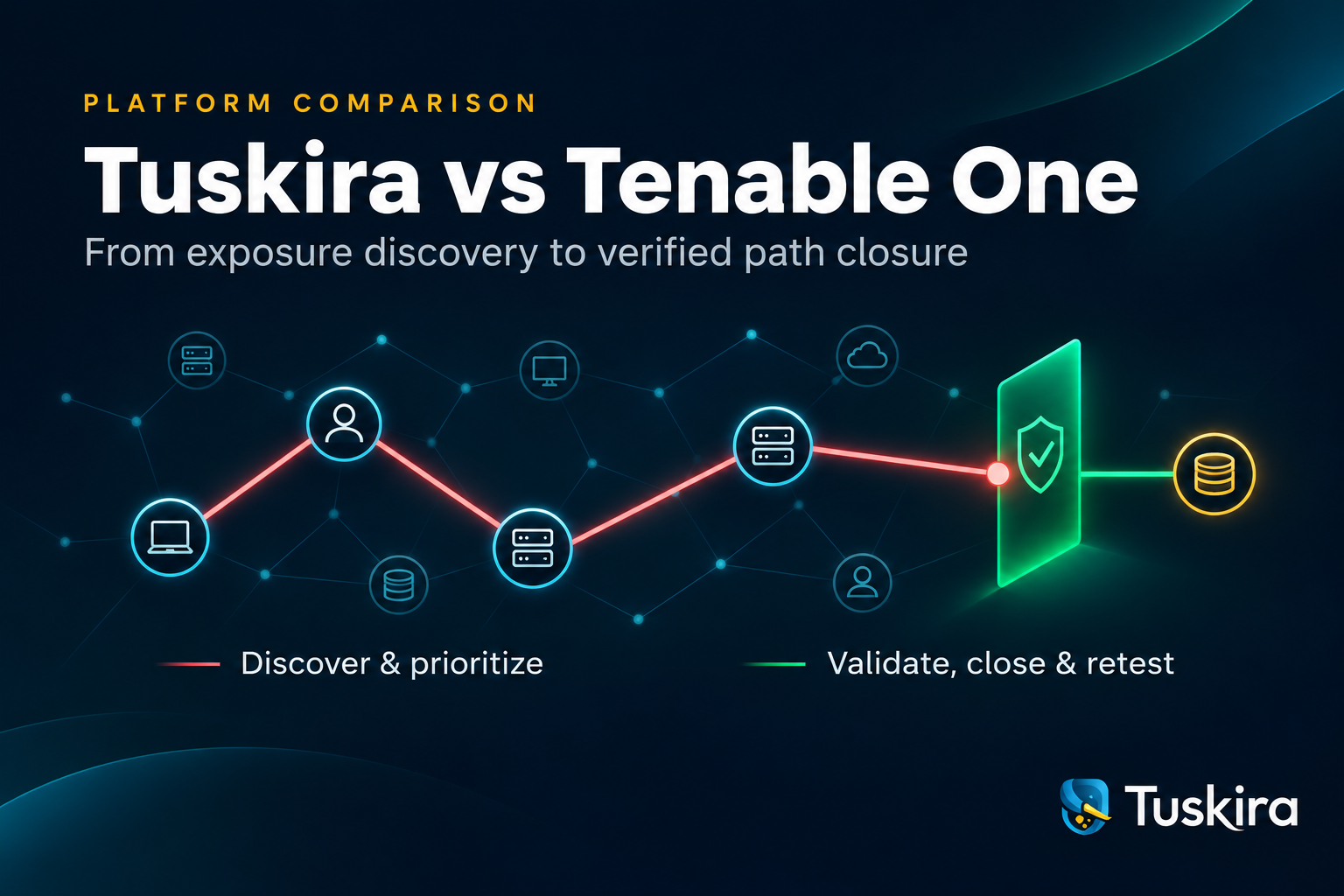
Tuskira can take those findings and work on a different part of the problem. It checks which paths are still open against your environment and defenses as they're configured today, closes them through approved changes to the controls you already run, and retests each path. The same model of your environment carries exposure and control context into SOC investigations.
The clearest difference is how each one treats your controls. Tenable's public materials describe checking whether a compensating control is active. Tuskira checks how that control is configured, such as whether an EDR is set to block or only to alert, because an active control in the wrong mode still lets the attack through. Then Tuskira closes the open path through a control you already own and retests it.
The two overlap in prioritization, attack path analysis and remediation. Tenable is the broader discovery and exposure data platform, and teams can run Tenable as the scanner with Tuskira on top of it.
An example of the difference
This is an illustrative scenario to show how the two approaches differ. It isn't a customer case.
A critical remote code execution flaw shows up on two web servers, and both sit on a route to the customer database. Tenable flags both as critical and puts both on attack paths. Both servers run an active EDR agent, so a control-aware view can show EDR coverage on both. The remaining question is whether each EDR policy is configured to stop this specific step. Tuskira reads that configuration directly.
Server A's agent is set to block, so the exploit step fails and that path is closed today. Server B's agent was switched to alert-only during an application issue months ago and never switched back. On server B the exploit step gets through, and the path to the database is open.
Server A moves down the queue with the evidence attached. For server B, Tuskira recommends a WAF rule for the vulnerable endpoint and a change to set the EDR policy back to block. Your team approves the changes, Tuskira makes them through the WAF and EDR you already run, and then retests the path to confirm it's closed. The patch follows on your normal schedule.
Same CVE, two servers, two answers. Both had EDR coverage, and only one had a policy that stopped the attack. Tuskira found the open path and closed it before the patch shipped.
Tuskira vs Tenable One, capability by capability
| Capability | Tuskira | Tenable One |
|---|---|---|
| Vulnerability scanning | Scanner-agnostic. Works alongside your scanners and reads findings from Tenable, Qualys, Rapid7 and other tools through 200+ integrations | Nessus, Tenable Vulnerability Management, Security Center and web app scanning, plus cloud, OT and identity exposure products |
| Attack path analysis | Breach paths modeled on a live Digital Twin of your assets, identities, exposures and controls | Attack path analysis across 150+ MITRE ATT&CK techniques, plus Adversary View, which uses Claude Mythos 5 to rank vulnerability chains from scan and finding data |
| Control context | Simulates each step of a path against the live configuration of the EDR, WAF, firewall and identity controls you've deployed | Continuous control validation maps active EDR, MFA, firewall and DLP controls onto attack paths and deprioritizes what they already neutralize |
| Attack-based testing | Vector runs autonomous red teaming from the internet inward, without touching production | About 3,000 direct check plugins probe individual vulnerabilities; pentest results come in through the Open Connector |
| Remediation | Recommends the control change that closes a path, or makes it once approved through supported integrations with tools you already run | Hexa AI creates and routes tickets, generates policies and triggers remediation; Adversary View recommends the fix that breaks each chain; Tenable Patch Management |
| Proof after the fix | Retests the path to confirm it's closed | Hexa AI routines verify that patches were applied and trigger rescans |
| Zero-day response | Quell checks reachability, tests existing controls, recommends or applies a compensating control, then revalidates; impact confirmed and a closing control identified in 15 minutes in production | Tenable Research coverage of new CVEs, exposure tracking and Hexa AI remediation workflows |
| Alert investigation | Iris triages and investigates L1 and L2 alerts across the tools you run, and investigations use the same model to see what an incident could reach | Threat stories correlate cloud detections in Tenable One Cloud Exposure; general SOC alert triage isn't positioned as a core Tenable One capability |
| Deployment | SaaS, private cloud or on-premises | Cloud-delivered platform, with on-premises scanning and data collection through Tenable Security Center Plus |
Based on publicly available vendor information as of November 2026. Verify current capabilities with each vendor.
What Tenable One does well
Tenable's strength is coverage. Tenable says Tenable One combines vulnerability, misconfiguration and entitlement coverage across IT assets, OT and IoT devices, cloud resources, AI assets, containers, web apps, code repositories and identity systems, backed by Tenable Research. On top of that data, its attack path analysis supports more than 150 attack techniques across endpoint, identity and cloud, and exposure signals look for toxic combinations of vulnerabilities, identities, threats and assets.
Hexa AI is the agentic layer. Tenable made it generally available in May 2026 and says it creates and routes tickets, generates custom policies and produces audit-ready reports, with MCP support for custom agents. Since July 2026, always-on routines scan for critical exposures daily, triage them by exploitability and reachability, trigger remediation and check that patches were applied.
Adversary View is the newest piece. Tenable said in October 2026 that it's live. Tenable's documentation says it builds an on-demand graph from existing scan and finding data and sends that data to Claude Mythos 5, which returns ranked attack paths with the scan evidence behind each hop and fixes ranked by how many paths they close. Tenable's documentation also lists what it needs. It requires a Tenable One Foundation or Advanced license, verbose scan settings and specific network plugins on at least two assets, and it isn't supported in FedRAMP Moderate environments. In-scope scan data goes to Claude Mythos 5 through Amazon Bedrock using a global inference profile, so analysis isn't confined to your data's regional AWS instance. Tenable says its AI providers don't train on customer data, and that for Adversary View, Anthropic keeps submitted data for 30 days for trust-and-safety purposes without using it for training. Teams with strict residency or retention rules should review those terms.
For a vulnerability management team that wants one vendor for discovery, scoring, path analysis, reporting and patch workflow, that's a complete package.
What Tuskira does
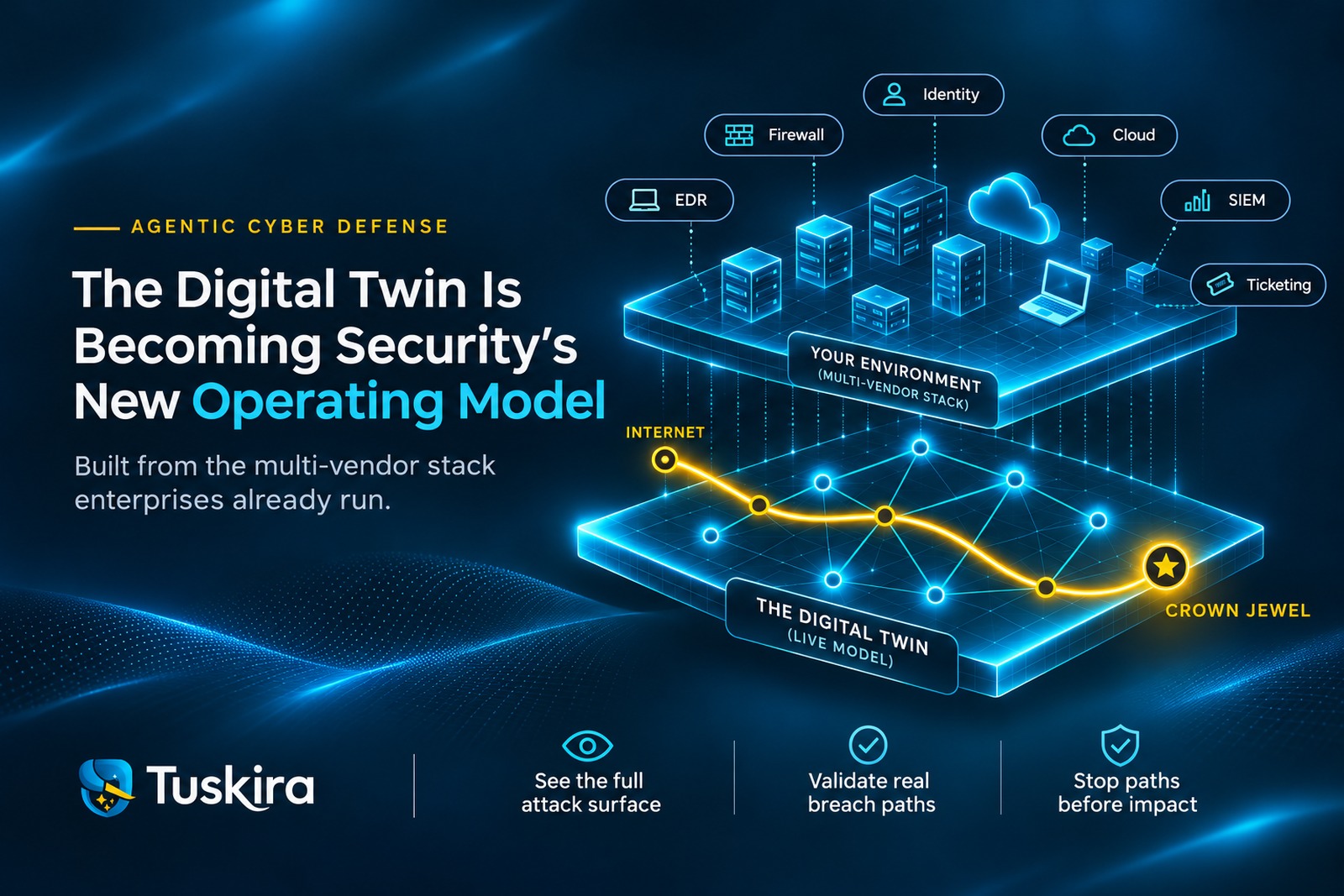
Tuskira starts where the scanner leaves off. Its Security Data Fabric normalizes signals from your scanners, cloud tools, identity providers and security controls into a live Digital Twin of your environment, which models your assets, identities, exposures and the controls between them. AI agents work on that shared model. Here's what that changes for your team.
- Every verdict names the control that decides it. Kairo checks each step of a breach path against the settings of the controls you've deployed and records whether each one blocks, detects or misses it. When someone asks why a critical finding moved down the queue, the answer is a specific control and setting.
- Open paths close this week. Tuskira recommends the control change that closes a path, makes it once approved through the tools you already run, and retests the path. You don't have to wait for the patch window.
- It works across your whole scanner mix. Tuskira reads findings from Tenable, Qualys, Rapid7 and other tools through 200+ integrations and merges them into one record per asset, so the analysis doesn't depend on one vendor's sensors.
- Zero-days get an answer in minutes. Quell checks whether a new vulnerability creates a reachable path and which existing control can close it. In production, Tuskira has confirmed zero-day impact and identified a closing control in 15 minutes.
- The SOC works from the same model. Iris investigates alerts, and an investigation can see which breach paths an incident sits on and which controls stand in the way.
How they differ on validation
Both vendors now use the word validation, and both rank attack paths, so the useful question is what evidence sits behind a verdict. A path can be inferred from scan and configuration data, checked against control telemetry, confirmed by a probe of one vulnerability, observed at runtime, or executed end to end in a controlled test. Each gives you a different level of assurance.
Tenable draws on several of these. Adversary View infers chains from scan and finding data, including live connections between hosts. Continuous control validation, announced in June 2026, maps active controls like EDR, MFA, firewalls and DLP onto attack paths, and Tenable says the platform checks whether compensating controls are active and deprioritizes weaknesses they already neutralize. Its public materials don't describe testing each control's policy settings, such as whether an EDR is set to block or only to alert. Nearly 3,000 direct check plugins probe individual vulnerabilities, and teams can bring pentest results into Tenable One through its Open Connector.
Kairo works at the level of the control's configuration. It simulates each step of a breach path on the Digital Twin against the settings your controls have today. A control that's installed but only set to alert, or a firewall rule with a gap in it, shows up as a step the attack gets through. Because Kairo simulates on the Digital Twin, it doesn't send exploit payloads to production workloads. Vector adds attack-based evidence from the outside with autonomous red teaming against your perimeter, and it doesn't touch production either.
How they differ on closure
Tenable's closure model runs through remediation workflow. Hexa AI routes tickets, generates policies and triggers remediation, Adversary View recommends the fix that breaks each chain, and always-on routines verify patches. Tenable also offers Tenable Patch Management. If your main goal is getting patches out faster and proving they landed, that's a direct fit.
Tuskira's closure model runs through your controls. Tuskira recommends the control change that closes an open path, or makes it once approved through the tools you already run, with your policy deciding what needs sign-off. Then it retests the path. That matters when a patch can't ship this week. A WAF rule, an EDR policy change or a firewall rule can close the path today, and the retest shows whether it worked.
Patch verification confirms a fix was installed. A retested path confirms the route is gone. Mature programs tend to want both.
Where the comparison goes beyond exposure management
Tuskira uses the same Digital Twin for exposure work before an attack and for SOC investigations during one. When Iris investigates an alert, it can see the asset's reachable paths, identities, critical destinations and current control state, without rebuilding that context from separate tools. An exposure Kairo flagged last week is already part of the picture when that asset shows up in an alert.
Tenable One offers threat stories for cloud detections in Tenable One Cloud Exposure, but Tenable positions Tenable One mainly around exposure management. It doesn't position it for L1 and L2 alert investigation across the tools a SOC runs.
Using Tenable and Tuskira together
Tuskira works alongside your scanner. It connects to Tenable Vulnerability Management and Tenable Asset out of the box through Tenable's APIs, and it queries the data where it lives. For each Tenable finding, Tuskira checks three things. Is the asset reachable? Is the flaw exploitable here? Do your controls already block it?
In one financial-services deployment, Tuskira reduced 12.3 million ingested findings to 0.46% requiring action after deduplication, suppression and known-exploit correlation. Internet exposure then determined which findings were addressed first, while control validation showed which paths remained undefended. Signal-to-verdict time fell from three weeks to 30 minutes. You can see the full list of supported tools on the integrations page.
In one sentence, Tenable begins with exposure data and optimizes remediation. Tuskira begins with the breach path and works out which approved control change closes it now.
Which should you choose?
Pick Tenable One if
- You need a scanner and broad discovery across IT, OT, cloud, identity, web apps and AI assets from one vendor.
- Your program is built around patching, and you want agents that route tickets and verify patches.
- You want attack path analysis, including Adversary View, and executive exposure reporting in the same platform as your scan data.
- You want to build custom agents on Tenable's exposure data through MCP.
Pick Tuskira if
- You already run scanners, Tenable or others, and the backlog is the problem.
- You want to know whether a path gets past your controls as they're configured today before you spend a change window on it.
- Patching is slow, and you want open paths closed through your EDR, WAF and firewall in the meantime, with a retest to prove it.
- You want exposure work and alert investigation running on the same model of your environment.
Run both if
You want Tenable's coverage and research feeding Tuskira's validation and closure. Tuskira can run this way, with Tenable as the scanner of record.
Questions to ask both vendors
- What kind of evidence supports this verdict? Was it inferred from scan data, checked against control telemetry, simulated against the control's configuration, or executed in a test?
- After the fix, do you retest the path, or confirm the patch was installed?
- Which fixes can you make through controls I already own, and who approves them?
For a wider view of the market, see our comparison of attack path analysis tools and the best AI vulnerability prioritization tools.
Frequently asked questions
Is Tuskira a Tenable alternative?
For part of Tenable One. Tuskira is scanner-agnostic, so if you need to find vulnerabilities you still need a scanner, and Tenable is a strong one. Tuskira overlaps with Tenable's prioritization, validation and remediation layers, and it approaches them through control validation and verified path closure. It can run on top of Tenable findings.
Does Tuskira integrate with Tenable?
Yes. Tuskira has out-of-the-box integrations with Tenable Vulnerability Management and Tenable Asset. It reads findings and asset data through Tenable's APIs, and the data stays in Tenable.
Does Tenable One validate exploitability?
Tenable says it does, through Adversary View's chain analysis, direct check plugins, continuous control validation and ingested pentest results. Tuskira's approach is to simulate each step of a breach path against the live configuration of your deployed controls and record whether the attack gets through.
What is Tenable Adversary View?
Adversary View is a Tenable Hexa AI capability that Tenable says went live in October 2026. It sends in-scope scan and finding data to Claude Mythos 5, which returns ranked attack paths with the evidence behind each hop and a list of fixes ranked by how many paths they close. It requires a Tenable One Foundation or Advanced license.
What is Tenable Hexa AI?
Tenable describes Hexa AI as the agentic orchestration engine inside Tenable One. It became generally available in May 2026 for Tenable One Foundation and Advanced customers. It runs workflows such as ticket routing, policy generation and patch verification.
Can Tuskira close an exposure before the patch ships?
Yes. Tuskira finds the control change that closes the path, such as a WAF rule or an EDR policy, and makes it once approved through the tool you already run. Then it retests the path to confirm it's closed, and the patch can follow on your normal schedule.
Put the difference to the test
Bring a Tenable export, one deployed control and one finding your team keeps arguing about. Tuskira will run the full loop with your team, from breach path to verified closure. Request a demo, or compare more platforms in the best CTEM tools for 2026.
The Digital Twin Is Becoming Security's New Operating Model
The ARTEX Chain Is Already in Your Backlog