Tuskira vs Dropzone AI: Platform Comparison
By David Mundy, VP of Marketing, Tuskira
This comparison is written by Tuskira, so we've stuck to what Dropzone AI says publicly about its own product, as of October 2026.
The short answer
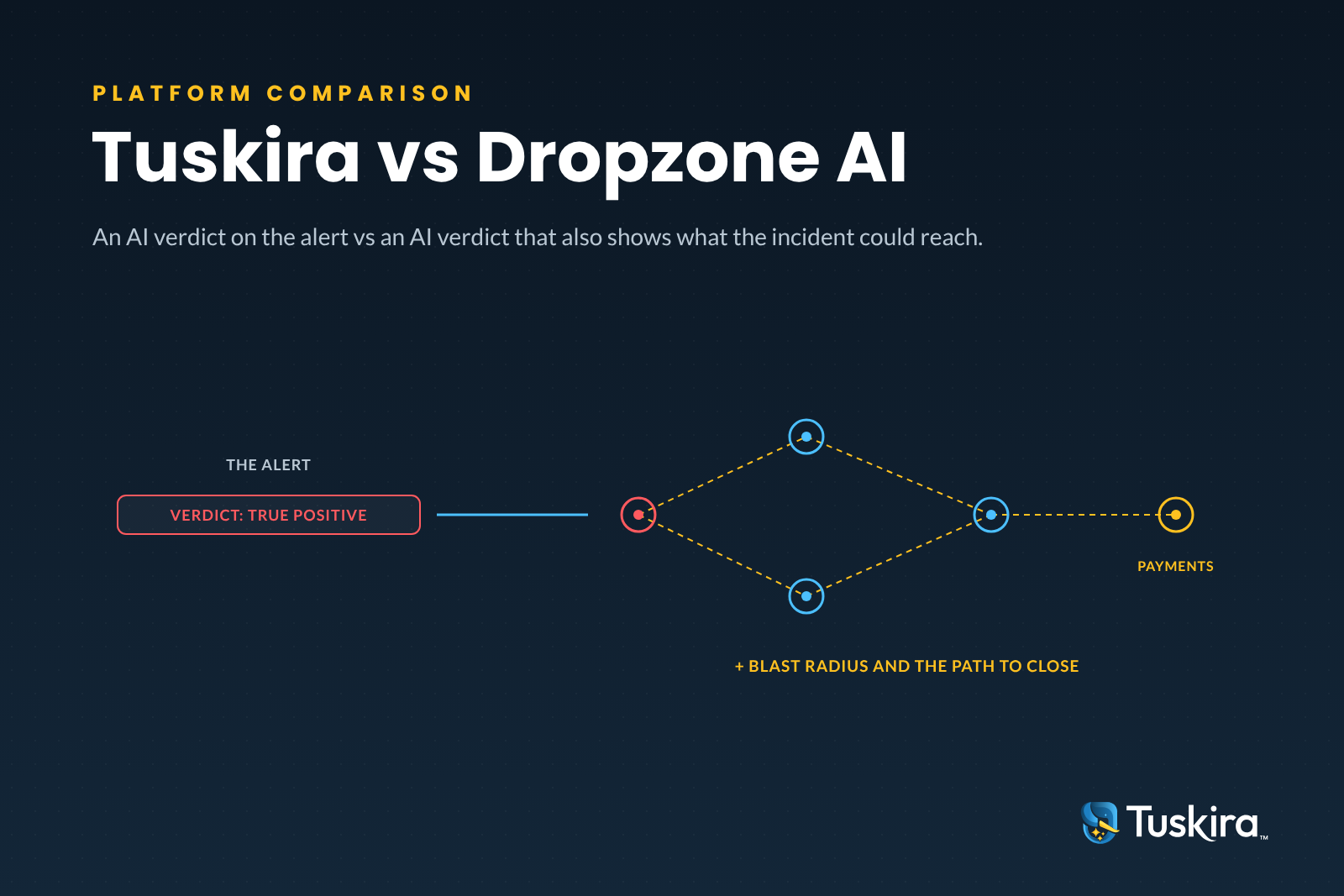
Dropzone AI is an AI SOC analyst. It investigates every alert and hands you a verdict with evidence. Tuskira does that too, and then goes further. Its investigations see what an incident could reach, because they run on the same model Tuskira uses to map and close breach paths. The same platform also validates exposures, runs autonomous red teaming and responds to zero-days, so the SOC and exposure management work from one picture.
If you're looking for a Dropzone AI alternative that covers more than alert triage, that's the difference.
Tuskira vs Dropzone AI, capability by capability
| Capability | Tuskira | Dropzone AI |
|---|---|---|
| AI-led alert triage and investigation | Native. Signal to verdict (true positive, false positive or escalate) with a confidence score and the full reasoning | Native. Autonomous investigation of every alert with the evidence behind each verdict |
| Threat hunting | Native. Hunts across your telemetry where it already lives | Native. AI Threat Hunter |
| Response | Native. Proposes containment through your existing controls, inside autonomy limits you set | Partial. Containment is analyst-authorized, with deeper response handed to a SOAR tool |
| Breach path context in investigations | Native. Every investigation sees what the incident could reach, from the same model that maps breach paths | Not offered. Investigates the alert, without a breach path model of your environment |
| Exposure and vulnerability prioritization | Native. Reachability, exploitability and control coverage across every scanner you run | Not offered. Not part of the product |
| Adversarial exposure validation | Native. Vector tests your perimeter like an attacker within the scope you approve, and Kairo validates breach paths against deployed controls | Not offered. Not part of the product |
| Zero-day response | Native. Checks whether a new vulnerability creates a reachable path and recommends the compensating control that closes it | Not offered. Not part of the product |
| Integrations | Native. 200+ out of the box, queried in place | Native. 90+, queried by API without moving data |
| Deployment options | Native. SaaS, private cloud or on-premises, with your choice of model | Partial. SaaS, with a single-tenant enterprise option and EU data residency |
Based on publicly available vendor information as of October 2026. Verify current capabilities with each vendor.
Why teams choose Tuskira
Investigations that know what's at risk
Most AI SOC tools start when an alert fires and only see the alert. Tuskira's AI SOC agent, Iris, works from the same model Tuskira uses to map breach paths, so when an alert turns real, the investigation already shows what the incident could reach and which controls stand in the way.
One platform before and during the attack
Alert triage, threat hunting, breach path validation, autonomous red teaming, vulnerability prioritization and zero-day response run on one shared context. You don't buy an AI SOC and then a separate exposure platform and try to connect them. What the SOC learns feeds straight back into closing the paths that made the incident possible.
Response through the controls you already own
When an investigation confirms a real threat, a response agent proposes containment through your existing EDR, firewall, identity and email tools. You set where agents stop for a human, and every step is logged with its reasoning and its cost.
Runs where you need it
Tuskira runs as SaaS, in your private cloud or on-premises, with your choice of model, and connects to 200+ tools out of the box without moving your data into a new lake.
Results from production deployments
- 12.3M findings to 0.46%. In one global financial services deployment, Tuskira cut 12.3 million raw findings to the 0.46% that were exploitable and reachable.
- 15 minutes to a closing control. For a new zero-day, Tuskira confirmed impact and identified a control that closes the path in 15 minutes.
- 200+ integrations out of the box, queried where the data lives.
Tuskira's founders built and sold Accurics to Tenable. The company is backed by Intel Capital and SYN Ventures.
Where Dropzone AI fits
Dropzone AI is a focused investigation layer that deploys quickly and works across a mixed stack. If your only goal is clearing the alert queue and you're happy to keep response and exposure management in other tools, it's a reasonable choice.
Questions to ask every AI SOC vendor
- When an alert is real, does the investigation show what the attacker could reach next?
- Can the platform tell me which of my exposures made this incident possible, and close them?
- What can the agent do without approval, and can I see the full reasoning for every verdict?
- Can it run in my private cloud or on-premises?
Frequently asked questions
Is Tuskira a Dropzone AI alternative?
Yes. Both triage and investigate alerts autonomously. Tuskira adds breach path context to every investigation, response through your existing controls, and exposure management, red teaming and zero-day response on the same platform.
Do I need to move my data to use either one?
No. Both query the tools you already run. Tuskira connects to 200+ out of the box.
Can Tuskira run on-premises?
Yes. Tuskira runs as SaaS, in your private cloud or on-premises.
Put it to the test
Bring a week of real alerts. Tuskira will triage them against your own stack and show, for every real one, what it could have reached and how to close that path. Request a demo, or see more options in the best AI SOC platforms in 2026.
The Best Zero-Day Response Platforms in 2026
How AI Alert Triage Helps a Lean SOC