Tuskira vs Vega: Agentic Cyber Defense Compared (2026)

By David Mundy, VP of Marketing, Tuskira · Last updated November 19, 2026
Tuskira wrote this comparison. Everything said about Vega comes from Vega's own public materials as of November 2026. Both companies use the term agentic cyber defense for different work.
The short answer
Vega runs detection, triage and investigation on security data where it already lives, in cloud services, data lakes and object storage. Vega positions it as a way to replace a legacy SIEM or cover what the SIEM can't ingest. Vega II, announced in September 2026, added a security-trained model, a memory of past investigations and a gateway for streaming in new data sources.
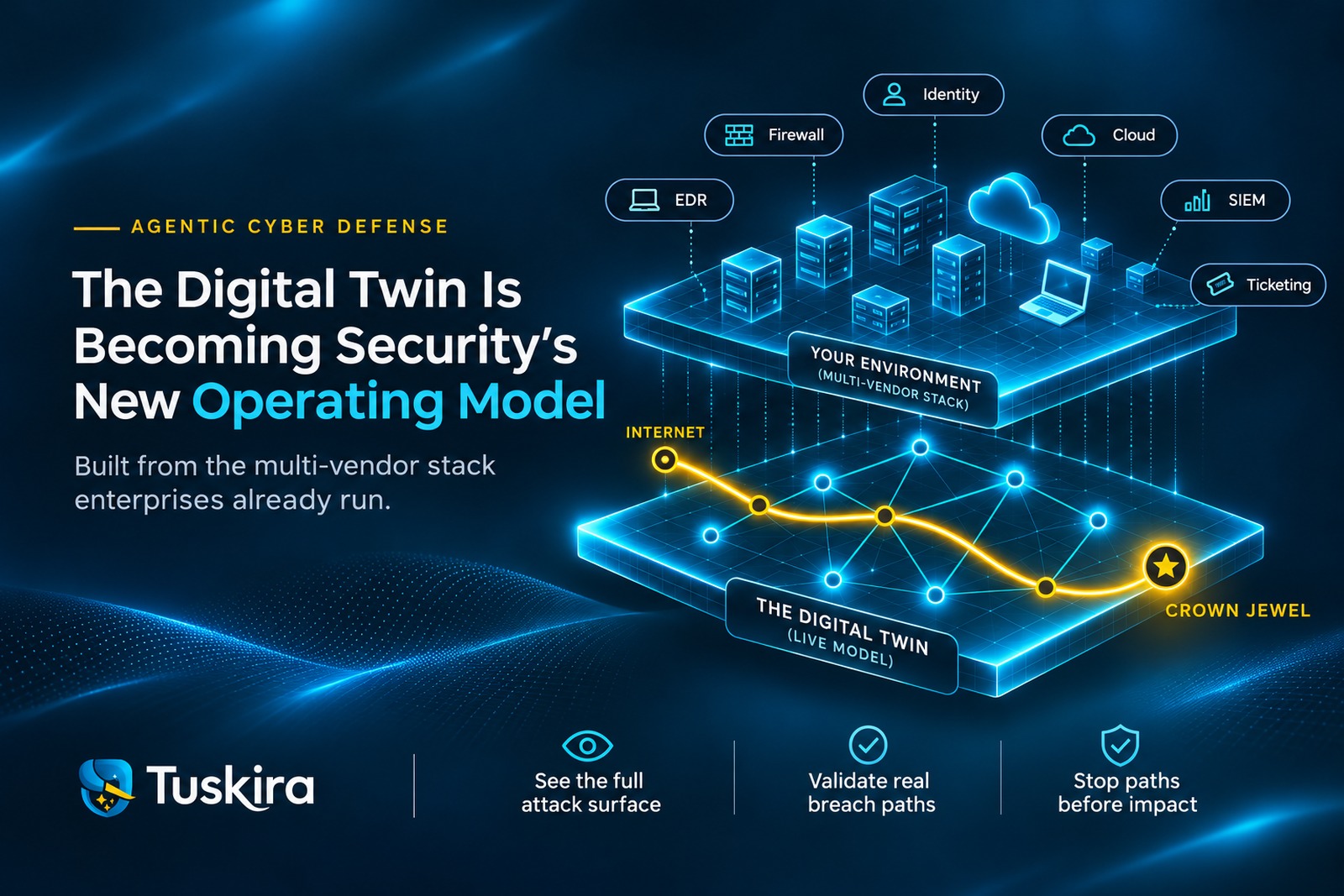
Tuskira works with the SIEM and detections you already run, so there's no migration. Its Iris agent triages and investigates alerts. Iris returns a verdict of true positive, false positive or escalate, with a confidence score and the full reasoning. Tuskira's data shows an AI agent can handle up to 2,000 security incidents a day, about what a human analyst handles in a year. The rest of the platform works before an attack. It models breach paths on a live Digital Twin of your environment, checks them against how your deployed controls are configured today, closes the open paths through approved control changes and retests.
The main difference is coverage. Vega's public materials cover detection and response. Tuskira covers response and the exposure work before an attack, from one model, so an investigation already knows which breach paths an asset sits on. In production, Tuskira confirmed a new zero-day's impact and identified a control that closes the path in 15 minutes.
An example of the difference
This is an illustrative scenario to show how the two approaches differ. It isn't a customer case.
An alert fires for suspicious PowerShell on a finance application server. Vega queries the relevant logs in place, runs its detection and triage loop, uses its memory of past investigations, and returns a verdict for an analyst to act on.
Iris investigates the same alert across the tools you run, using data from the Digital Twin. The server sits on a breach path to the payments database, its EDR policy was switched to alert-only last quarter, and the service account it uses can reach two other systems. Iris reaches a verdict and stages containment for approval, such as revoking the session and setting the EDR back to block.
After the incident, Tuskira retests the path and closes the remaining gap through the controls you already own, so the same route can't be used again.
Tuskira vs Vega, capability by capability
| Capability | Tuskira | Vega |
|---|---|---|
| Category framing | Agentic cyber defense, before and during the attack | Uses agentic cyber defense for detection and response |
| SIEM | Works with your existing SIEM and detections, so there's no migration | Positioned to replace a legacy SIEM or augment it for data the SIEM can't ingest |
| Data access | Reads from 200+ tools through out-of-the-box integrations without centralizing data, and builds a Security Data Fabric and Digital Twin | Federated analytics that query each source in place, plus distributed indexing over object storage |
| Detection | Uses the detections you already run, so your detection content keeps working | Agentic detection, Detection Skills and detection and posture assessment against MITRE ATT&CK |
| Alert triage and investigation | Iris triages and investigates L1 and L2 alerts with breach-path and blast-radius context, and returns a verdict with a confidence score and full reasoning. Up to 2,000 incidents a day per agent, per Tuskira data | Autonomous triage and investigation loop with a security-trained model and investigation memory |
| Response | Stages containment through the controls you already own, with approval | Turns alerts into cases for a decision |
| Exposure and breach paths | Kairo maps and validates breach paths; Lattice prioritizes exploitable, reachable vulnerabilities | Not described in Vega's public materials |
| Control validation | Checks each step of a path against the live configuration of your EDR, WAF, firewall and identity controls, then retests after changes | Not described in Vega's public materials |
| Zero-day response | Quell checks reachability, tests existing controls and applies a compensating control with approval | Not a stated focus in Vega's public materials |
| Attacker's-eye testing | Vector runs autonomous red teaming from the perimeter without touching production | Not described in Vega's public materials |
Where Vega fits
Vega fits teams whose main project is replacing a legacy SIEM.
Why teams choose Tuskira
Tuskira keeps your SIEM and adds agents that investigate alerts and close the breach paths behind them. It tells you whether an alert is real, which open paths sit behind it, and whether your controls are configured to stop them, then closes the open path so the same route can't be used again.
Can you run both?
Yes. A team could use Vega for detection on data in place, and Tuskira for exposure validation, breach-path closure and investigation. Both do alert triage and investigation, so most teams will pick one for that job.
For more on the category, read What is agentic cyber defense?, or see how AI SOC platforms compare in the best AI SOC platforms.
Frequently asked questions
Is Tuskira a Vega alternative?
Yes, for alert triage and investigation. Tuskira also finds and closes the breach paths behind those alerts before an attack, which Vega's public materials don't describe. And it works with the SIEM you already run, so there's no migration.
Do I have to replace my SIEM to use Tuskira?
No. Tuskira works with the SIEM and detections you already run, so you keep what you've paid for and add exposure validation, breach-path closure and investigation on top.
What is Vega II?
Vega II is the platform release Vega announced in September 2026. It added a security-trained AI model, Vega Memory for past investigations and Vega Gateway for bringing in new data sources.
Which vendors cover agentic cyber defense end to end?
Several vendors use the term, and most apply it to one side of an attack. Vega applies it to detection and response. Cymulate applies it to testing defenses ahead of an attack. Tuskira covers both, before and during the attack, from one model of the environment.
Put the difference to the test
Bring a recent alert your team spent too long on. We'll investigate it on your environment, show the breach paths behind it and close the open one. Request a demo.

What Is Agentic Cyber Defense? Definition, How It Works and What to Ask
The Digital Twin Is Becoming Security's New Operating Model