What Is Agentic Cyber Defense? Definition, How It Works and What to Ask

By David Mundy, VP of Marketing, Tuskira · Last updated November 19, 2026
Agentic cyber defense, defined
Agentic cyber defense is the use of AI agents that reason over a live model of an organization's environment to reduce exposure before an attack and to investigate and respond during one. The agents act through the security controls the organization already runs, within policies people set, and they verify every outcome.
Before an attack, agents find the paths an attacker could use to reach critical systems, test whether your current controls stop each one, and close the ones that are open. During an attack, agents investigate alerts using the same model and stage containment steps for a person to approve. Findings from each side update the model the other side uses.
Most vendors using the term cover one side. Some use it for AI that triages SOC alerts. Others use it for AI that tests and tunes controls before an attack. A platform that covers one side leaves the other side to your team.
Why the term exists now
AI makes it cheaper to find vulnerabilities and to build exploits from published fixes. In Anthropic's lab tests, a frontier model turned a public patch into a working exploit in under an hour.
Fixes are slower. In June 2026, Tuskira Research found that one AI-driven program disclosed 1,596 verified vulnerabilities across 281 open-source projects in 63 days, and that discovery was outpacing visible fixes by about 16.5 to 1. Verizon's 2026 Data Breach Investigations Report puts the median time to fully fix a known-exploited vulnerability at 43 days, up from 32.
Attackers can exploit a vulnerability in hours. Defenders take weeks to fix it. Agentic cyber defense uses AI agents to do defensive work at machine speed, before and during an attack.
What agents do before the attack
Before an attack, agents do five things.
- Test from the outside. Agents probe the internet-facing estate the way an attacker would, within a scope the customer approves.
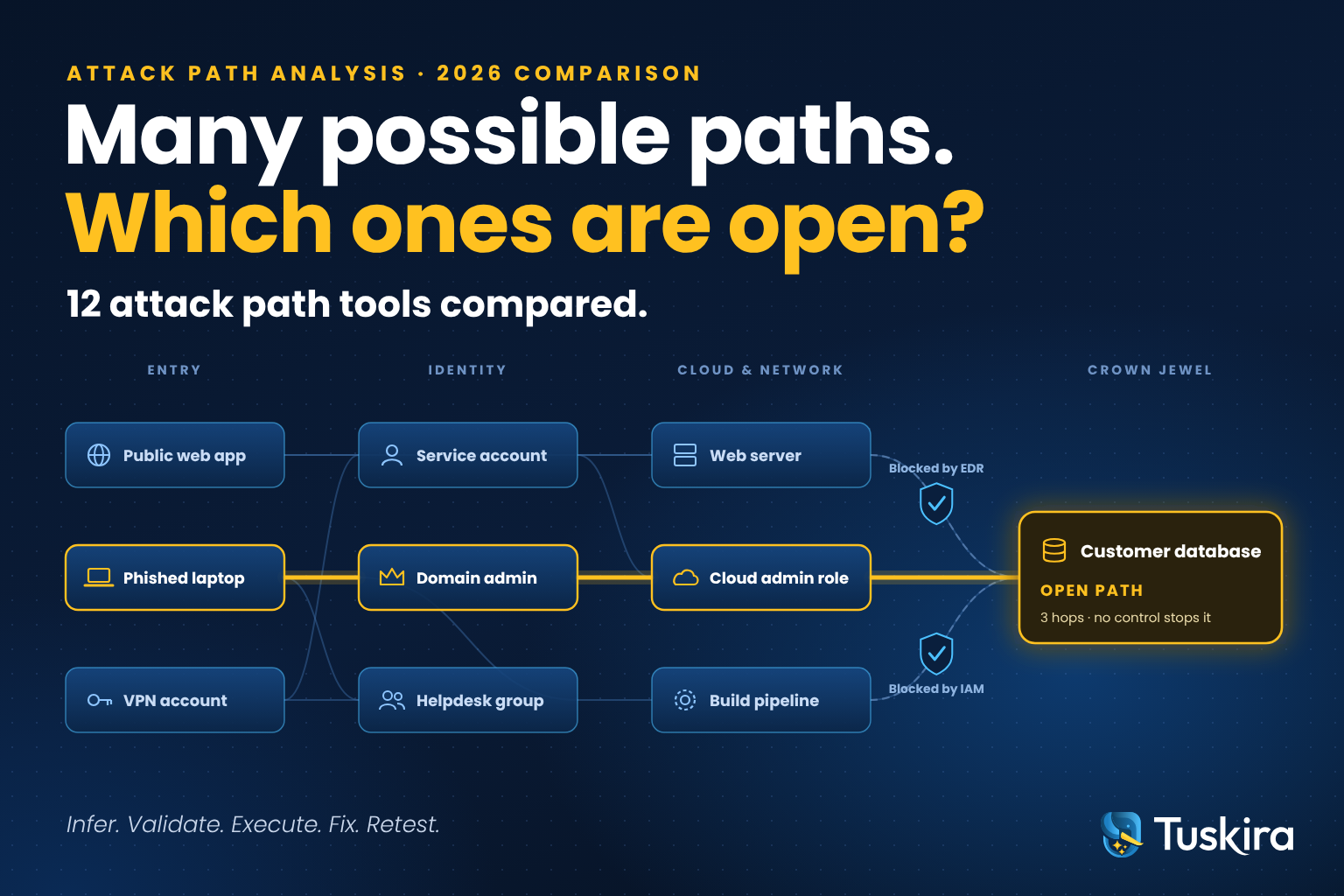
- Map breach paths. Agents chain vulnerabilities, misconfigurations and identity weaknesses into the routes that reach critical data and systems.
- Validate against deployed controls. Agents check each step of a path against the current configuration of your EDR, WAF, firewall and identity controls. For example, an EDR policy set to alert-only doesn't block anything, and this step flags it.
- Close the open paths. Agents recommend, or make with approval, the control change that breaks a path, such as a WAF rule or an EDR policy. Then they retest to confirm the path is closed.
- Answer the zero-day question. When a new CVE lands, agents check whether it's reachable in your environment and whether a control you already own stops it, before a patch exists.
What agents do during the attack
During an attack, agents do four things.
- Triage and investigate. Agents work L1 and L2 alerts across the tools you run and reach a verdict with the evidence attached.
- Use exposure context. Because the same model drives both halves, an investigation knows which breach paths the affected asset sits on and what it could reach next.
- Contain with approval. Agents stage containment steps, such as revoking a session or blocking a range, through the controls you already run. People approve them.
- Close the loop. What the investigation learns goes back into the model, so the same path gets tested and closed before it can be used again.
How it differs from related categories
| Category | Main job | Before the attack | During the attack |
|---|---|---|---|
| Agentic cyber defense | Agents reduce exposure and respond to attacks from one model of the environment | Yes. Finds, validates and closes breach paths | Yes. Investigates and contains with approval |
| AI SOC | AI agents triage and investigate alerts | Usually out of scope | Yes. This is the core job |
| Exposure management and validation (CTEM, AEV, BAS) | Find, prioritize and test exposures | Yes. This is the core job | Usually out of scope |
| SOAR | Run predefined playbooks across tools | Rarely | Runs the steps someone scripted in advance |
| SIEM | Collect and correlate logs and detections | Rarely | Detects and alerts; people or other tools respond |
Agentic cyber defense runs on top of your SIEM, EDR, firewall and scanners. Agents read data from those tools and make changes through them.
The guardrails that make it safe to use
Agents that change production controls need limits. In September 2026 the UK's National Cyber Security Centre said someone has to be accountable for every automated action. Ask any vendor for these six guardrails.
- Policy sets the limits. You decide which actions an agent can recommend, which it can stage for approval and which it can never take on its own.
- Every action shows its evidence. The agent states which path it's closing or which incident it's containing, and why.
- Changes are reversible. Control changes roll back cleanly, and the agent predicts the blast radius before it acts.
- Results are verified. After every change, the agent retests to confirm the change worked.
- Everything is logged. Each finding, decision, approval and action lands in an audit trail.
- Testing stays off production. Breach paths can be simulated on a model of the environment, so validation doesn't send exploit payloads at live workloads.
Most teams start with agents that only recommend changes. Next they let agents stage changes for approval. Then they let agents make a small set of reversible changes on their own.
What Gartner research says about the shift
Gartner research on the future of cyber defense describes the same change in how defense is organized. The following quotes are reproduced verbatim from the research.
“Agentic orchestration of cybersecurity controls will be the next multibillion-dollar cybersecurity battle.”
“Attackers already use AI to target enterprises, forcing enterprises to proactively and reactively use AI for cyber defense to identify and remediate risk at machine speed and scale across an organization’s global attack surface grid.”
“A critical aspect of this transformation is the integration of the traditional silos between proactive security (identifying and remediating exposures and vulnerabilities) and reactive security (active threat detection and response).”
“Selling the final autonomous stage to an immature organization is a risk; vendors must instead meet customers where they are, initially focusing on “human on the loop” rather than full autonomy.”
Source: Gartner, Tech FutureSight: Protect the Global Attack Surface With an Autonomous Cyber Defense System, Neil MacDonald, 12 December 2025.
The views that follow are Tuskira's own.
How Tuskira delivers agentic cyber defense
Tuskira is an agentic cyber defense platform. AI agents on the security tools you already own reduce exposure before the attack, investigate and respond during it, and feed every outcome back into your defenses.
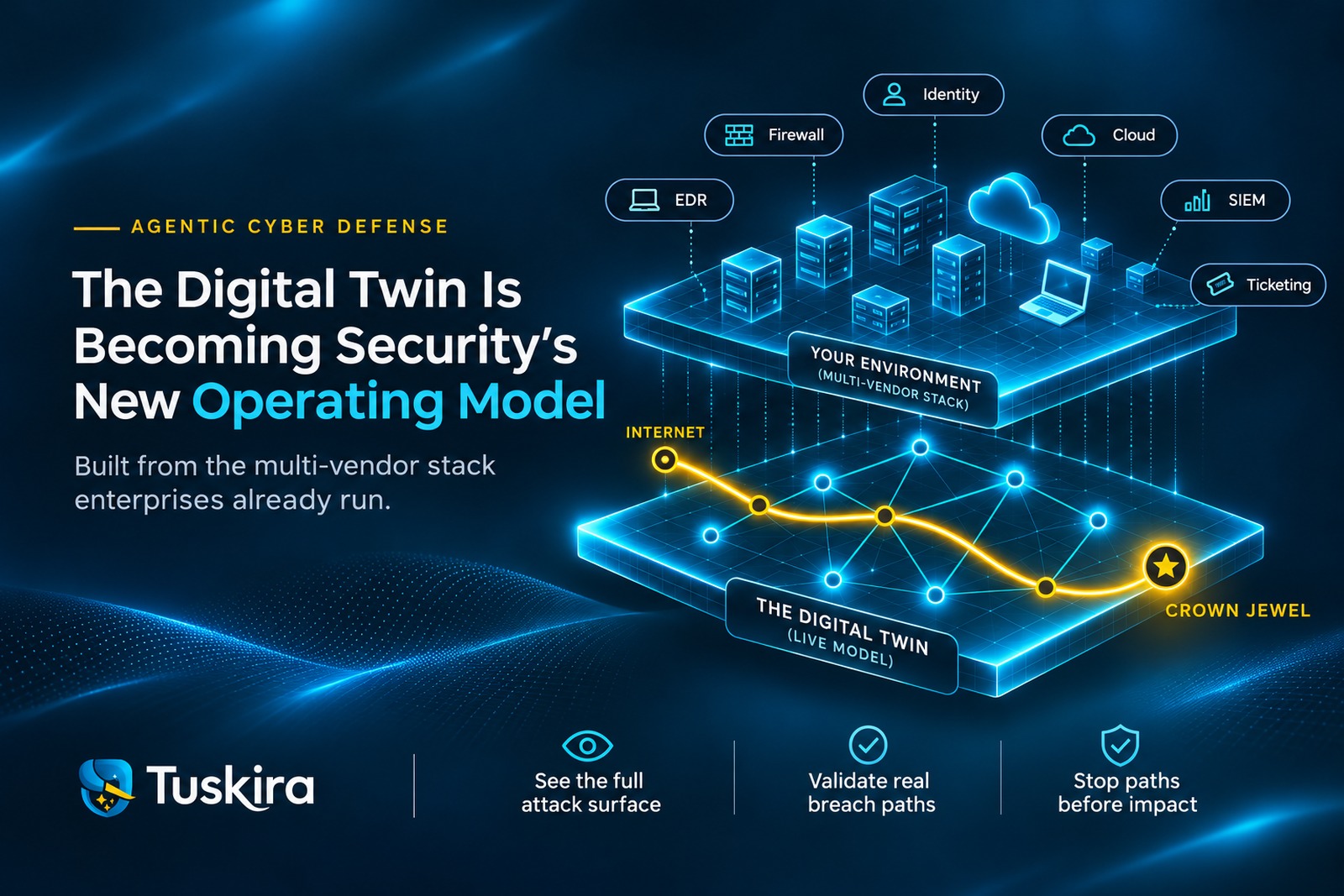
The agents reason over the Security Data Fabric, which normalizes signals from more than 200 out-of-the-box integrations into a live Digital Twin of your environment. Each agent has one job.
| Agent | When | What it does |
|---|---|---|
| Vector | Before the attack | Runs autonomous red teaming from the perimeter inward, within approved scope and without touching production |
| Kairo | Before the attack | Maps breach paths inside the environment, validates them against your deployed controls on the Digital Twin and closes the open ones |
| Lattice | Before the attack | Reduces vulnerability findings to the ones that are exploitable, reachable and undefended |
| Quell | Before the attack | Checks whether a new CVE opens a path, tests the controls you have, applies a compensating control with approval and revalidates |
| Iris | During the attack | Triages and investigates alerts with exposure and blast-radius context and stages containment for approval |
Tuskira's main difference is control validation. It checks how each deployed control is configured, closes the open path through a control you already own, and retests it. In production, Quell confirmed a new vulnerability's impact and identified a closing control in 15 minutes.
Questions to ask any agentic cyber defense vendor
- Does it cover both halves, before and during the attack, from one model of my environment?
- Does it check how my controls are configured, or only whether they're installed?
- Can it close a path through tools I already own, and does it retest afterward?
- What can an agent do without approval, and who sets that policy?
- Does validation touch production, or does it run on a model of my environment?
- Can I see the evidence and audit trail behind every action?
- Does it replace tools I've already paid for, or work through them?
Frequently asked questions
What is agentic cyber defense?
Agentic cyber defense is the use of AI agents that reason over a live model of an organization's environment to reduce exposure before an attack and to investigate and respond during one. The agents act through the security controls the organization already runs, within policies people set, and verify every outcome.
How is agentic cyber defense different from an AI SOC?
An AI SOC uses agents to triage and investigate alerts, which is the during-the-attack half. Agentic cyber defense includes that work and adds the before-the-attack half, where agents find, validate and close breach paths. Both halves share one model of the environment.
Is agentic cyber defense the same as autonomous cyber defense?
The terms overlap. "Autonomous" usually means systems that act without people. "Agentic" means agents that act within limits people set and ask for approval on higher-risk actions. Most security teams want the agentic model today.
Does agentic cyber defense replace a SIEM or EDR?
No. It works through the tools you already run. Agents read data from your SIEM, EDR, cloud, identity and network tools, and they act through those same controls.
Is it safe to let AI agents change security controls?
Yes, if the platform has guardrails. Look for policy limits on what agents can do alone, approval steps, reversible changes, a retest after every change, a full audit trail, and validation that runs on a model of the environment instead of against production.
What does agentic cyber defense do about zero-days?
When a new vulnerability is disclosed, agents check whether it's reachable in your environment and whether an existing control already stops it. If not, they recommend or apply a compensating control, such as a WAF rule, and retest. This protects the environment until the patch is applied.
See it on your environment
Bring one finding your team disagrees about and one control you rely on. We'll run the full process on your environment, from finding the breach path to confirming it's closed. Request a demo, or read the Patch Gap research behind it.
Gartner, Tech FutureSight: Protect the Global Attack Surface With an Autonomous Cyber Defense System, Neil MacDonald, 12 December 2025.
GARTNER is a registered trademark and service mark of Gartner, Inc. and/or its affiliates in the U.S. and internationally and is used herein with permission. All rights reserved.
Gartner does not endorse any vendor, product or service depicted in its research publications and does not advise technology users to select only those vendors with the highest ratings or other designation. Gartner research publications consist of the opinions of Gartner's research organization and should not be construed as statements of fact. Gartner disclaims all warranties, expressed or implied, with respect to this research, including any warranties of merchantability or fitness for a particular purpose.
The Digital Twin Is Becoming Security's New Operating Model
The ARTEX Chain Is Already in Your Backlog