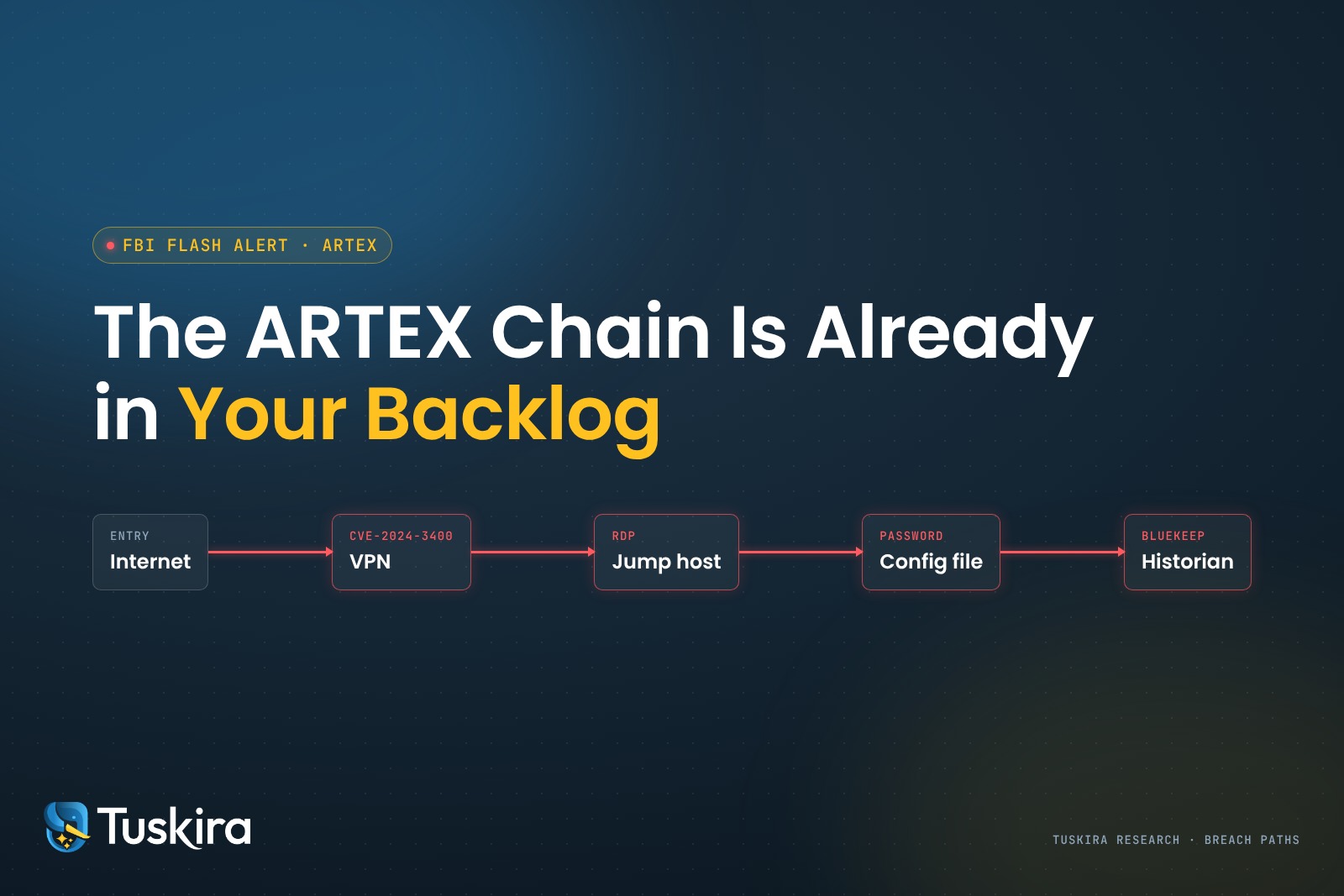
Tuskira vs Cymulate: Agentic Cyber Defense Compared (2026)

By David Mundy, VP of Marketing, Tuskira · Last updated November 19, 2026
Tuskira wrote this comparison. Everything said about Cymulate comes from Cymulate's own public materials as of November 2026. Both products test security controls before an attack, so they overlap.
The short answer
Cymulate calls its approach agentic cyber defense engineering. It runs production-safe attack simulations to test threats, controls and exposures, validates and tunes SIEM and EDR detections, and pushes indicators and detection rules to connected controls through Auto Mitigation. Cymulate Cowork, dated August 2026, adds agents that run validation routines, track mitigation tasks and report on them.
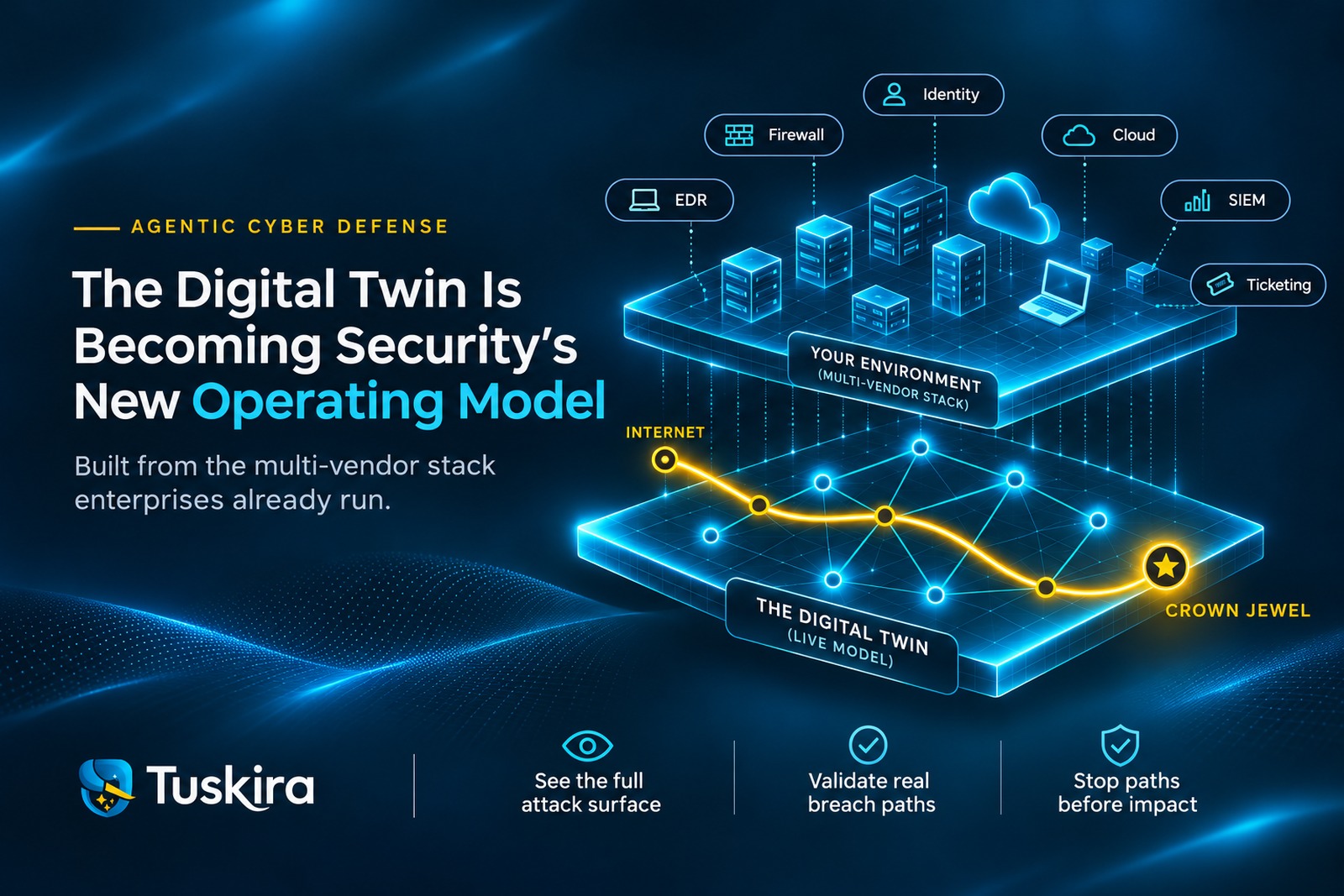
Tuskira tests controls before an attack and also investigates alerts during one. It models breach paths on a live Digital Twin of your environment, checks each step against how your deployed controls are configured today, closes the open paths through approved changes to those controls, and retests. Its Iris agent investigates alerts using the same breach-path data.
In production, Tuskira confirmed a new zero-day's impact and identified a control that closes the path in 15 minutes. In a global financial-services deployment, exposure triage fell from three weeks to 30 minutes.
The main difference is scope. Cymulate's public materials cover work before an attack, including detection engineering. Tuskira covers before and during an attack from one model, so its alert investigations use the same breach-path data it used to close paths.
An example of the difference
This is an illustrative scenario to show how the two approaches differ. It isn't a customer case.
A new remote code execution CVE is published for a web application framework. Cymulate's agents pick up the advisory, run the matching attack scenarios, and report which controls detected or blocked them. If an EDR missed the behavior, Auto Mitigation can push indicators or a behavioral detection rule to that EDR, and Cymulate re-runs the scenario.
Tuskira starts with your environment. It finds the two servers running the framework, sees that only one sits on a route to the customer database, and checks the controls on that route as they're configured today. The WAF in front of it has no rule for the vulnerable endpoint, and the server's EDR policy was left in alert-only mode. Tuskira recommends a WAF rule and a switch back to block. Your team approves, Tuskira makes both changes through the tools you already run, and retests the path on the Digital Twin to confirm it's closed.
Two weeks later, an alert fires on that server. Iris already knows the server was on a path to customer data and which controls changed and when. It starts the investigation with that data and reaches a verdict faster.
Tuskira vs Cymulate, capability by capability
| Capability | Tuskira | Cymulate |
|---|---|---|
| Category framing | Agentic cyber defense, before and during the attack | Agentic cyber defense engineering, focused on validating and adapting defenses ahead of an attack |
| How testing runs | Breach paths simulated on a live Digital Twin, so validation doesn't send exploit payloads to production workloads. Vector tests the perimeter from the outside without touching production | Production-safe attack simulations across the environment, plus Threat Studio for custom offensive scenarios |
| Control validation | Checks each step of a breach path against the live configuration of your EDR, WAF, firewall and identity controls | Continuous testing of threats, controls and exposures, with SOC validation of detection and response effectiveness |
| Breach path analysis | Breach paths across assets, identities, exposures and controls, prioritized by what reaches critical data | Exposure validation and attack-path scenarios within its simulation library |
| Fixing what's open | Closes the path itself. Picks the control change that breaks it, such as a WAF rule, EDR policy, firewall rule or identity change, and makes it through the tools you already own once approved | Auto Mitigation pushes IoCs and behavioral EDR detection rules to connected controls; Mitigation Hub turns findings into tasks |
| Proof after the fix | Retests the same path on the Digital Twin and records it as closed, with the evidence | Re-runs attack scenarios after mitigation tasks close |
| Detection engineering | Works with the detections you already run, so nothing has to be rebuilt | Detection Studio validates, maps and tunes SIEM detection rules |
| Zero-day response | Quell checks reachability, tests existing controls, applies a compensating control with approval and revalidates | Agents assess exposure to new threats, CERT advisories and KEV entries against existing validation results |
| Alert investigation | Iris triages and investigates L1 and L2 alerts with breach-path and blast-radius context, returns a verdict with a confidence score and full reasoning, and stages containment for approval | Not positioned as an alert investigation or incident response product |
| Integrations | 200+ out-of-the-box integrations | Integrates with dozens of security controls and vulnerability assessment tools |
Where Cymulate fits
Cymulate fits teams whose main need is an attack simulation library and a detection engineering workflow for SIEM rules.
Why teams choose Tuskira
Tuskira tells you which paths are open in your environment today, closes them through the controls you already own before the patch ships, and gives the SOC that same data when an alert fires. Validation runs on a model of your environment, so nothing is attacked in production.
Can you run both?
Yes. Some teams use attack simulation to tune detections, and Tuskira to validate and close breach paths and investigate alerts. The products overlap mainly on control validation.
For more on the category, read What is agentic cyber defense? or compare more platforms in the best attack path analysis tools.
Frequently asked questions
Is Tuskira a Cymulate alternative?
Yes. Both test your controls before an attack and both push changes to controls. Tuskira also validates breach paths on a Digital Twin instead of production, closes them through the controls you own, and investigates alerts during an attack. Teams that use Cymulate's detection engineering for SIEM rules can keep that workflow alongside Tuskira.
What is Cymulate agentic cyber defense engineering?
It's Cymulate's name for its approach to testing, prioritizing and adjusting defenses. It includes exposure validation, Vero AI, Cowork agents, Detection Studio and Auto Mitigation. All of it covers work before an attack.
Does Cymulate do incident response or alert triage?
Cymulate's public materials don't describe alert investigation or incident response. Cymulate tests how well SOC detection and response work. Tuskira's Iris agent triages and investigates alerts.
Does Tuskira run attacks against production?
No. Kairo simulates breach paths on the Digital Twin, so it doesn't send exploit payloads to production workloads, and Vector tests the perimeter without touching production.
Put the difference to the test
Bring one breach path your team worries about and one control you rely on. We'll validate the path on your environment, close it and confirm it's closed. Request a demo.

What Is Agentic Cyber Defense? Definition, How It Works and What to Ask
The Digital Twin Is Becoming Security's New Operating Model