How One Security Context Graph Connects Exposure and Response
Editor's note: what this article calls the Security Context Graph is now called the Security Data Fabric. The name changed; the technology did not.
Most security stacks are a sprawl of tools that don't talk to each other. Here's how we connect exposure management and response into a single motion: four AI agents reasoning over one shared map of your environment.
The problem isn't too few tools. It's that they don't share a brain.
Walk into almost any security operations center, and you'll find the same setup. A vulnerability scanner over here. An EDR over there. A cloud security tool, an identity provider, a SIEM trying to stitch some of it together. Each one is good at its own job. None of them sees the whole picture.
That was survivable when attackers moved at human speed. You could scan on a schedule, queue the findings, and respond after the fact. Nobody loved it, but time was mostly on your side.
That time is gone. Frontier AI is rapidly compressing the time between vulnerability disclosure and usable exploitation. Meanwhile, the people defending the environment are buried: per Gartner's April 2026 Emerging Tech: AI Vendor Race: Reasoning Models Are Essential for Preemptive Cybersecurity, a single human analyst can realistically handle somewhere around 1,800 alerts a year, and more than an hour of dwell time often disappears just stitching one attack together by hand across disconnected tools. Each tool only ever sees one chapter of the story. A human has to read the whole book.
The instinct is to buy another tool. That usually makes it worse: more consoles, more alerts, more things to correlate manually. The problem is structural, and fixing it takes an architectural shift, not another console. Your people have become the integration layer. Every gap between tools, and there are often several in a single investigation, is a gap a human has to close, in their head, at 2 a.m.
We built Tuskira to remove that job. Put every signal on one shared map, and let AI agents reason over it together, so exposure, detection, investigation, and response stop living in separate silos.
One map: the Security Data Fabric
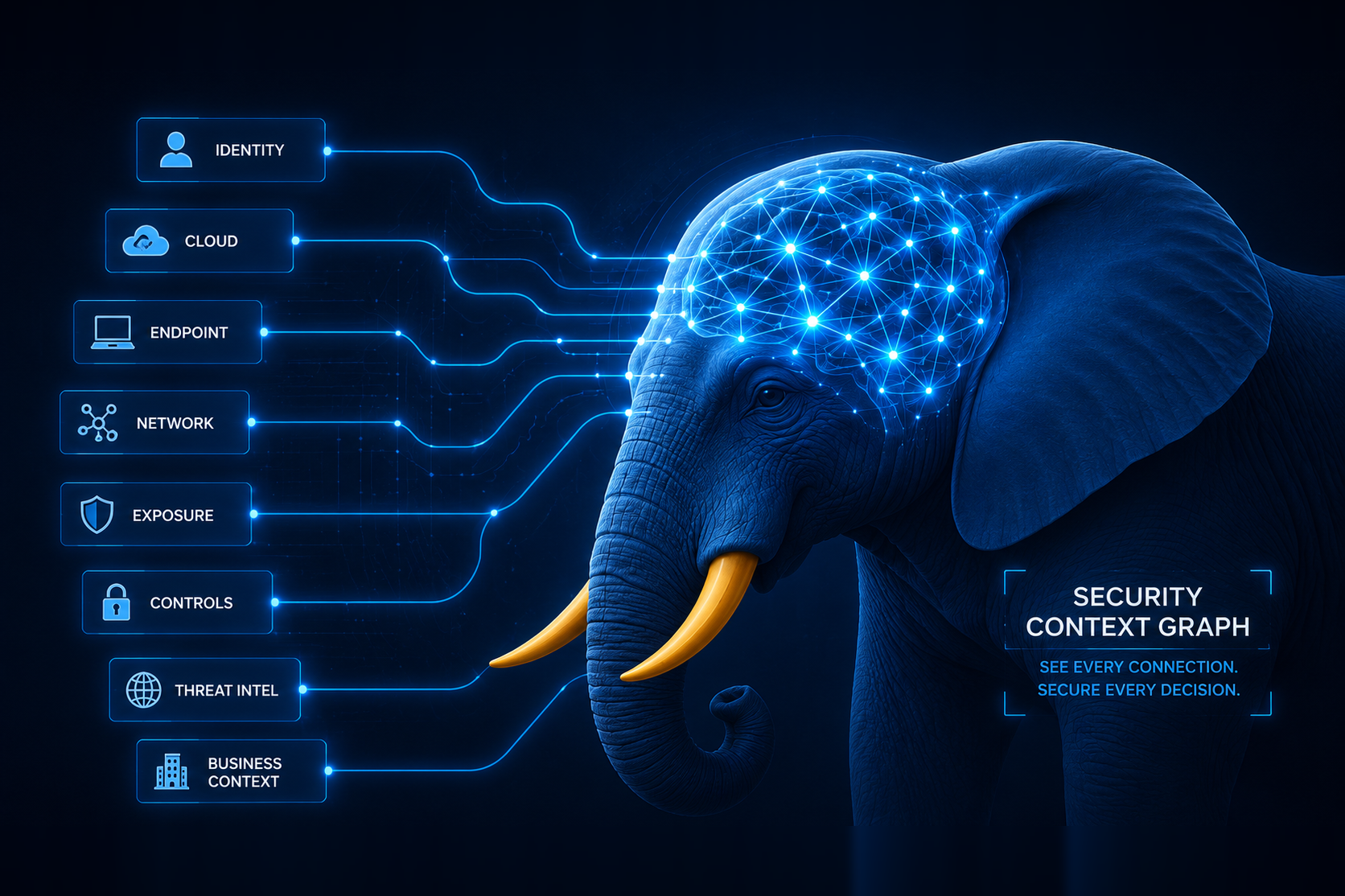
Everything in the platform sits on top of a single foundation we call the Security Data Fabric and the digital twin built on it: a live model of how your infrastructure, identities, and defenses fit together.
Here's what it does in plain terms. It takes signals from the tools you already run, spanning identity, cloud, endpoint, network, exposure findings, security controls, and threat intel, and normalizes them into one connected model. Instead of ten dictionaries that don't agree, there's one. Every agent and every analyst reasons over the same truth.
Two design choices matter here:
- It works with what you own. The graph is built from 150+ integrations across your existing stack. You're not ripping anything out.
- It doesn't require another centralized log repository. Tuskira maintains the connected security context it needs and retrieves current evidence from the relevant source systems when an investigation requires it. You don't have to duplicate every raw event into another data lake before Tuskira can reason over your environment.
The payoff is subtle, but the gains are enormous. When a signal fires, it doesn't become alert #11,000 in a queue. It lands on the map, right next to the over-privileged identity it used, the workload it can reach, and the control that was supposed to stop it. Context isn't something an analyst assembles later. It's already there.
Four agents, two jobs
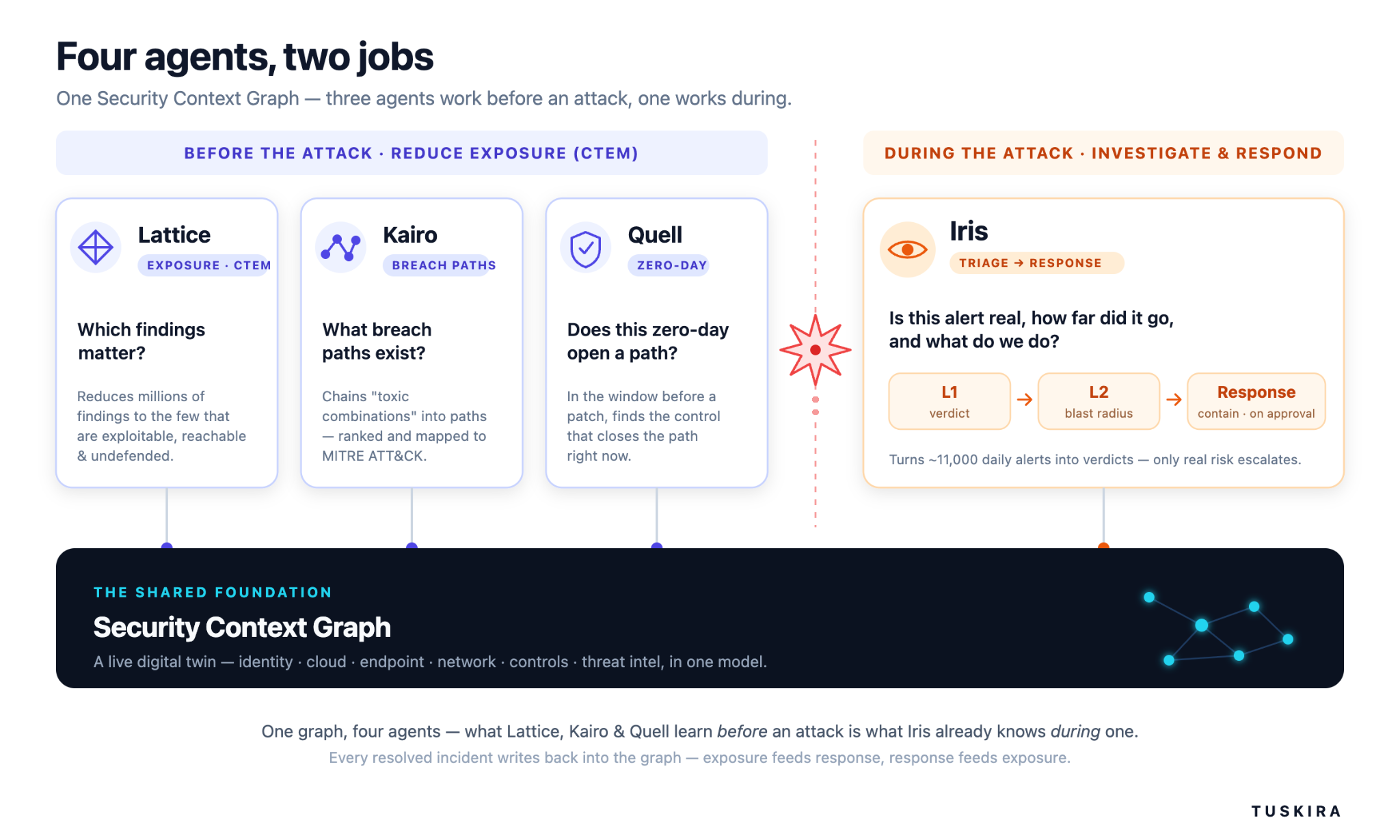
On top of that shared graph, Tuskira runs four specialized AI agents. The easiest way to understand them is to split them into a proactive motion and a reactive one.
Proactive: reduce breachable exposure. This is Continuous Threat Exposure Management (CTEM), and three agents handle it: Lattice, Kairo, and Quell.
Reactive: investigate and respond. This is the SOC's live workflow, and one agent runs the triage-to-response workflow end to end: Iris, covering L1 and L2 triage plus response.
They're not four products bolted together. They're four reasoning engines drawing on the same graph, which is what lets the proactive and reactive sides feed each other. More on that in a minute. First, what each one does.
Lattice: “Which of these millions of findings matters?”
Every scanner you own generates findings. Most teams drown in them. Lattice is the CTEM agent that cuts the pile down to the part that's real: the findings that are exploitable, reachable, and currently undefended. A critical CVSS score on an unreachable asset may be far less urgent than a medium-severity flaw sitting on a reachable path to a critical system.
That's a deliberate break from severity-score security. CVE and CVSS ratings describe a flaw in isolation; they can't see your network, your identities, or your compensating controls. Lattice reads risk from the digital twin instead: what's reachable, what's defended, and what touches something that matters.
And because the graph knows which controls stand between a finding and the assets behind it, Lattice's shortlist doubles as a defense-optimization map. Often the fastest way to take a finding off the board is a control change you can make today, not a patch you'll wait weeks for.
In one global financial-services deployment, this took 12.3 million findings down to about 0.46% actionable risk. The remaining findings did not require immediate action. Lattice's shortlist is what gets handed to the next agent.
Kairo: “What breach paths exist?”
Attackers don't respect tool boundaries, and neither does Kairo. It takes Lattice's shortlist plus the identity, cloud, endpoint, and control context in the graph, and maps how those pieces chain together into a traversable path to something that matters.
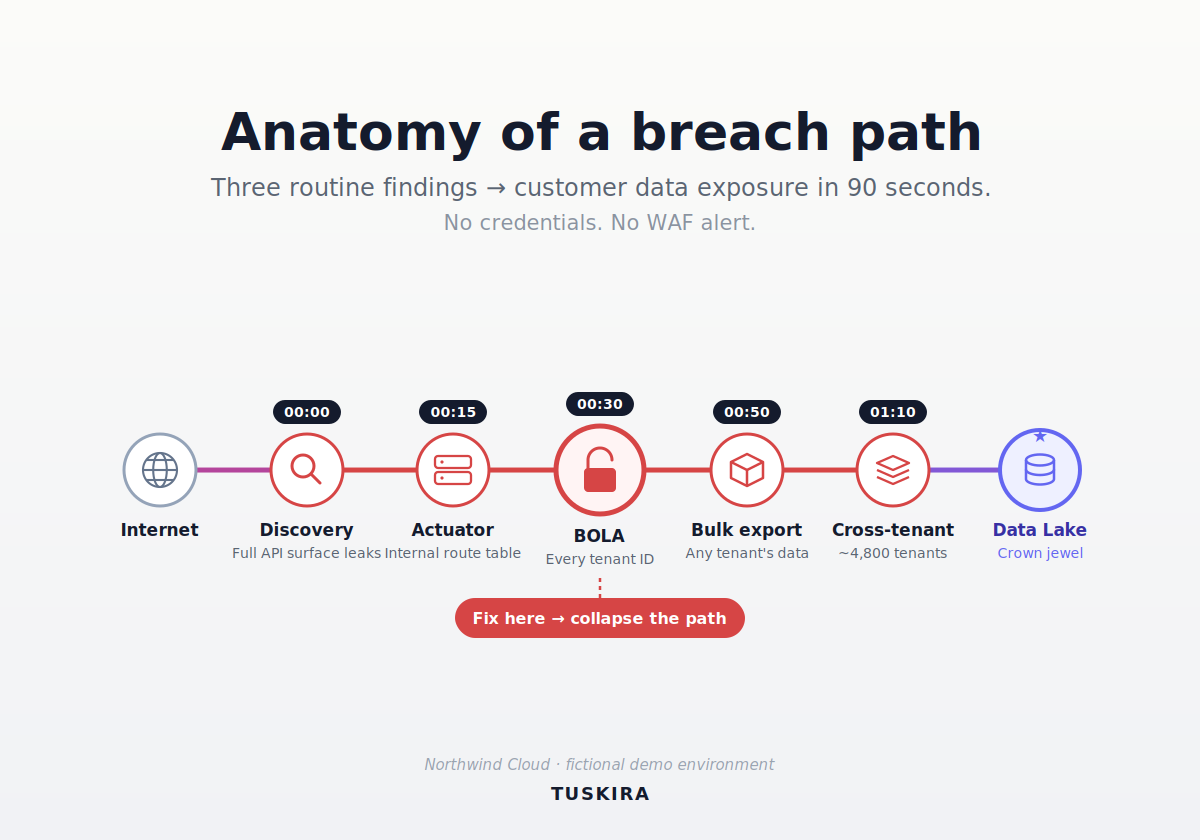
This is the “toxic combination” idea. A suspicious sign-in, an endpoint pivot, a cloud trust relationship, an exposed workload, some unusual data movement: each looks routine on its own. Chained together, they're a breach path. Kairo surfaces those combinations, ranks each path by how exploitable it really is, and maps it to MITRE ATT&CK so it's legible to your team.
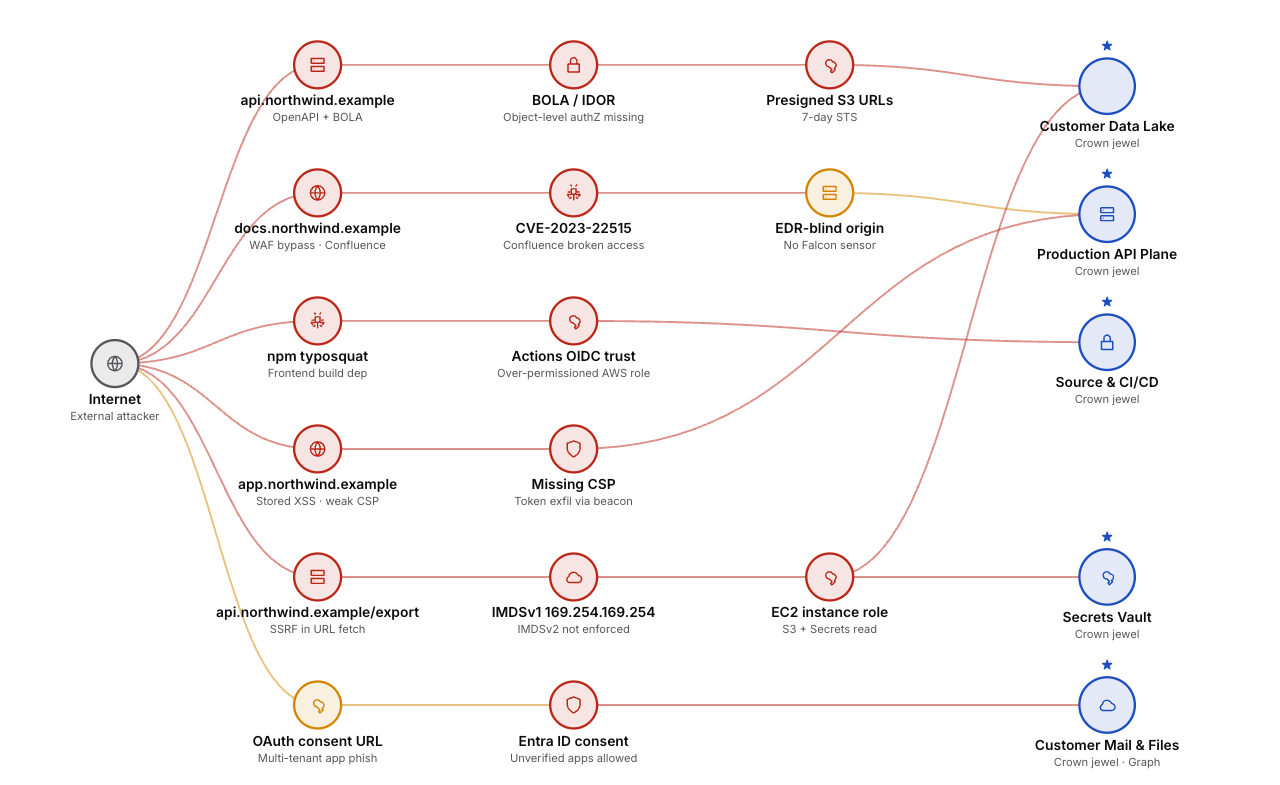
Two things make it practical rather than academic. Residual path detection finds the paths that are still open after your existing controls and detections are accounted for: the “covered on paper, breachable in practice” gaps. And the highest-leverage control action finds the single change, one firewall rule or one IAM tightening, that breaks the most paths at once through a shared chokepoint. That's how one customer cut a 206,000-finding backlog down to a handful of real risks closed with just five policy changes. As our CEO puts it, the goal is to move teams “from counting findings to building breach resilience.”
Kairo's map of paths feeds two places: Iris, for when something fires, and Quell, for when the world changes overnight.
Quell: “Does this new zero-day open a reachable path?”
A zero-day drops. A patch is days away. What do you do tonight?
Quell is built for exactly that window. When a new zero-day or critical exposure appears, it asks three questions against your environment, in order: Is it reachable here? Would our current controls stop it? And if not, which compensating control change can close the path right now? You get a straight answer and a specific action instead of a company-wide fire drill.
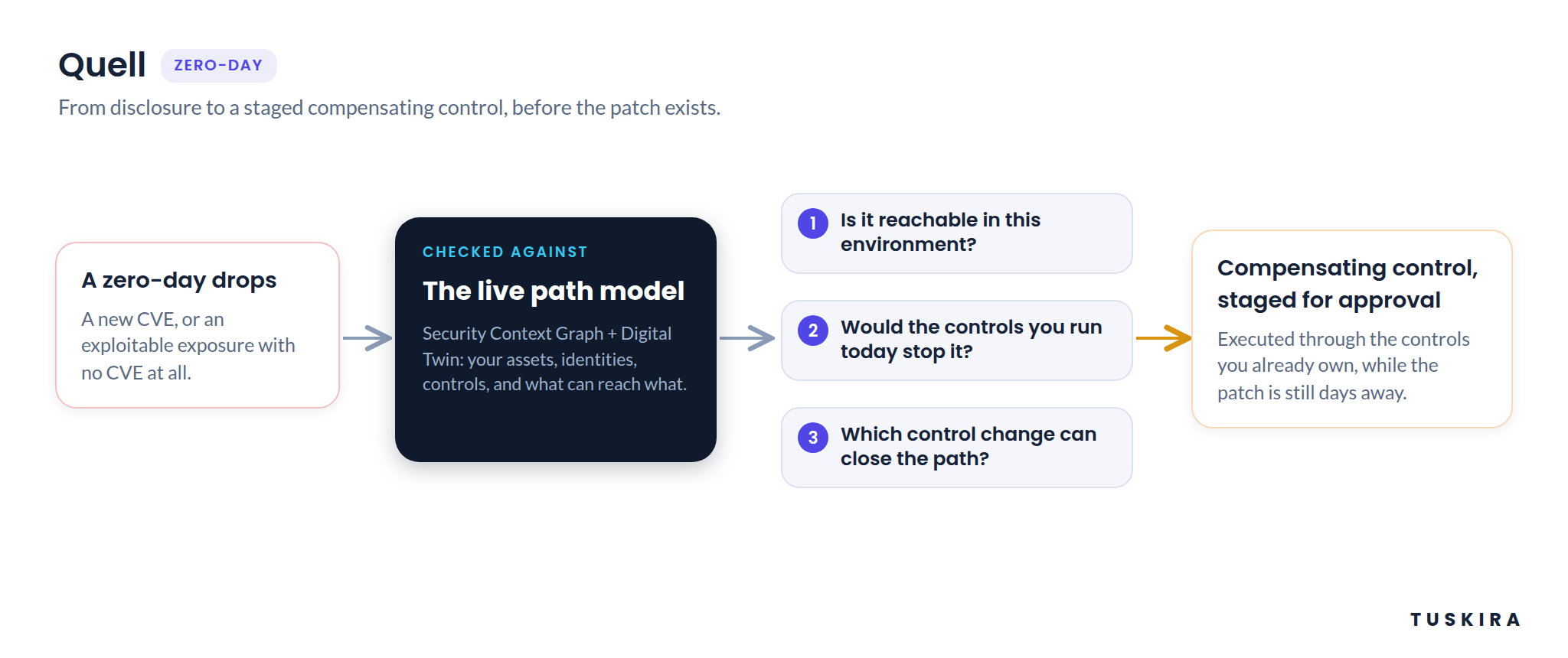
The window between disclosure and patch stops being a company-wide fire drill and becomes a workflow: assess the exposure, stage the control, close the path. For how Tuskira governs frontier-model-discovered exposures end to end, see the Agentic Control Plane for Exposure Management.
Iris: “Is this alert real, how far did it go, and what do we do?”
When something does fire, Iris runs the triage-to-response workflow end to end, tier by tier:
- L1 renders a risk-based verdict on every alert in seconds, with a confidence score and a full reasoning chain attached. Crucially, it decides whether an alert is meaningful risk, not just whether it's technically malicious. That distinction is what kills the noise.
- L2 maps the blast radius across the full path and validates the kill chain: did this happen the way the alert implies, and how far could it go?
- Response assembles the containment, scoped by the policies you set.
Instead of ~11,000 daily alerts landing on humans, Iris turns them into verdicts and escalates only what's real.
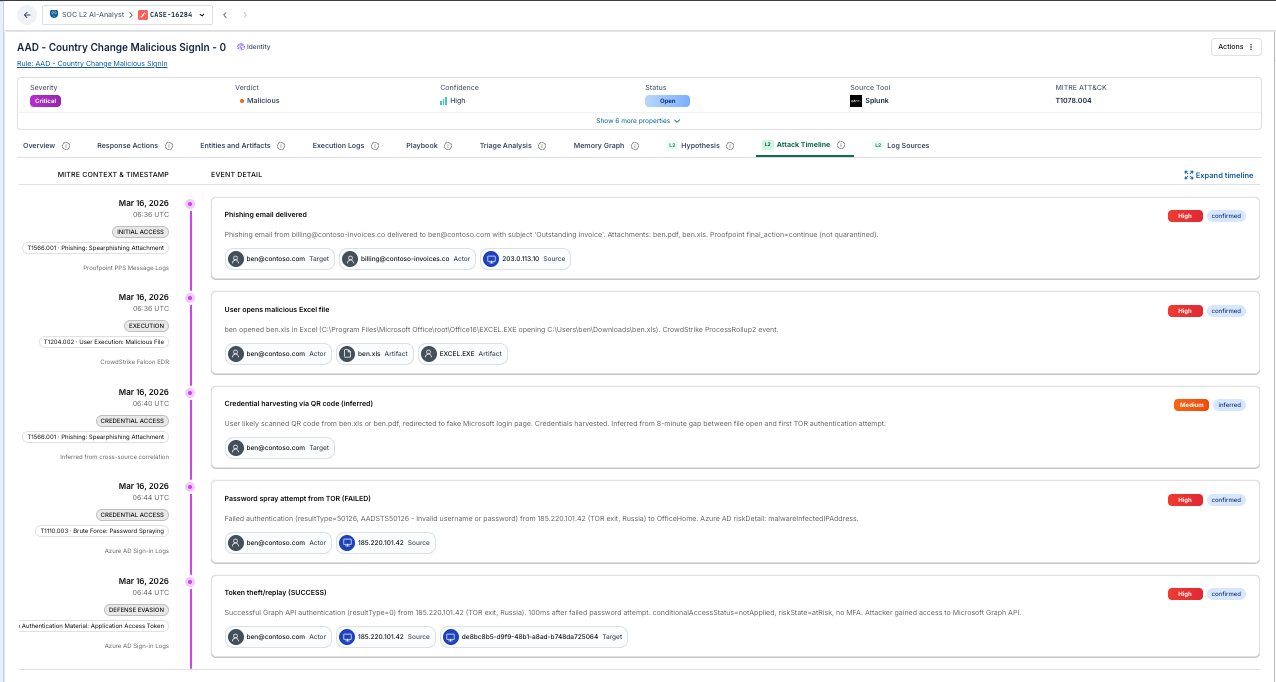
Don't take our word for the scale. Gartner's April 2026 research note cites Tuskira's own deployment data:
“Data from Tuskira AI demonstrates that an AI agent can handle up to 2,000 security incidents per day — compared to 1,800 to 2,000 for a human analyst per year — freeing human experts to focus on edge cases and high-value anomalies.”
Gartner, Emerging Tech: AI Vendor Race: Reasoning Models Are Essential for Preemptive Cybersecurity, April 2026
The part that makes it a platform, not a bundle
Here's the piece most “AI SOC” pitches skip, and it's the whole point.
When Iris investigates an alert, it doesn't start from a blank page. The breach paths Kairo already mapped are sitting right there in the graph, so the moment a sign-in trips, Iris already knows what that identity can reach and what's downstream. Blast radius isn't a research project. It's a lookup.
And it runs the other direction too. Every incident Iris validates and closes writes back into the graph. That updated picture changes what Lattice prioritizes next and what Kairo now considers reachable. Exposure feeds response; response feeds exposure. The graph also becomes institutional memory: the context a senior analyst carries in their head, which assets matter, which alerts have burned you before, what closed the last incident, stays in the graph instead of walking out the door with turnover.
That's the difference between a bundle and a platform. A bundle is four tools sharing a logo. A platform is four agents sharing a brain: a continuous loop where left-of-boom and right-of-boom keep sharpening each other.
In practice, that makes Tuskira a unified agentic SOC operations layer. It connects exposure management and response through one graph and acts through the controls you already own. It is not a replacement for your detection tooling or your log pipeline.
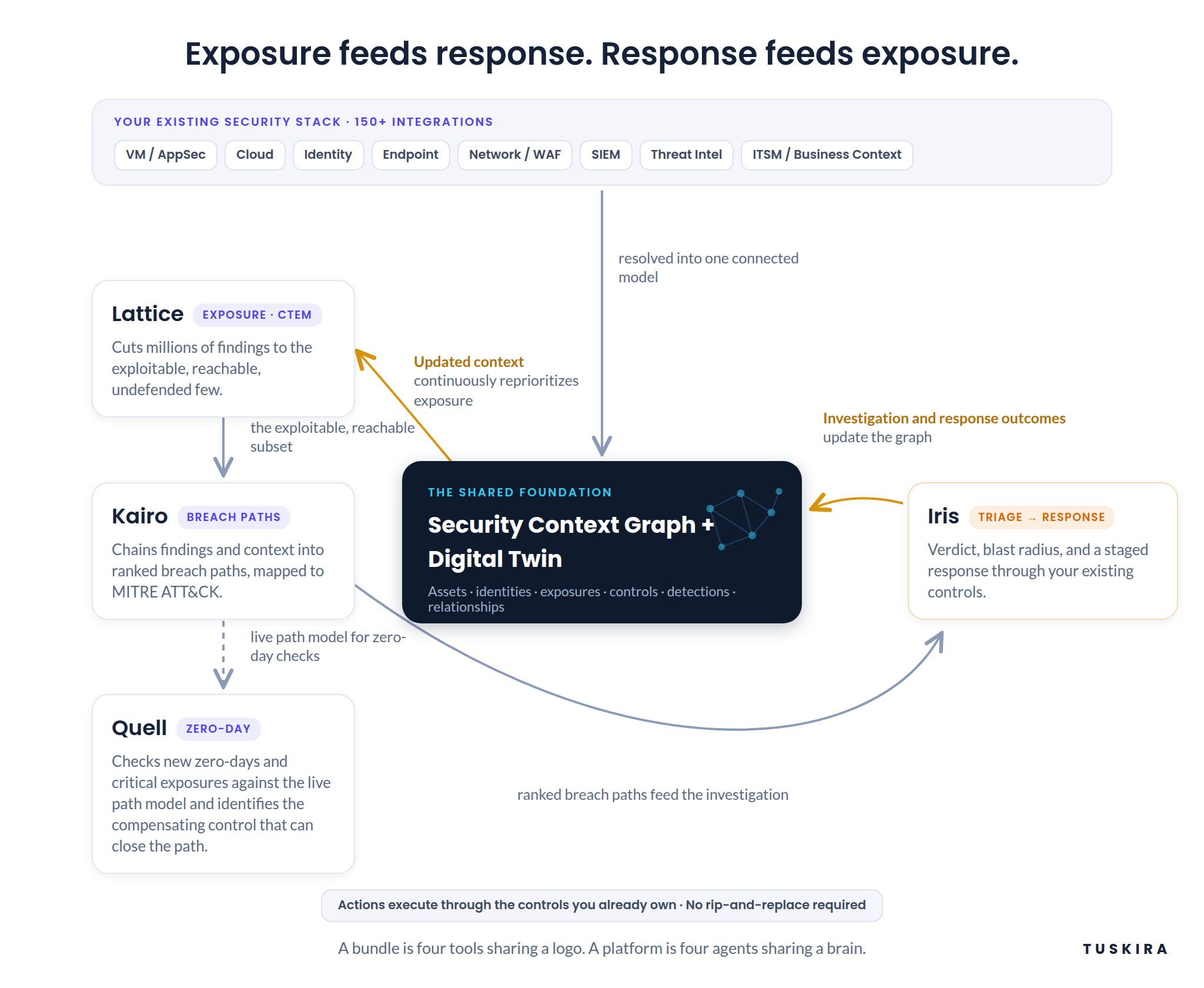
Here's how the hand-offs chain:
- Lattice answers “which findings matter?” It consumes all exposure and vulnerability findings, and produces the exploitable, reachable, undefended subset, which feeds Kairo.
- Kairo answers “what breach paths exist?” It consumes Lattice's subset plus identity, cloud, endpoint, and control context, and produces ranked breach paths mapped to ATT&CK, which feed Iris and Quell.
- Quell answers “does this zero-day open a path?” It consumes a new zero-day or critical exposure plus the live path model, and produces a reachability verdict and the compensating control that can close it.
- Iris answers “is the alert real, how far, what next?” It consumes the live alert plus Kairo's paths, and produces a validated verdict, blast radius, and scoped containment, which update the graph.
Read that list top to bottom and you can see the loop close.
The human stays in command
Autonomy without control is just a faster way to make a big mistake, so the boundaries are yours to set.
You decide what moves without you and what waits for a human sign-off. Anything high-impact or irreversible waits for a person to approve it. Every verdict, approval, and action is logged and auditable, and Tuskira assembles the response through the controls you already own: the session revoke in your identity provider, the IP block at your firewall, the IAM tightening, staged for approval rather than bolted on around them. The AI does the reasoning and the legwork. A human stays in command of what matters.
What it looks like at 2:17 a.m.
Theory is nice. Here's the whole loop on one real-shaped incident.
2:17 a.m. An off-hours sign-in to Azure AD from a new geography and an anomalous process on an endpoint fire as alerts from the tools you already run: your identity provider and your EDR.
Instead of remaining isolated in two separate systems, Tuskira correlates them against the shared context of the environment: both land on the digital twin, right beside the over-privileged identity the sign-in used and the workloads it can reach.
2:18 a.m. The Security Data Fabric already holds what the investigation needs: the identity's privileges, the workloads it can reach, the current exposure state, and the controls that stand in the way. It also holds the breach path Kairo modeled long before tonight: phished credential → MFA bypass → admin escalation → cross-account role → a database holding sensitive records. Reachable, and undetected by the controls meant to catch it.
2:19 a.m. Iris correlates the sign-in, the endpoint behavior, and the identity event into one case, validates the path, maps the blast radius, and renders a verdict: Critical, with a 96% confidence score and the full reasoning attached. Because Kairo has already modeled the environment, Iris doesn't begin the investigation from scratch. A human sees one clear case, not eleven thousand alerts.
2:21 a.m. The on-call reviews the staged response: the session revoke, the IP block, the IAM tightening, all assembled through your existing controls. One approval and the path is closed, no patch cycle, no new ticket queue. The graph updates, and the next investigation is a little smarter for it.
First verdict in about 12 seconds. Contained in roughly 4 minutes. A human in command the entire time.
The shift that matters
For years, exposure management and the SOC were two different teams, two different budgets, two different tools. That made sense when attacks were slow. It doesn't anymore.
When exposure and response share one live model of your environment, the boundary between them disappears. The breach paths you find before an attack become the blast radius you already understand during one. Shared context stops being a nice-to-have and becomes the control plane for the whole operation.
That's the model we have built, and it's why, in one deployment, triage went from three weeks to about 30 minutes. Not because anyone worked harder. Because the tools finally started sharing a brain.
See what one graph changes in your environment. Request a Breach Resilience Assessment.
Frequently asked questions
What is agentic SecOps?
It's a security operating model where AI agents reason over a shared model of your environment to handle exposure, detection, investigation, and response as one connected motion, rather than as separate tools a human has to stitch together. The agents make decisions with context, not fixed playbooks.
What is a Security Data Fabric?
It's a single, live model that normalizes identity, cloud, endpoint, network, exposure, control, and threat-intel signals into one connected picture of your environment. Every agent and analyst reasons over the same graph, so an alert arrives already surrounded by the context needed to judge it.
Does Tuskira replace my SIEM?
No. Tuskira works with your existing stack through 150+ integrations. It maintains connected security context and retrieves relevant telemetry from source systems when needed, without requiring you to duplicate all raw logs into another repository. Tuskira complements your detection tooling and log pipeline rather than replacing them.
What's the difference between Lattice, Kairo, Quell, and Iris?
Lattice decides which vulnerabilities matter (exploitable, reachable, undefended). Kairo maps how those combine into real breach paths. Quell handles zero-days and critical exposures: whether a new one opens a reachable path and which control change can close it. Iris runs the live triage-to-response workflow: L1 and L2 triage plus response.
Does the AI take action on its own?
Only within boundaries you set. Tuskira assembles and stages response actions through the controls you already own; you decide which reversible, low-risk actions can proceed on policy and which wait for human approval. Every action is logged and auditable.
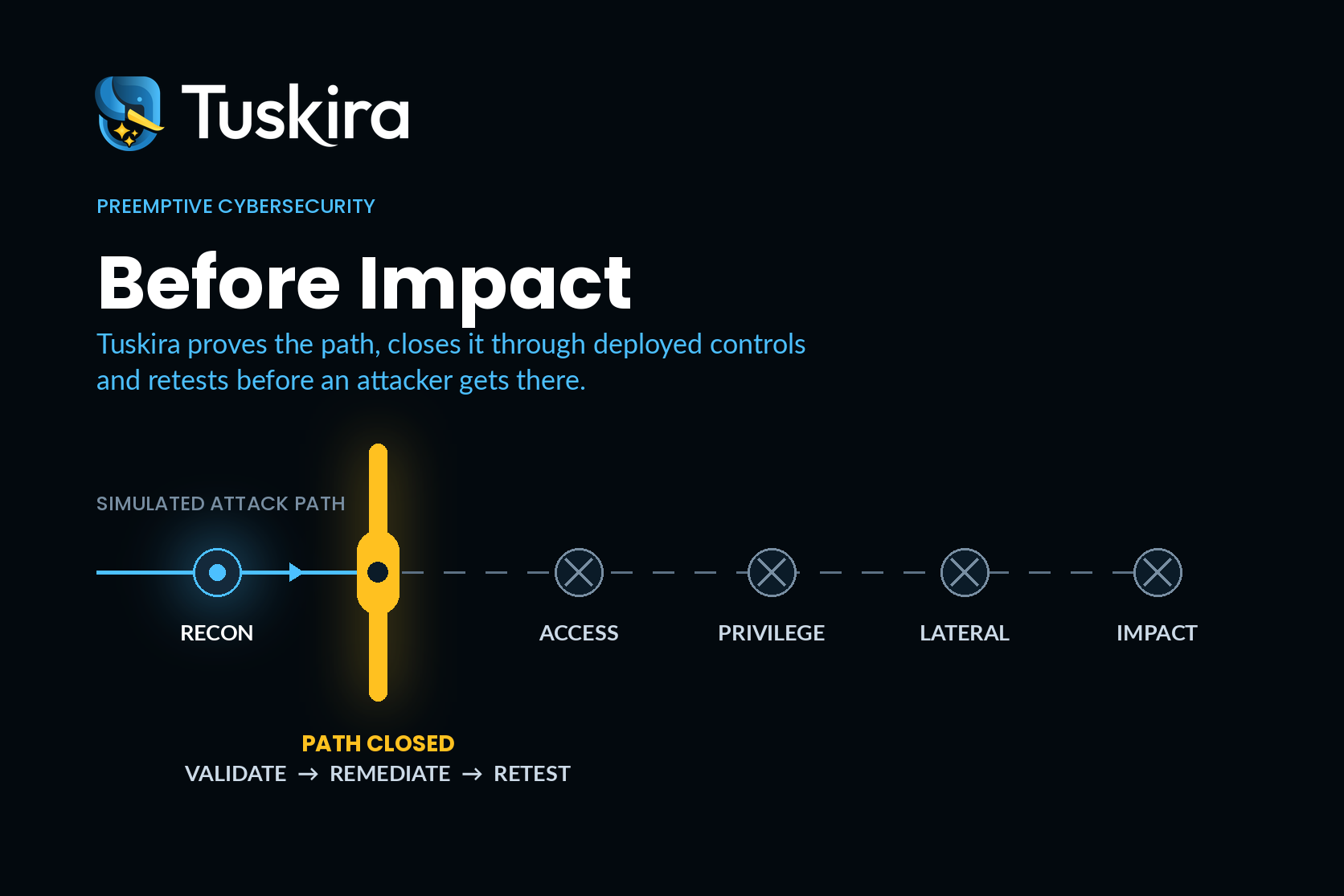
Tuskira Named in the 2026 Gartner® Emerging Tech Impact Radar: Preemptive Cybersecurity
Meet Vector: Autonomous Red Teaming That Doesn't Stop at Exposed