Tuskira Named in the 2026 Gartner® Emerging Tech: AI Vendor Race — Tech Innovators in AI Agent Reasoning
Tuskira has been named in the 2026 Gartner® Emerging Tech: AI Vendor Race — Tech Innovators in AI Agent Reasoning report, published 3 July 2026. We're pleased to be included.
What the research says about the market
The report's findings on the market include the following:
“Tech innovators are solving for agent scale by investing in solution specialization, model affordability and use-case complexity.”
“Specialization is no longer solely achieved through model investments. Increasingly, learning techniques and the agentic harness will prove foundational to delivering domain-focused value.”
“Cost is a critical barrier to the scalable adoption of reasoning agents within the enterprise, prompting investments into smaller models and distillation techniques for efficient and affordable agents.”
The views that follow are Tuskira's own.
Our approach: context, learning, and the harness
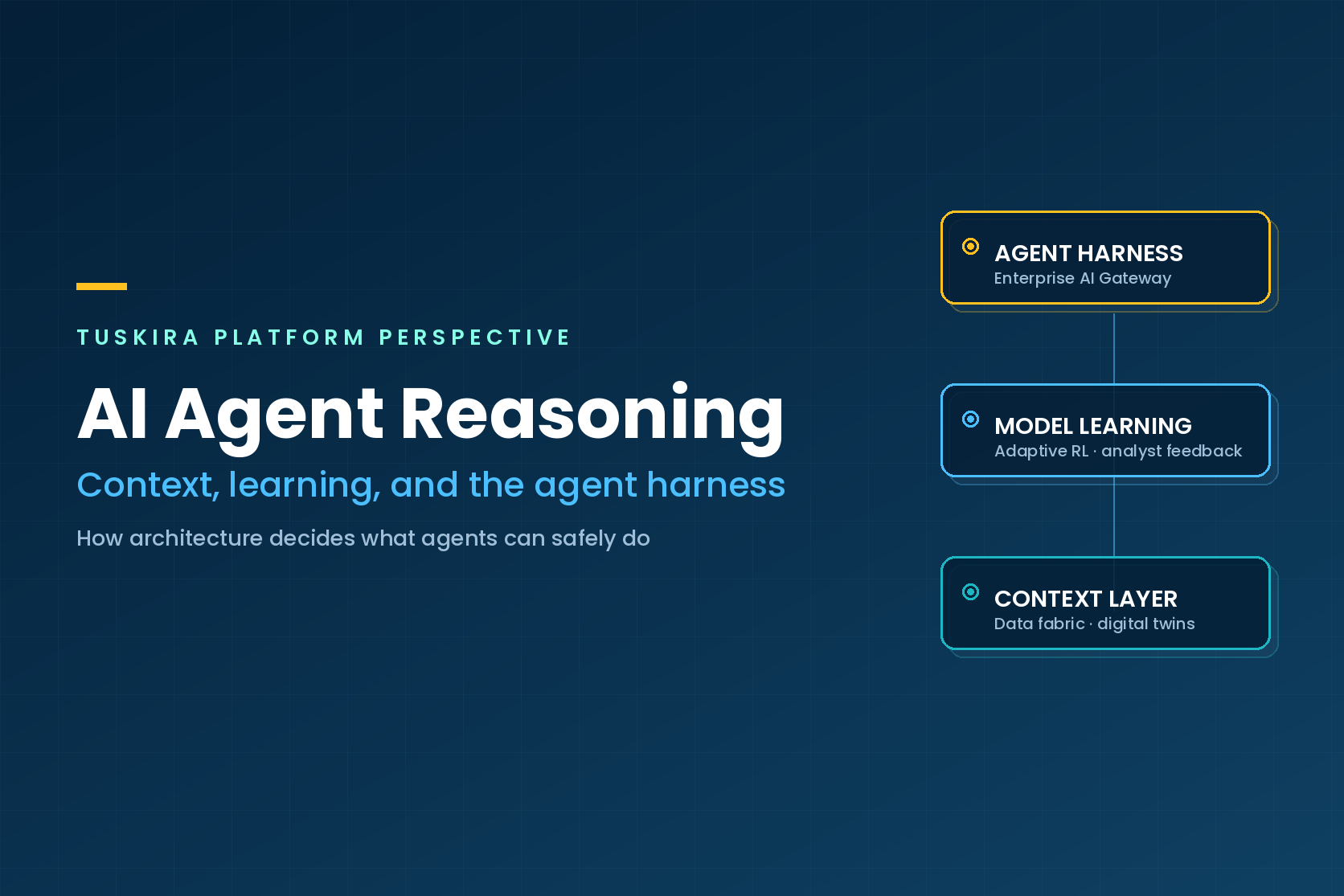
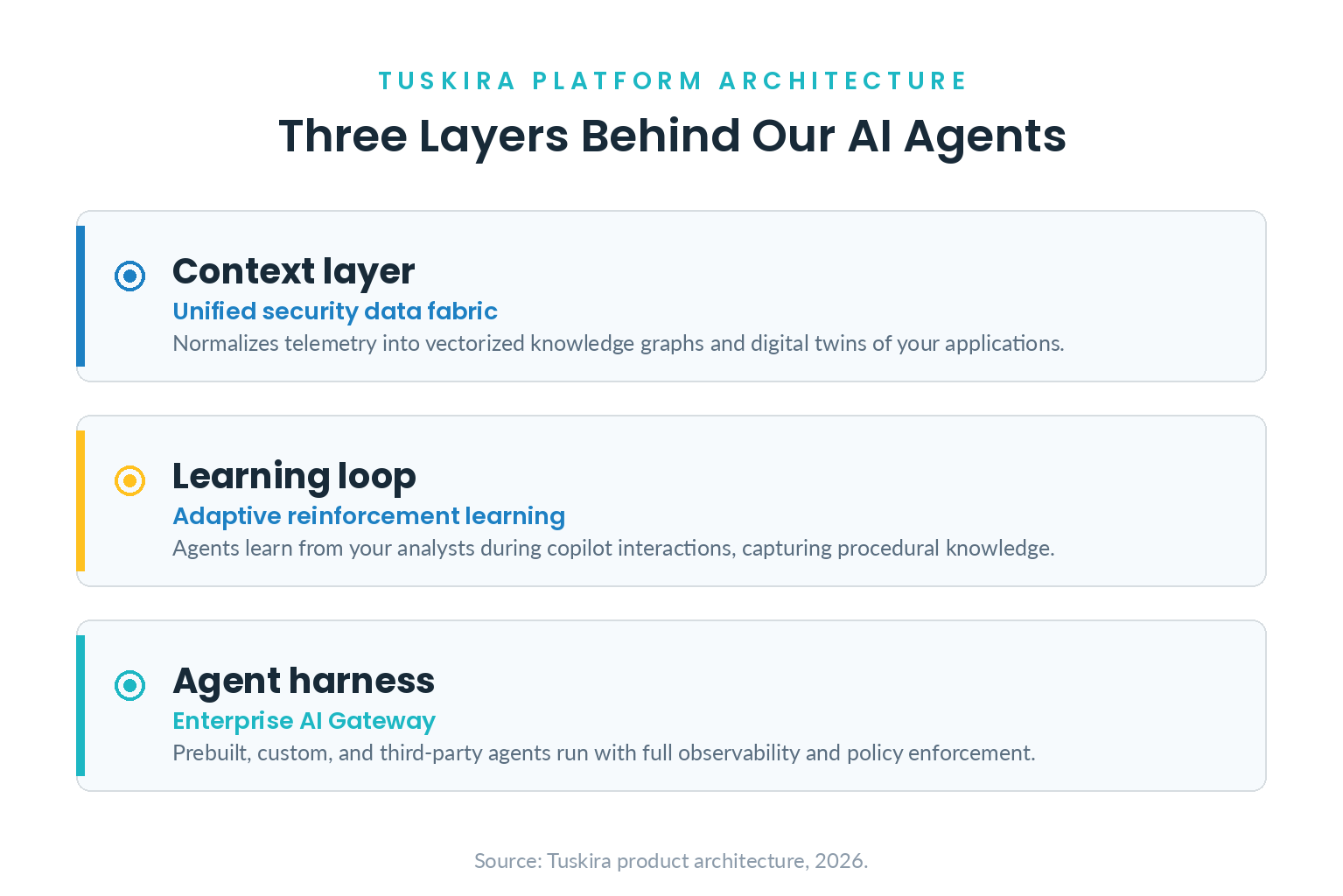
We built Tuskira on the premise that the context layer, model learning, and the agent harness matter as much as the model itself. Here is what that means in practice.
Context layer. A unified security data fabric normalizes telemetry from across your stack into vectorized knowledge graphs and digital twins of your business applications. Fine-tuned domain models reason over that context, so agents can simulate attacks virtually and determine whether your defenses would hold, based on your infrastructure rather than a generic playbook.
Learning loop. An adaptive reinforcement learning loop lets agents learn from your analysts during copilot interactions, so the tribal knowledge that usually walks out the door with staff turnover gets captured in procedural playbooks instead.
Agent harness. The whole platform functions as an agentic harness with an Enterprise AI Gateway: prebuilt threat and vulnerability agents with full observability, custom agents where you need them, and support for third-party models where you already have them.
The result is that security operations stops being a manual, siloed process and becomes a specialized, multi-agent platform automating work like Level 1 SOC triage and zero-day threat hunting.
Why this matters to us
In our opinion, model innovation alone is no longer enough. We believe platforms that pair deep organizational context with automated, auditable action will outperform fragmented toolchains.
That's the thesis Tuskira was built on. Our Unified Threat Operations platform exists because the interesting question was never “Can a model reason about security?” It was “Can agents reason about your environment, your detections, your exposures, your controls, well enough to act?”
Gartner clients can read the full research on gartner.com (subscription required).
See what Tuskira's agents can do in your environment. Request a demo.
Gartner, Emerging Tech: AI Vendor Race — Tech Innovators in AI Agent Reasoning, Danielle Casey, Radu Miclaus, Aapo Markkanen, Evan Zeng, Vibha Chitkara, Walker Black, 3 July 2026.
GARTNER is a trademark of Gartner, Inc. and its affiliates.
Gartner does not endorse any vendor, product or service depicted in its research publications, and does not advise technology users to select only those vendors with the highest ratings or other designation. Gartner research publications consist of the opinions of Gartner's research organization and should not be construed as statements of fact. Gartner disclaims all warranties, expressed or implied, with respect to this research, including any warranties of merchantability or fitness for a particular purpose.
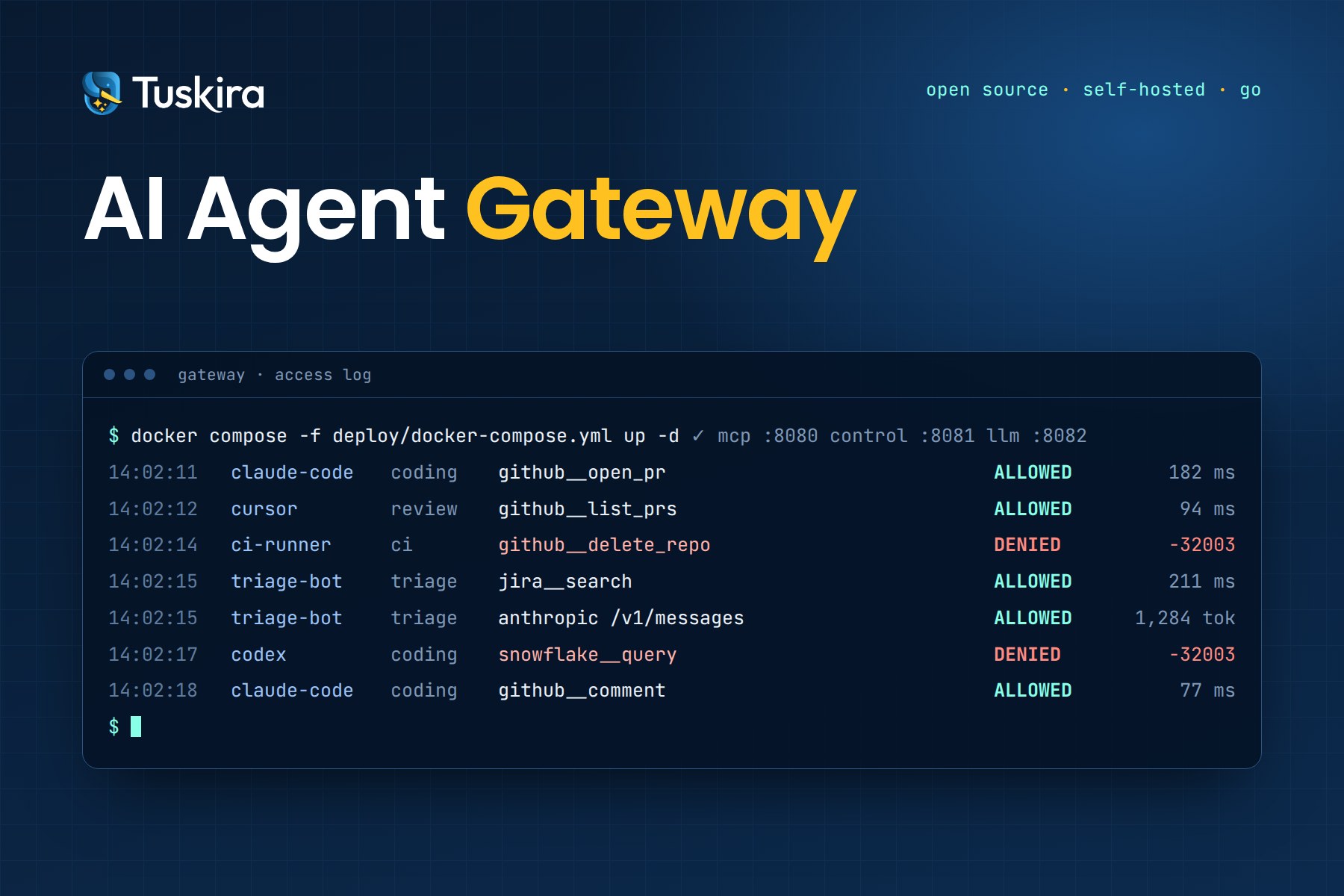
Tuskira Open Sources the AI Agent Gateway
Tuskira Named in the 2026 Gartner® Emerging Tech Impact Radar: CSP Infrastructure and Operations