Tuskira Named in the 2026 Gartner® Emerging Tech Impact Radar: Generative AI
Tuskira has been named in the 2026 Gartner® Emerging Tech Impact Radar: Generative AI report, published 7 August 2026. We're pleased to be included.
What the research says about the market
The report's findings on the market include the following:
“Generative AI is facing a validation hurdle as, despite surging investment in associated technologies, returns frequently lag behind expectations, highlighting an urgent need for proven value.”
“Rapid advances in agentic AI, including expert agents and multiagent generative systems, will enable a step-change in enterprise automation, productivity, and innovation. In the near term, investing in robust AI context platforms will be absolutely essential for organizations to capture and scale the value of these agentic systems.”
“Relying on a single AI model is unsustainable amid the growing complexity and diversity of enterprise use cases. Model routing and orchestration layers are emerging as critical technologies, empowering organizations to dynamically optimize performance, cost, and risk across a portfolio of specialized models.”
The report also includes the following Strategic Planning Assumption:
“By 2028, 99% of agent platform providers will offer simulation environments, up from less than 25% in 2026.”
The views that follow are Tuskira's own.
Our take: security operations is where agentic AI has to prove itself
The gap between what agentic AI promises and what it delivers is, in our view, the defining problem of this market cycle. Enterprises have spent two years standing up pilots. Comparatively few can point to a number that changed.
We think security operations is the discipline where that question gets settled first, for an unglamorous reason: the outcomes are countable. Either an alert got triaged correctly or it didn't. Either an exposure is reachable or it isn't. Either a control would have stopped the attack or it would have failed. There is very little room for an agent to appear productive while accomplishing nothing, which is exactly the condition under which real capability becomes visible.
What an agent has to earn before it acts on its own
Three things, in our experience, and none of them is model size.
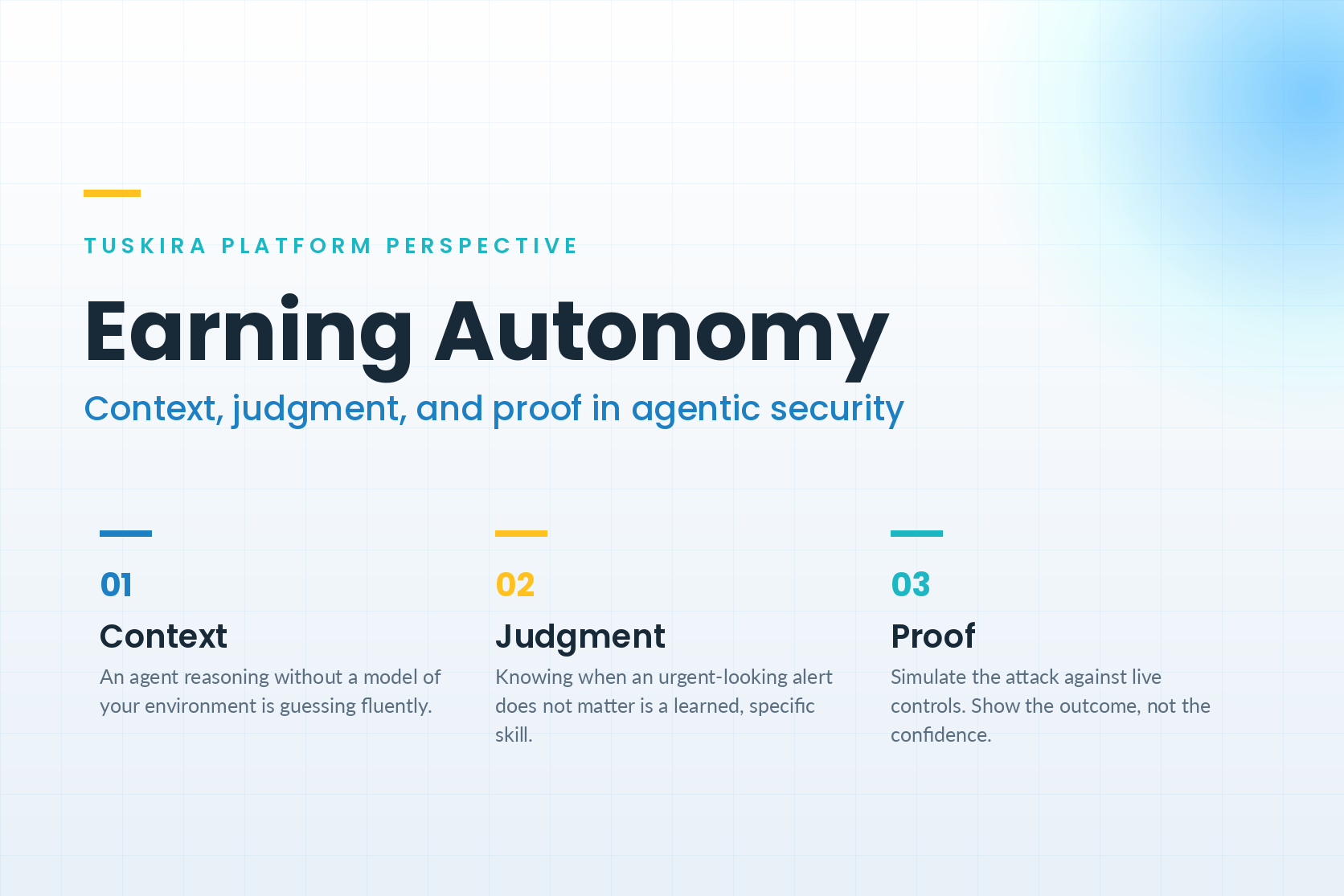
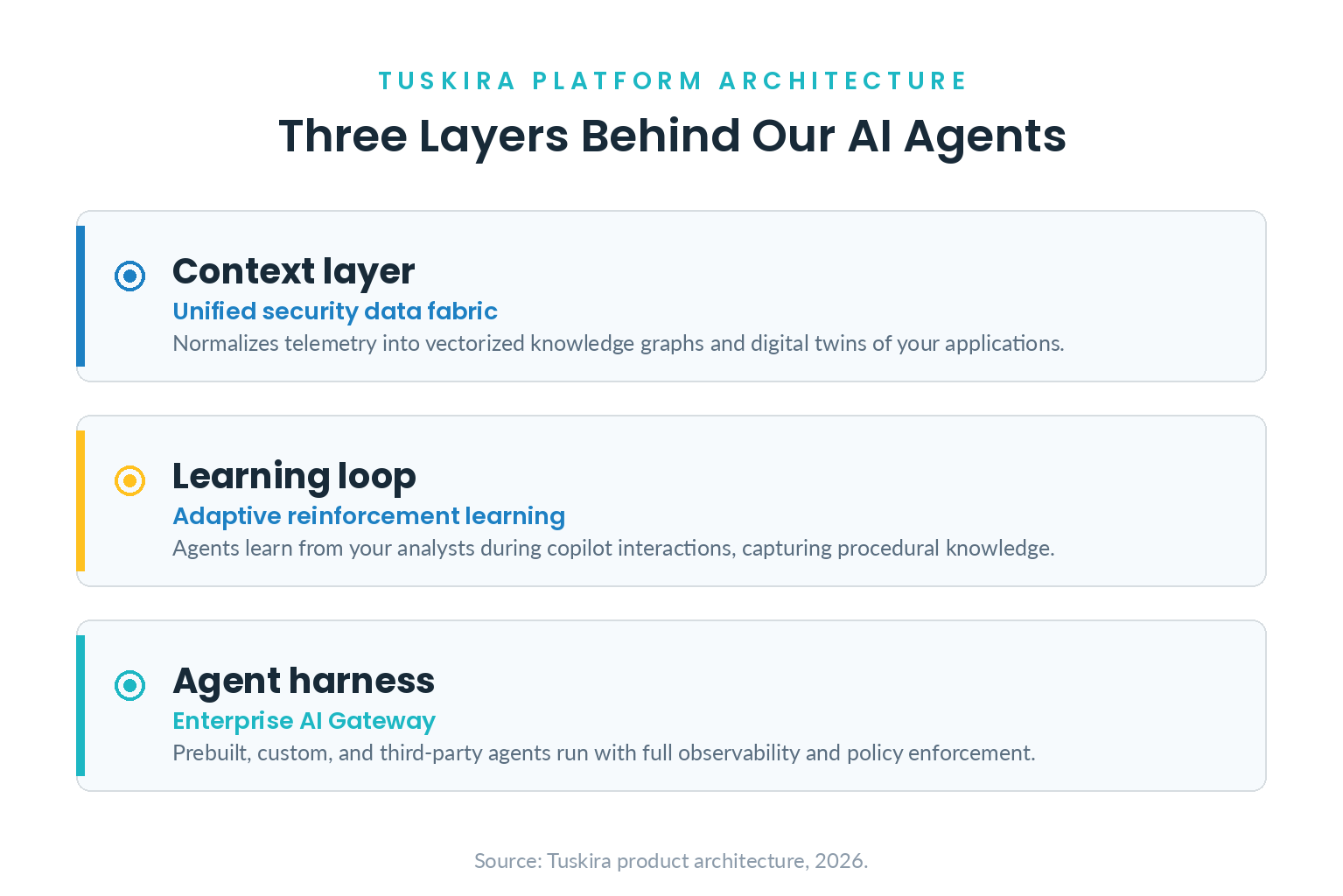
- Context. An agent reasoning without a model of your environment is guessing fluently. Our unified security data fabric normalizes telemetry from across the stack into vectorized knowledge graphs and digital twins of your business applications, so agents reason against your actual infrastructure rather than a generic playbook. We consider this the precondition for autonomy, not an enhancement to it.
- Judgment. A general model does not know how a security analyst weighs a noisy detection against a reachable exposure, or when an alert that looks urgent is irrelevant because the vulnerable path is already blocked. That judgment is specific, learned, and mostly undocumented. We encode it in our agents deliberately, because a system that cannot make that call is a system a human has to babysit.
- Proof. The failure mode we worry about most is an agent that is convincing and wrong. Simulating attack behavior against a customer's live control set turns a claim into a test: we can show whether a given threat would actually be stopped, rather than reporting that it was ticketed. We would rather be measurably right than persuasively confident.
Why this matters to us
We built Tuskira as a Unified Threat Operations platform on a bet that the hard part of agentic security was never the model. It was the context the model reasons over, the judgment it encodes, and the ability to prove the result. Those are the three things we have spent our engineering on, and they are the three things we would tell any buyer to test.
So if you are evaluating agentic AI for security operations, ours included, we would suggest a simple bar: make the vendor show you an outcome, not a workflow. Ask what the agent knew about your environment before it acted. Ask how you would know if it were wrong.
Gartner clients can read the full research on gartner.com (subscription required).
See what Tuskira's agents do in your environment. Request a demo.
Gartner, Emerging Tech Impact Radar: Generative AI, Annette Zimmermann, Anushree Verma, Ray Valdes, Danielle Casey, Aakanksha Bansal, Vibha Chitkara, Radu Miclaus, Roberta Cozza, Russ Hendy, Alizeh Khare, Tuong Nguyen, Kiumarse Zamanian, Arnold Gao, Ethan Cai, Omar Ansari, Aapo Markkanen, 7 August 2026.
GARTNER is a trademark of Gartner, Inc. and its affiliates.
Gartner does not endorse any vendor, product or service depicted in its research publications, and does not advise technology users to select only those vendors with the highest ratings or other designation. Gartner research publications consist of the opinions of Gartner's research organization and should not be construed as statements of fact. Gartner disclaims all warranties, expressed or implied, with respect to this research, including any warranties of merchantability or fitness for a particular purpose.
Tuskira Named in the 2026 Gartner® Emerging Tech Impact Radar: Preemptive Cybersecurity
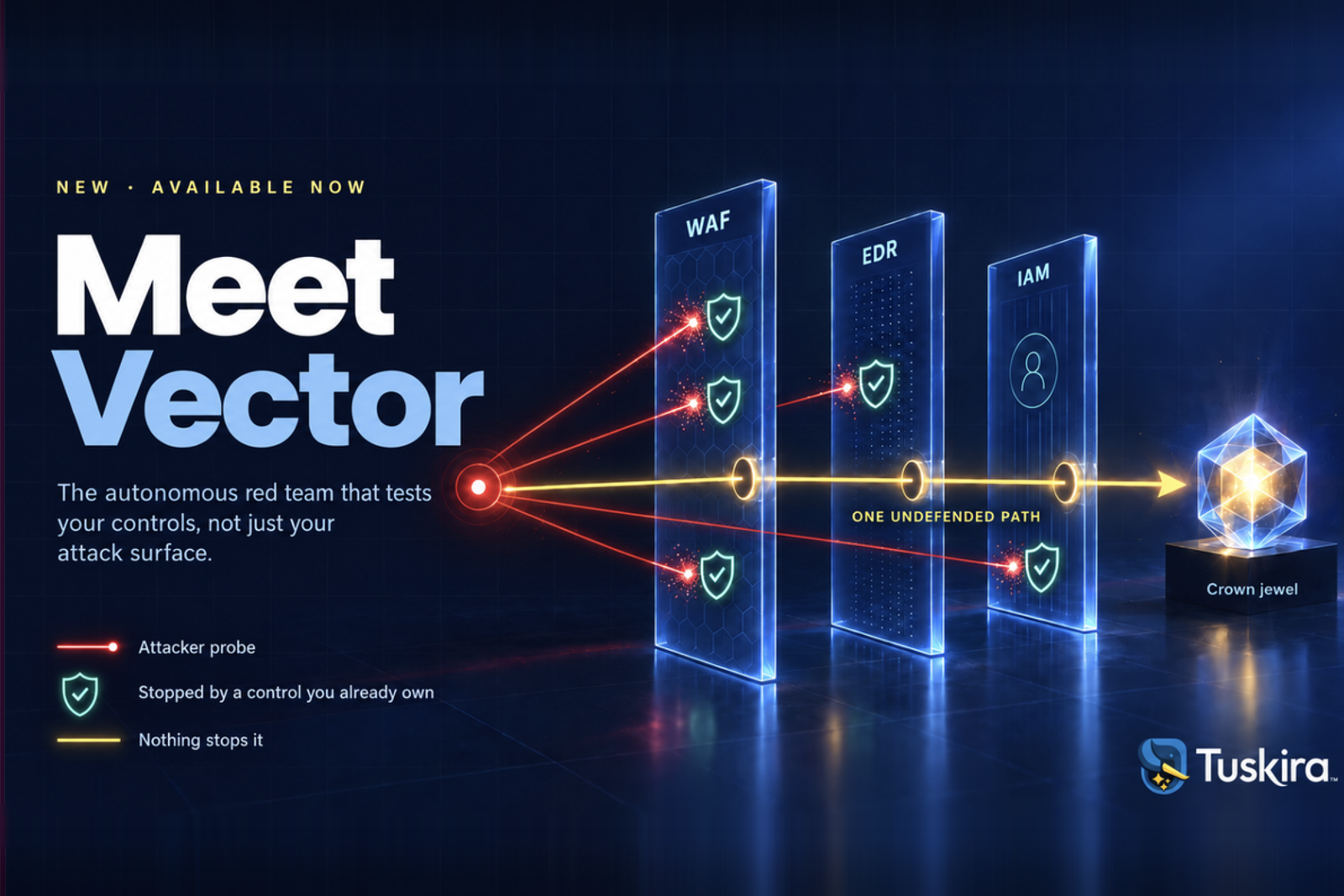
Meet Vector: Autonomous Red Teaming That Doesn't Stop at Exposed