The deadline your patch queue can't meet
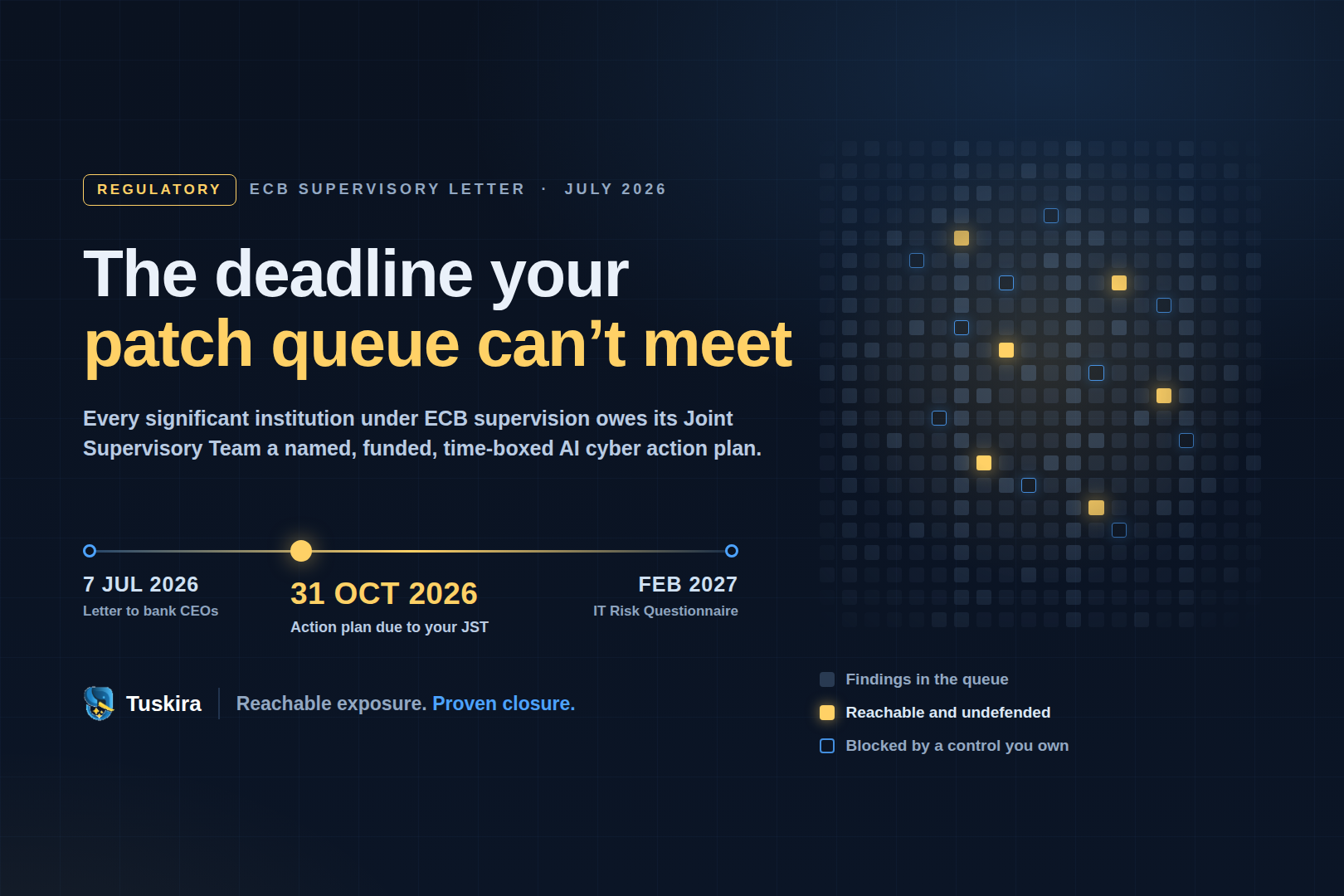
Ten weeks from now, every bank the European Central Bank directly supervises owes its Joint Supervisory Team an action plan for AI-accelerated cyber threats. Named measures. Assigned roles. Allocated resources. Implementation timelines. Due October 31, 2026.
Most of those plans are being drafted right now, and most of them will describe a faster patch cycle. That is the wrong answer to the question the supervisor asked.
What the letter says
On July 7, Supervisory Board Chair Claudia Buch wrote to the CEOs of all significant institutions under ECB supervision. Emerging AI models, the letter states, “are capable of identifying software vulnerabilities and generating functioning exploits at unprecedented speed, compressing the timeline between vulnerability discovery and exploitation.” The ECB frames this as a long-term shift in the threat landscape rather than a temporary phenomenon.
Four short-term priorities are named:
- Accelerate vulnerability and patch management at scale
- Enhance monitoring, detection and AI-enabled defensive capabilities
- Verify that third-party risk management is fit for the current threat environment
- Prioritize protection of perimeter technologies and internet-facing ICT assets
The supervisor considers this significant enough to have moved the annual IT Risk Questionnaire from September 2026 to February 2027, clearing calendar space for the work. The scope also reaches past Europe’s own banking groups: euro-area subsidiaries designated as significant institutions fall under the same supervision and the same date.
The evidence arrived before the letter did
In May, Anthropic reported that its Mythos model, running with early-access partners, had identified more than 10,000 software vulnerabilities in its first month across widely used software.
Tuskira Research measured the other half of that equation. In Tuskira Research’s May 22, 2026 snapshot, AI-driven vulnerability discovery outpaced visible Mythos-attributed remediation by approximately 16.5x, drawn from 1,596 verified vulnerabilities disclosed across 281 open-source projects in 63 days.
That ratio is the letter’s core anxiety stated as arithmetic. Every unresolved weakness in your environment is easier to find today than it was a year ago, and the finding is no longer gated on scarce human expertise.
The trap in the obvious response
Read priority one quickly and it says patch faster.
You can’t. Nobody can. Patch-and-respond was designed for human-speed attackers: scan on a schedule, queue the findings, remediate in monthly windows. When working exploits can be produced in an afternoon, a 30-day patch SLA is not a control. It is a countdown. Headcount does not rebuild the model, because the constraint was never how fast your team works. It is how fast the software supply chain, the change window, and the vendor’s own release cycle allow a fix to reach production.
The letter does not ask banks to patch everything. It asks them to strengthen controls, demonstrate defensive capability, and show accountability. That is a different assignment, and a more achievable one.
What a defensible plan proves
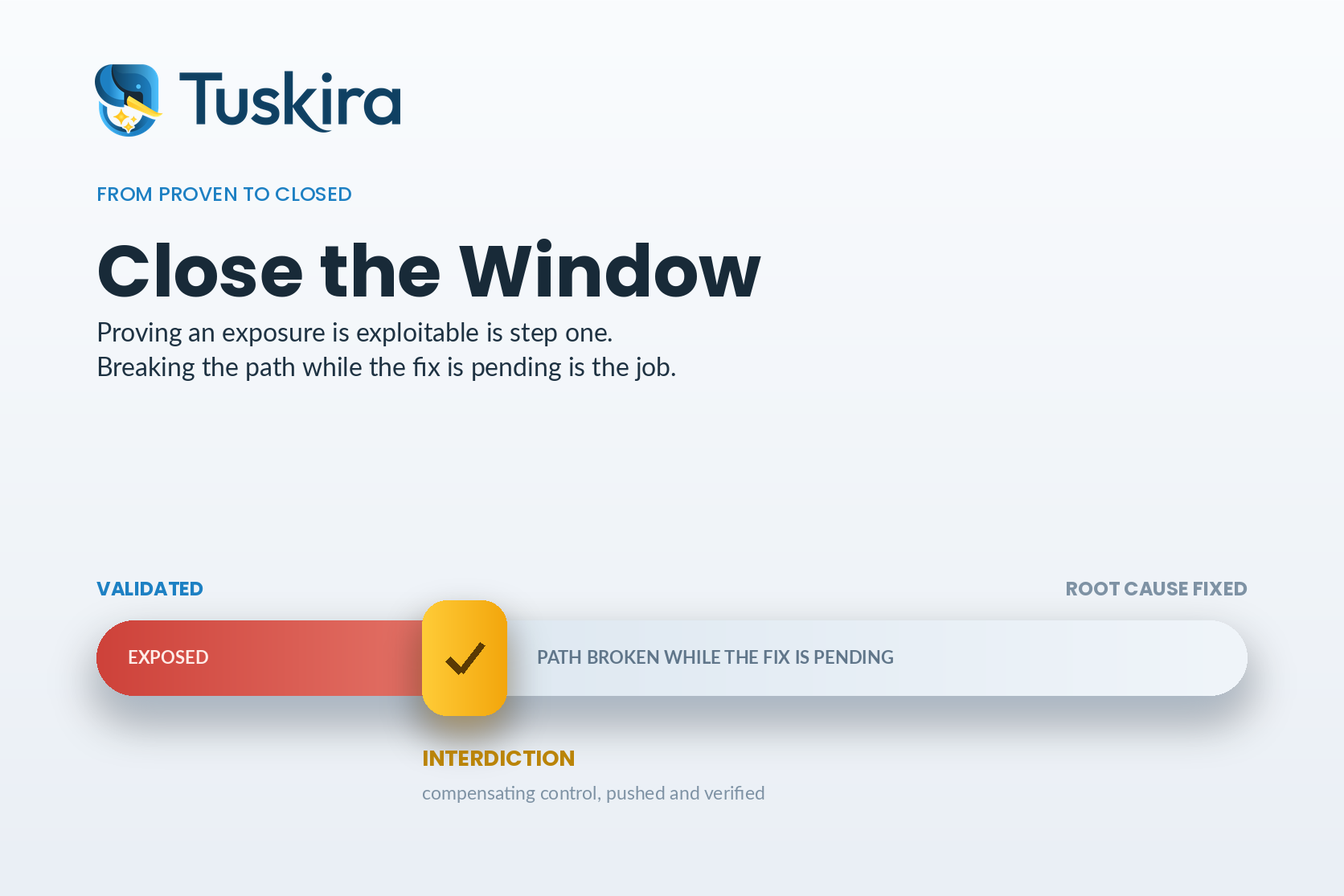
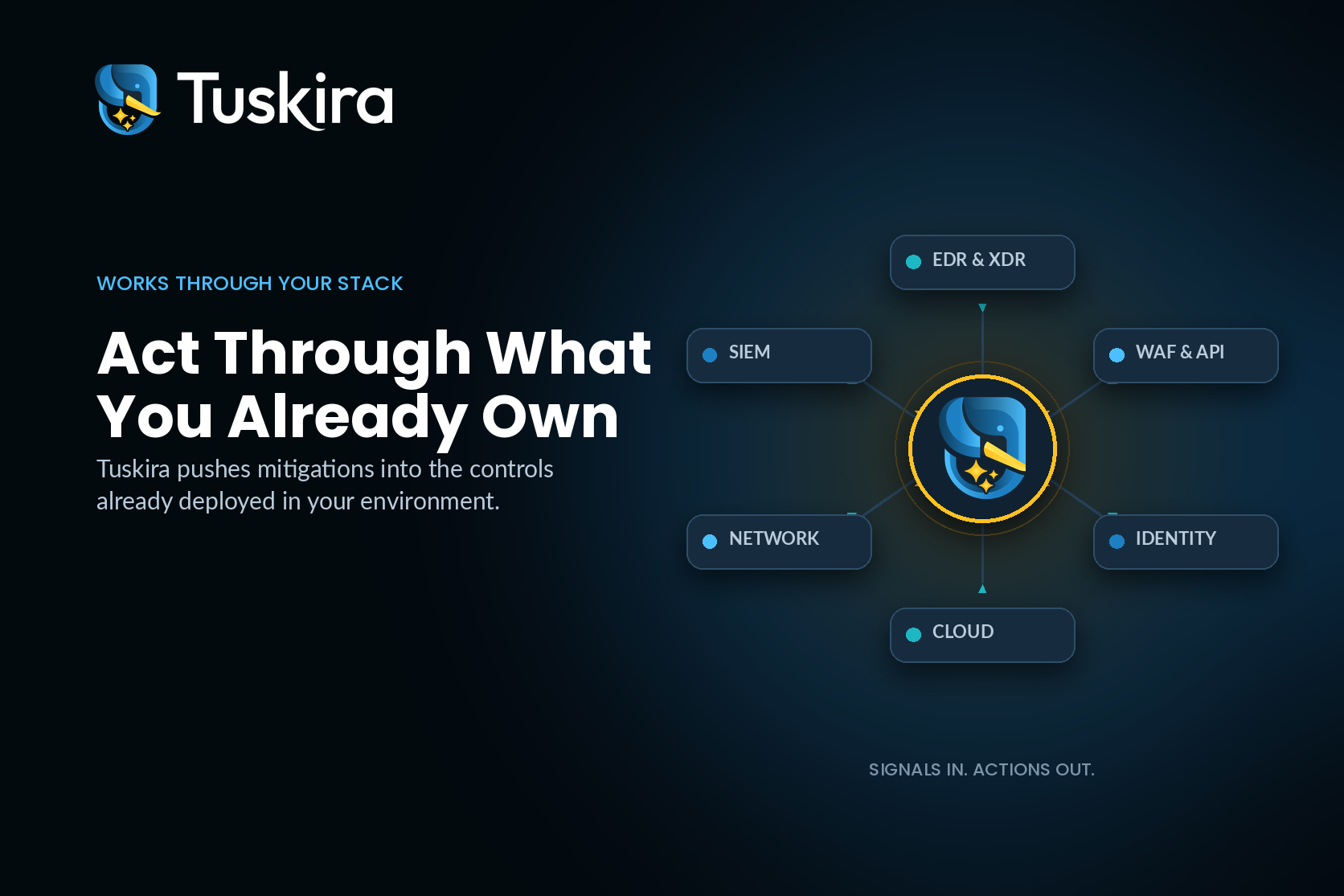
Priority 1 is prioritization, not volume. Which exposures are reachable by an attacker in your environment as deployed? Which are already blocked by a control you own: a WAF rule, an EDR policy, an identity boundary, a segmentation rule? Validating reachable exposure and applying an approved compensating control closes risk in hours while the durable fix follows on a sane engineering schedule. A supervisor can be shown that. A longer queue is not evidence of anything except a longer queue.
Priority 2 is a machine-speed evidence trail. The regulator has effectively said that machine-speed attacks require machine-speed defense. Investigation that depends on people stitching context across a dozen consoles cannot produce the record a Joint Supervisory Team will ask for. AI-driven investigation that returns a verdict, a timeline, and a blast radius, with a human approving the response, can.
Priorities 3 and 4 are the same question asked twice. Internet-facing assets, third-party software, and open-source components are called out explicitly because they are where real breach paths start. The concrete work behind that language is mapping the reachable route from an exposed asset to the systems that matter, validating whether your existing defenses would stop traversal, and severing the path.
October 31 is an evidence deadline
An action plan with named owners, budgets, and timelines is an audit artifact. What makes it credible is the ability to show, continuously, which exposures are reachable, which controls block them, and what closed the gap when none did. A unified security data fabric across the stack you already run produces that record as a byproduct of operating, rather than as a reporting exercise assembled twice a year.
Ten weeks is not long. The institutions that treat this as a document will produce a document. The ones that treat it as an operating-model question will produce proof.
Read the research: The Emerging Patch Gap
See it against your own environment: Request a demo
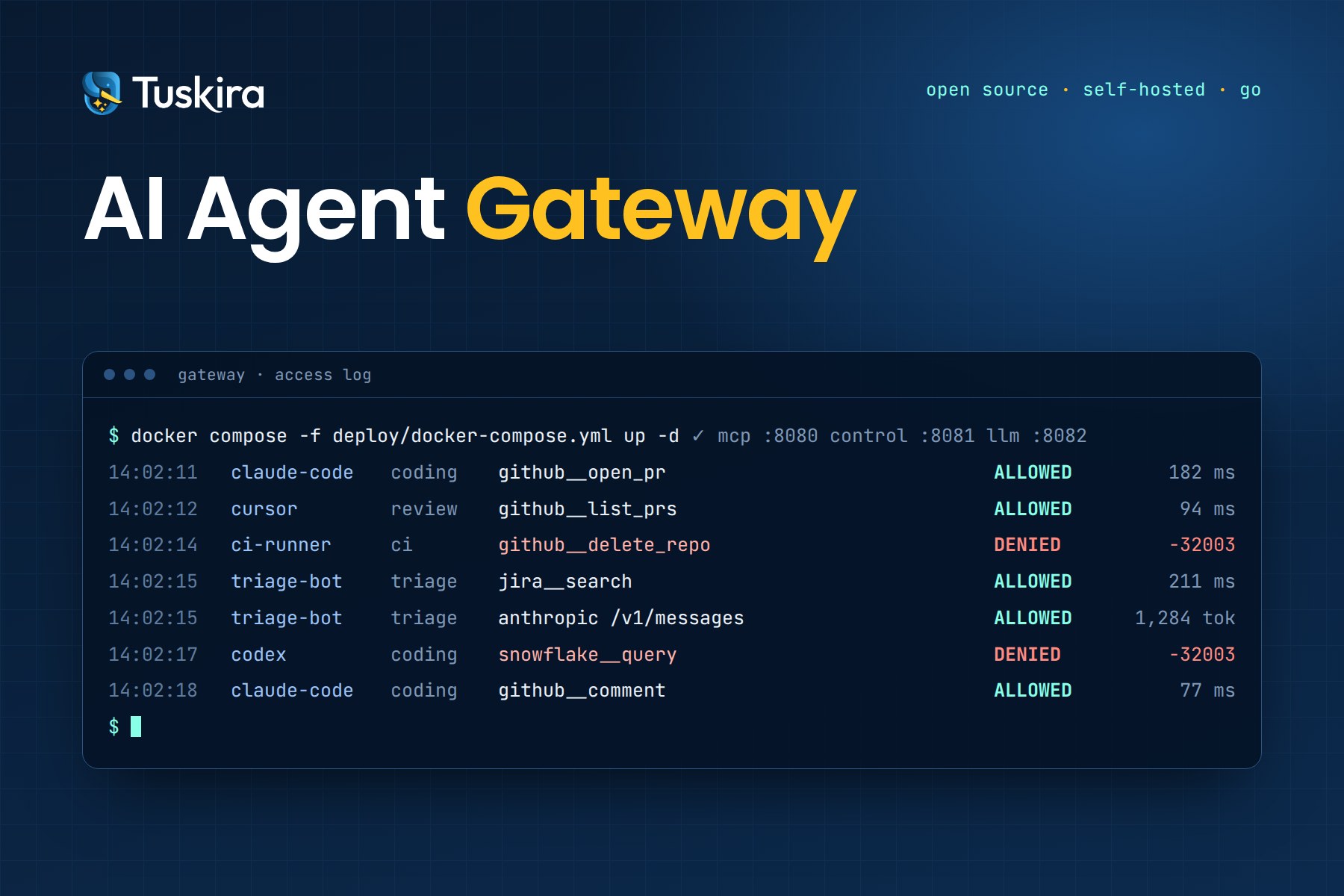
Tuskira Open Sources the AI Agent Gateway
Tuskira Named in the 2026 Gartner® Emerging Tech Impact Radar: CSP Infrastructure and Operations