Megalodon Shows Why Patching Alone Is No Longer Enough
By Harkirat Bhardwaj, Founding AI Engineering & Security Research Engineer, Tuskira Research
Six hours. That's how long it took.
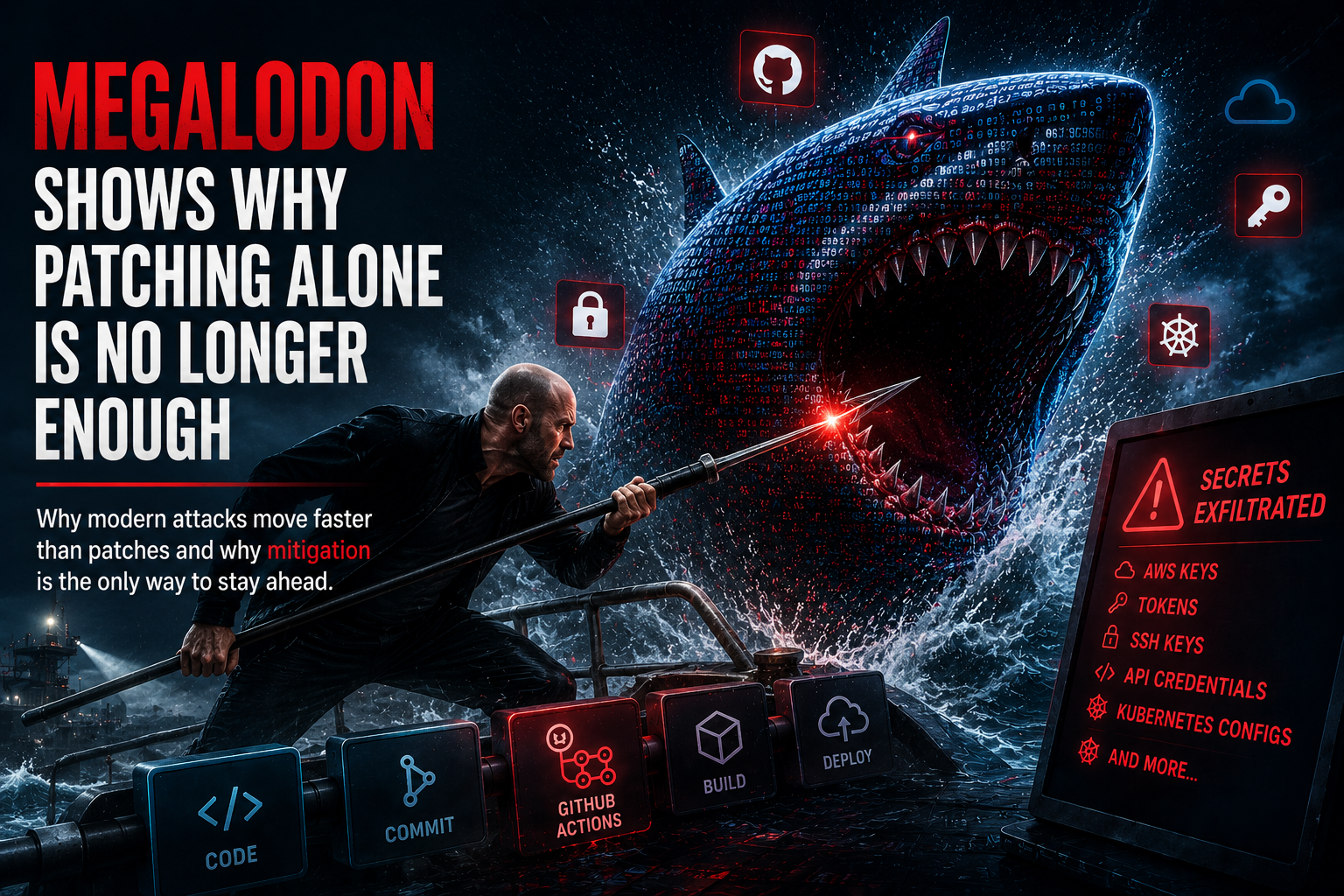
In a single window, more than 5,500 GitHub repositories were silently poisoned with malicious commits. The attackers injected GitHub Actions workflows engineered to harvest CI/CD secrets, cloud credentials, SSH keys, Kubernetes configs, GitHub tokens, and API credentials, then planted dormant backdoors in trusted pipelines, primed to be triggered later via the GitHub API. By the time most security teams understood what they were looking at, the exploit path already existed inside trusted software pipelines.
Megalodon wasn’t just another supply-chain incident. It was a stress test for how quickly security teams can determine reachability, control coverage, and blast radius when trusted pipelines are compromised. The model many still operate under (discover, prioritize, patch, contain) quietly assumes there's time. Time to investigate. Time to write a detection. Time to push a fix before the attacker is anywhere meaningful.
Discovery isn't the bottleneck anymore. Operationalization is.
Anthropic reported that Project Glasswing partners used Claude Mythos Preview to identify more than 10,000 high- or critical-severity vulnerabilities across widely deployed software. Think about what that number actually means. The economics of offense have flipped.
Attackers used to need weeks to find vulnerabilities, weaponize them, stand up infrastructure, and run a campaign. AI collapses that into hours. Sometimes minutes.
Megalodon showed what that looks like when it lands on your environment: poisoned workflows pushed at scale, trusted repos compromised in parallel, secrets exfiltrated immediately, persistence established before the first alert was even acknowledged. The attack didn’t wait for scanner updates, package warnings, or manual pipeline review. It moved at the speed of the pipeline itself. And that’s exactly where the traditional vulnerability management model starts to collapse.
The vulnerability management workflow breaks right here
The traditional model is a sequence everyone in this industry has memorized. A vulnerability gets disclosed. Vendors release signatures. Security teams identify affected assets. Patches get tested and deployed. Risk goes down.
Megalodon walks through that sequence and ignores it.
In an attack like this, a patch may not be the immediate answer. The software supply chain itself is the attack surface. The trusted workflow is the propagation mechanism. Cloud credentials become lateral movement. CI/CD becomes the persistence layer. The whole thing is happening inside the boundaries you thought were already safe.
So the question stops being "how fast can we patch?" The honest question (the one that matters) is whether your existing controls would stop this exploit path right now, in your environment, against your crown-jewel assets. Can you answer that question with confidence?
That operational blind spot is where modern breaches now happen.
Mitigation, not just remediation
We're entering a world where mitigation matters more than remediation speed. To be clear, that's not an argument against patching, as it still matters, but it just can't be your survivability strategy during the zero-day window anymore. That window is too short and too crowded to work.
What matters now is whether your team can do five things fast:
- identify which exploit paths are actually reachable in your environment
- validate whether your existing controls would stop them
- find the silent bypasses you don't know about
- disrupt propagation before exploitation scales
- operationalize compensating controls in minutes
Most security programs have visibility. They see alerts, vulnerabilities, exposures, pages of threat intel. What they're missing is the second layer. They can’t reliably tell you whether an exploit path is genuinely reachable, whether the existing stack would actually stop it, or which single control change would buy down the most real-world breachability today. That operational gap is where modern breaches live.
Reachability beats severity
Megalodon also exposed another flaw: Severity alone isn't enough anymore.
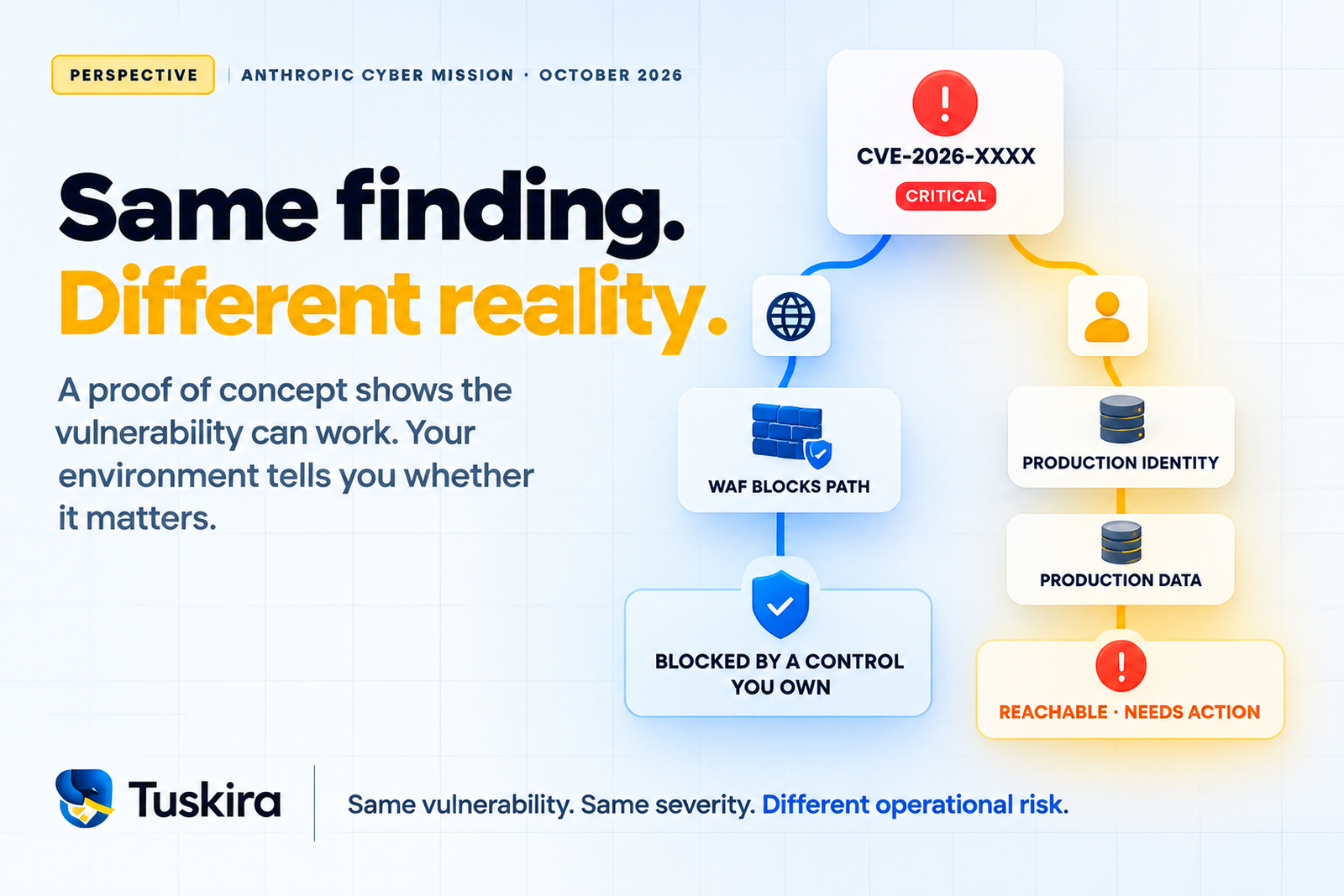
A "critical" vulnerability that can't reach anything meaningful is, in practice, less dangerous than a "medium" buried inside a trusted CI/CD pipeline with access to production secrets. Attackers don't think in CVSS scores. They think in paths.
Can they move laterally? Steal credentials? Bypass a control? Establish persistence? Chain three medium-severity exposures into a clean route to your data?
That's how the offensive side actually plans. Security operations has to evolve to think the same way, grounding every detection, every investigation, and every response action in real exploit reachability and real breachability, not in isolated findings sitting in separate queues that nobody has time to triage.
When Detection Becomes Disruption
Here's the shift that defines the post-Mythos era. Megalodon is a preview: faster discovery, automated propagation, adaptive payloads, trusted workflow abuse, rapid credential operationalization, and machine-speed attack chaining. That’s the rhythm security teams now have to defend against.
The organizations that survive this shift will be the ones that can continuously answer three questions:
- Is this attack actually reachable in our environment?
- Would our existing controls stop it?
- Is that still true as the environment changes?
Detection used to be what happened after prevention failed. But when detection is grounded in reachability, distributed across existing controls, and operationalized fast enough to change the outcome, it becomes a disruption layer. The goal is to close the path before exploitation turns into impact.
Megalodon proved how little time defenders now have. The teams that learn to operationalize at that speed are the ones who get to write a different headline next time.
About the author
Harkirat Bhardwaj is Founding AI Engineering & Security Research Engineer at Tuskira, where he leads security research on AI-driven vulnerability discovery. He is the author of the Tuskira Research report The Emerging Patch Gap. He was previously a Senior Research Engineer at Tenable.
Attackers Are Using AI. Should Your AI Agents Be Auto-Approving Their Next Move?
Anthropic on Finding Vulnerabilities Becoming the Easy Part