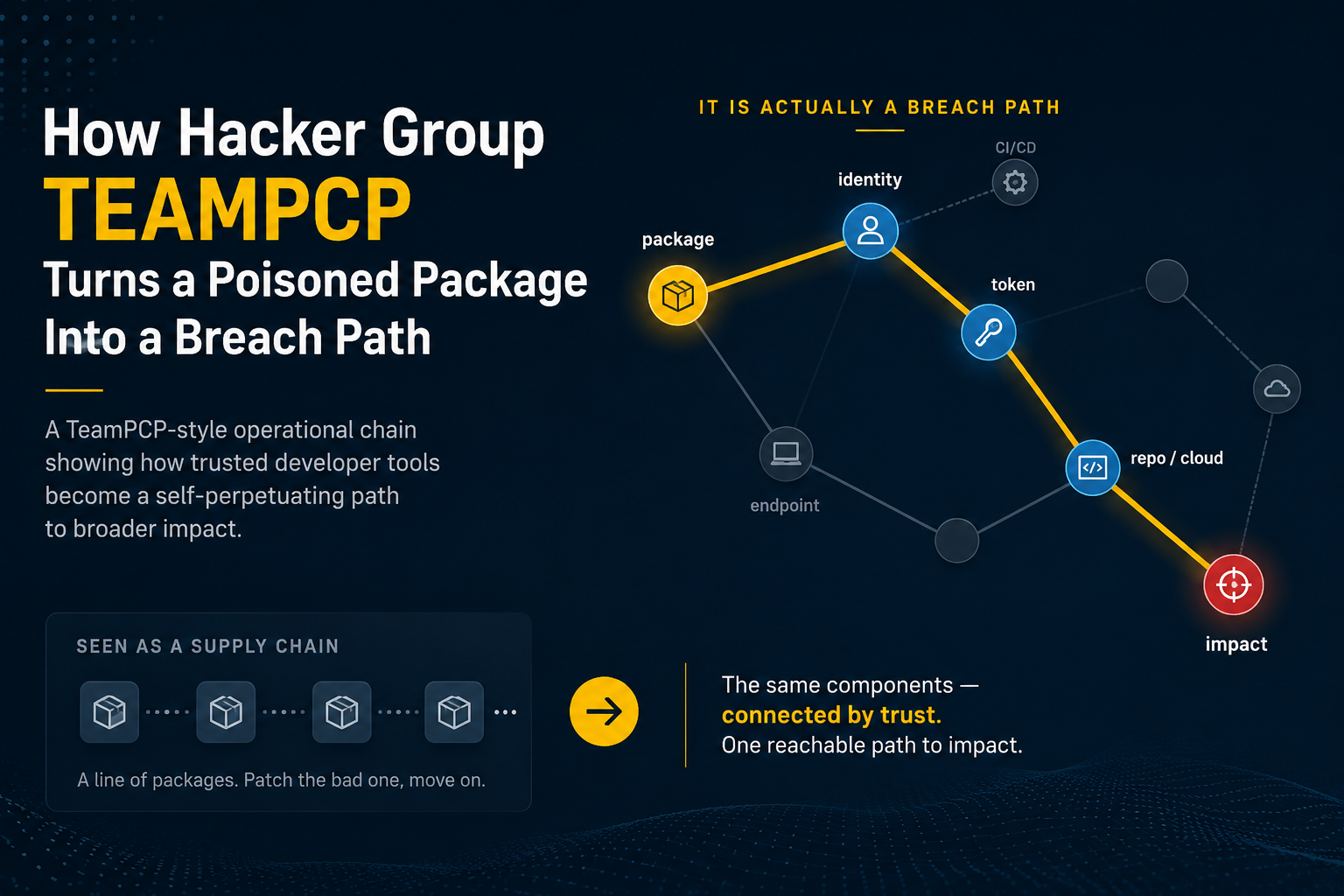
How Hacker Group TeamPCP Turned a Supply Chain Attack Into a Breach Path
By Harkirat Bhardwaj, Founding AI Engineering & Security Research Engineer, Tuskira Research
The security industry is describing TeamPCP as a software supply chain threat. That's true, but not telling the whole story.
TeamPCP is a financially motivated hacking group linked to a wave of software supply chain attacks involving poisoned open-source packages, compromised developer tools, stolen credentials, and repository access.
What makes TeamPCP dangerous isn't only the poisoned package. It's the ability to chain together identities, developer endpoints, CI/CD systems, repositories, cloud credentials, and downstream trust relationships into a single continuous attack path.
That distinction matters because most enterprises still defend those systems separately. Attackers do not.
The GitHub Breach Wasn't One Failure
According to reporting from WIRED and research from Socket, Wiz, and Palo Alto Networks, TeamPCP compromised a VSCode extension, gained access to developer systems, stole credentials and tokens, accessed repositories, and then propagated further through software development workflows.
The scale is what makes this more than a one-off. Researchers describe it as the longest-running spree of software supply chain attacks on record: in just the last few months, TeamPCP has hidden malware in more than 500 distinct packages across roughly 20 separate waves, breaching hundreds of organizations along the way. GitHub is only the latest name on a list that already includes OpenAI and the data firm Mercor.
And it compounds. Each compromised tool harvests the credentials needed to poison the next one, which then lands on more developer machines, yielding more credentials. Researchers call it a flywheel of supply chain compromises, and the term is exact: access in one place becomes access in the next, and the set of breached networks grows on its own.
None of those steps is novel on its own. Supply chain attacks aren't new. Credential theft isn't new. Token abuse isn't new. CI/CD compromise isn't new.
The novelty is the operational chaining, when one incident, say, a poisoned package, becomes six links in a single chain:
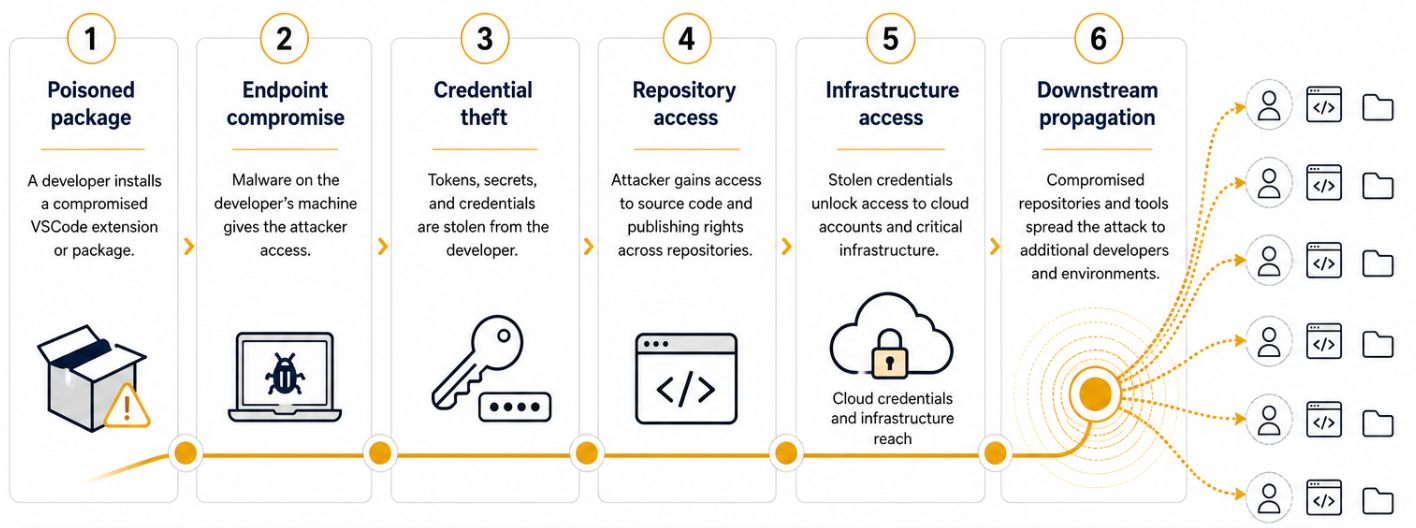
TeamPCP didn’t exploit one vulnerability; it connected each step to the next. That is a reachable breach path, and it's exactly where many security organizations still struggle operationally.
Why Traditional Security Operations Break Here
The modern enterprise still organizes security around domain ownership.
- AppSec owns packages and dependencies.
- IAM owns tokens and identities.
- Endpoint teams own developer machines.
- Cloud teams own infrastructure.
- SOC teams own alerts and investigations.
- Detection engineering owns SIEM rules.
- Vulnerability management owns CVEs.
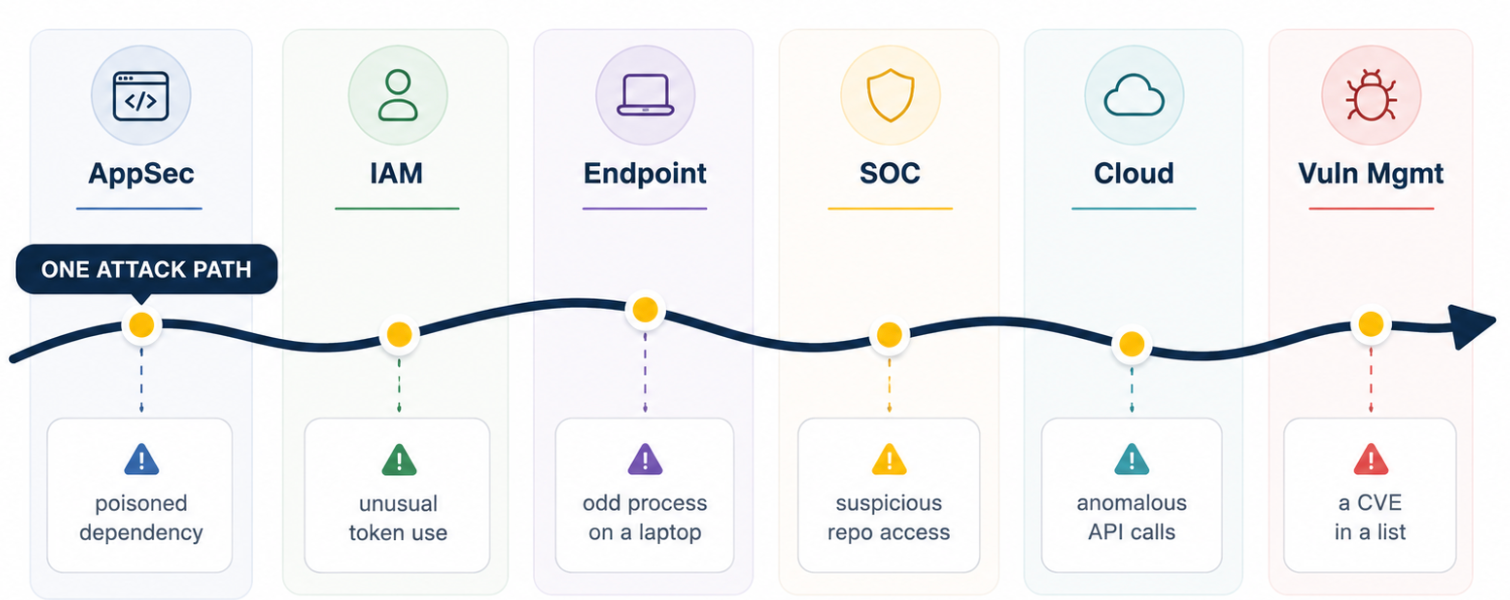
But TeamPCP moves across all of them simultaneously, and it doesn't care where your organizational boundaries fall. It follows trust relationships across packages, identities, tokens, repositories, cloud infrastructure, and CI/CD systems. That means no individual queue sees the entire attack path.
- The AppSec team may see a poisoned dependency.
- The IAM team may see unusual token usage.
- The SOC may see suspicious repository access.
- The cloud team may see anomalous API activity.
Each signal looks incomplete in isolation, but the operational failure is context fragmentation.
Attackers Exploit Paths, Not Points
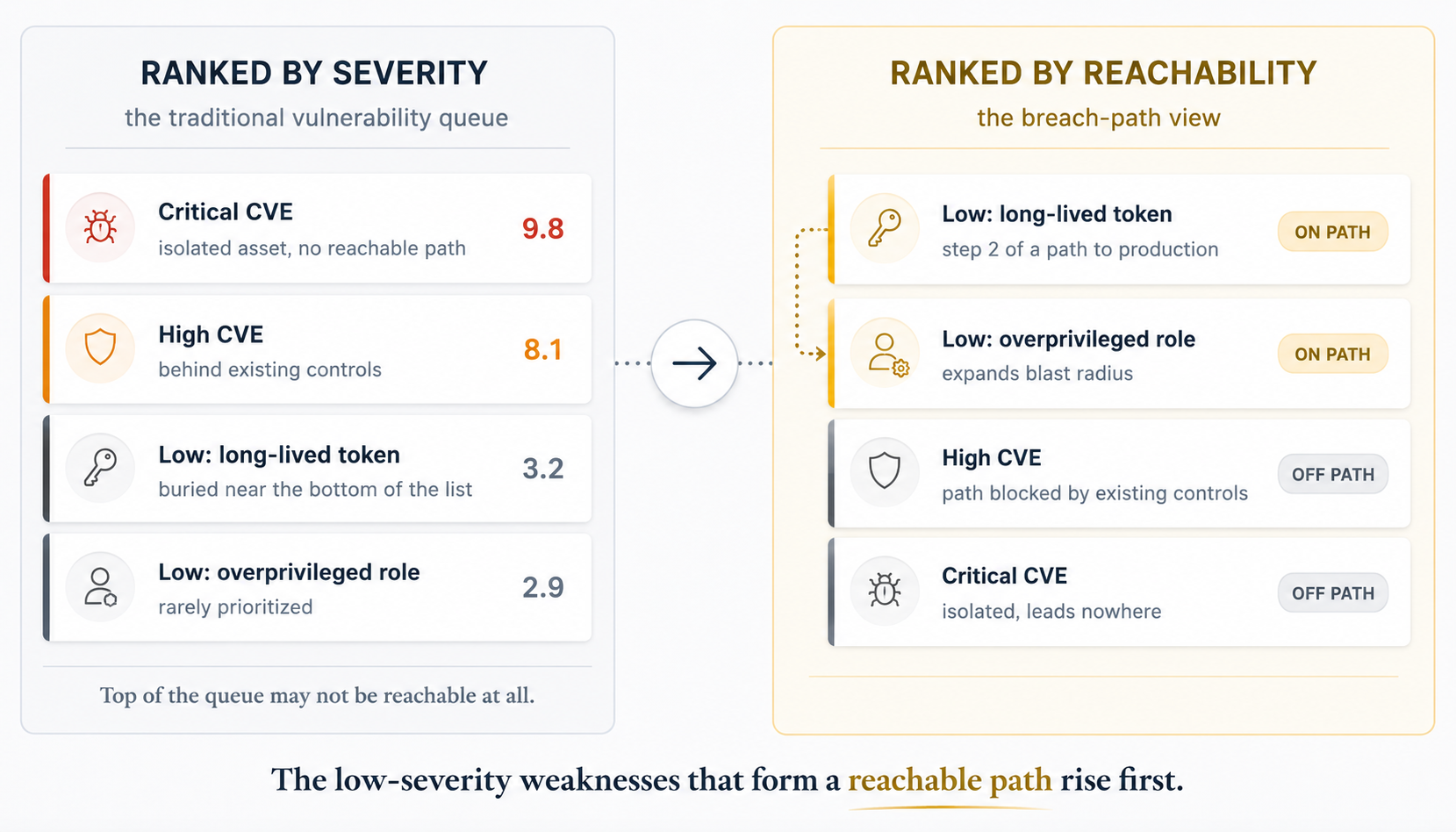
A low-severity package issue may not matter alone. A long-lived GitHub token may not matter alone. An overprivileged service account, a missing EDR rule — none of them, on its own, is worth a sleepless night.
But together, they can create a reachable path to production systems or sensitive data.
This is the operational shift security teams now have to deal with, and the question isn't "Is this CVE critical?" The real question is: "Can this weakness combine with identities, permissions, controls, and trust relationships to create a reachable path to impact?"
That's a fundamentally different security problem.
The Economics of Chaining Are About to Change
TeamPCP demonstrates that attackers are already operationalizing multi-stage attack chains at scale, today, at human speed. Cloudflare's recent Project Glasswing research suggests the cost and speed of building those paths is likely to collapse even further.
In that research, Cloudflare pointed a frontier vulnerability-research model at more than fifty of its own repositories. The most important observation wasn't that the model found vulnerabilities. It was that the model could take low-severity bugs that would traditionally sit invisible in a backlog and chain them into a single, more severe exploit, reasoning across primitives, writing proof-of-concept code, running it, reading the failure, and adapting until the chain worked.
Cloudflare is explicit that this was controlled research against their own code, and that the model even pushed back on some requests. But they are equally explicit about where it points: the same capabilities that helped them find bugs in their own code will, in the wrong hands, accelerate the attack side against every application on the Internet.
Cloudflare's research reinforces the same defensive lesson TeamPCP teaches: isolated findings matter less than whether weaknesses can be chained into reachable attack paths. The difference is one of economics. TeamPCP shows what operational chaining looks like in the wild; Cloudflare shows how AI may make that kind of chaining faster, cheaper, and more scalable. As the cost of discovering and operationalizing those chains falls, defenders should assume attackers will increasingly find and exploit paths that human analysts would previously have ignored as too time-consuming or too fragmented to matter.
Why Faster Patching Alone Won't Solve This
One of the strongest points in Cloudflare's analysis was the warning against treating this as simply a "patch faster" problem. Because it's not.
Patching addresses individual weaknesses, but attack paths emerge from relationships between vulnerabilities, identities, permissions, repositories, cloud trust, CI/CD systems, network access, and defensive gaps.
That means organizations need to understand:
- which identities create blast radius
- which tokens expose privileged paths
- which repositories connect to production systems
- which controls actually interrupt attacker movement
- which detections are missing across the chain
- and which compensating controls reduce reachable risk immediately
This is where traditional vulnerability management breaks down. Severity doesn't equal risk. Reachability does.
What Modern Defense Actually Requires
Defending against attacks like TeamPCP requires more than faster patching or isolated detections. It requires a shared operational context that connects identities, repositories, endpoints, cloud infrastructure, permissions, detections, and compensating controls into a single, continuously evaluated attack graph.
That means security operations must evolve from disconnected queues into a coordinated operational model capable of:
- identifying reachable breach paths across domains
- understanding identity and token blast radius
- validating whether existing controls actually interrupt attacker movement
- tuning detections around live attack paths
- and correlating exposure directly to investigation and response workflows
This is the architectural shift many organizations are now moving toward: unifying proactive exposure analysis and reactive security operations into the same operational layer, one place where exposure and response see the same attack graph and act on it together.
Because attackers already operate that way.
The Real Problem Isn't the Package
TeamPCP's success didn’t depend on discovering one catastrophic vulnerability. It depended on repeatedly identifying trust relationships that organizations failed to model operationally: developer tools trusted by endpoints, tokens trusted by repositories, repositories trusted by CI/CD systems, and CI/CD systems trusted by production environments. That is why this is fundamentally a breach-path problem rather than a software supply chain problem alone.
The dangerous part of TeamPCP is that many enterprises still operate security as disconnected systems while attackers operate as connected workflows.
Attackers already understand this. Security operations now have to catch up.
The organizations that adapt fastest will be the ones that identify reachable paths earliest, understand trust relationships best, validate defensive coverage continuously, and break operational attack chains before they fully materialize.
About the author
Harkirat Bhardwaj is Founding AI Engineering & Security Research Engineer at Tuskira, where he leads security research on AI-driven vulnerability discovery. He is the author of the Tuskira Research report The Emerging Patch Gap. He was previously a Senior Research Engineer at Tenable.
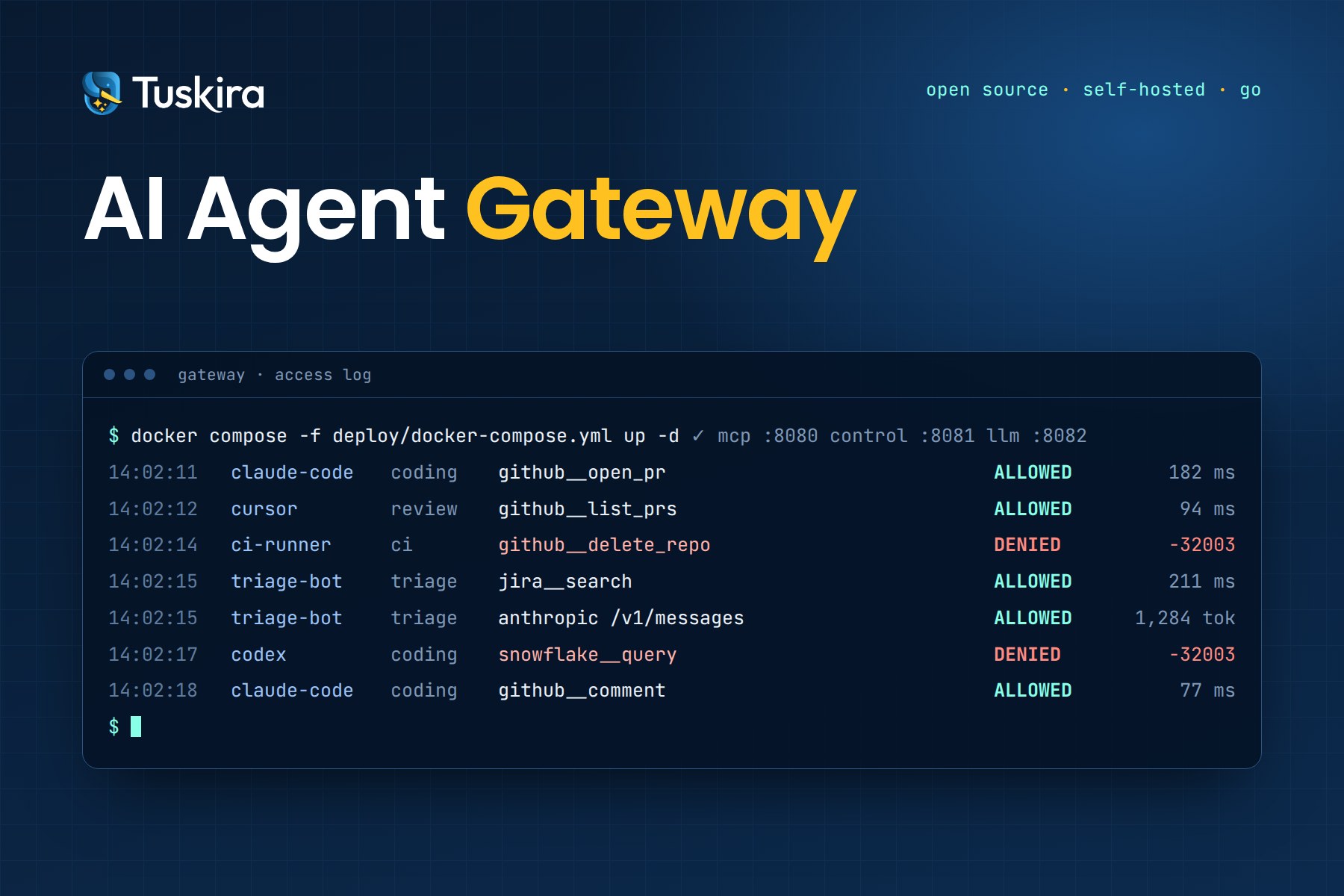
Tuskira Open Sources the AI Agent Gateway
Tuskira Named in the 2026 Gartner® Emerging Tech Impact Radar: CSP Infrastructure and Operations