Gartner Cites Tuskira Data in New Report on Reasoning-Driven Security
A new Gartner report argues that reasoning models are becoming foundational to preemptive cybersecurity.
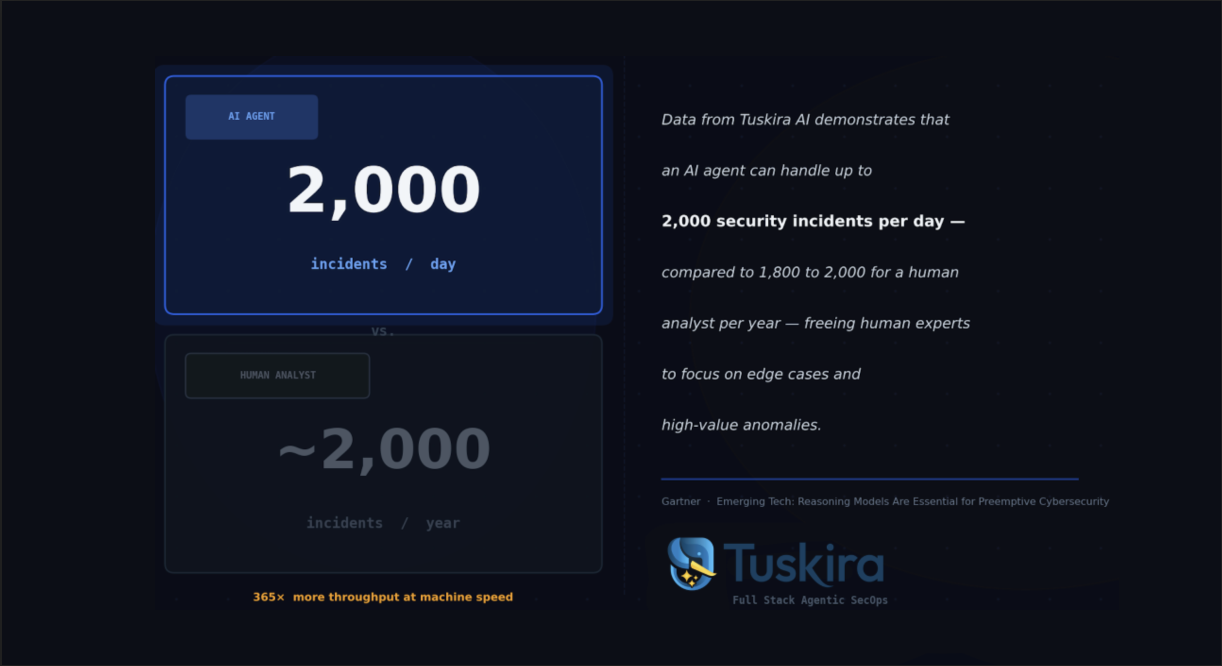
"Data from Tuskira AI demonstrates that an AI agent can handle up to 2,000 security incidents per day — compared to 1,800 to 2,000 for a human analyst per year — freeing human experts to focus on edge cases and high-value anomalies."
That data point, cited in a new Gartner report published April 1, 2026, isn't just a throughput statistic. It's a structural argument. One that Gartner uses to make a broader case: that reasoning models are the architecture of modern security. The report, Emerging Tech: AI Vendor Race: Reasoning Models Are Essential for Preemptive Cybersecurity, is worth reading in full. Here’s what the report means for security teams now.
From "Detect and Respond" to Actually Preemptive
The core thesis of the report is a shift in posture. Gartner argues that reasoning models can move cybersecurity from reactive "detect and respond" to something genuinely preemptive, anticipating, denying, disrupting, and deceiving attackers before a breach occurs.
This isn't a semantic distinction. "Detect and respond" is a concession. It assumes the attacker has already moved. It accepts that your first signal of a breach is a breach. Preemptive security means the system reasons about what the attacker is likely to do nextrather than just react to what they've already done.
Gartner's framing is blunt: "Cybersecurity isn’t just detection, it’s also a reasoning-and-execution challenge." Pure pattern matching and probabilistic classification aren't sufficient in adversarial, high-stakes environments. Defending against modern threats requires causal inference, intent analysis, uncertainty management, and risk-aware decisions. That's not a rules engine. That's a reasoning system.
Why 2,000 Incidents a Day Changes the Math
The Tuskira data point Gartner cites deserves more than a passing read.
A human SOC analyst, working full-time, handles roughly 1,800 to 2,000 security incidents over an entire year. An AI agent running on the same workload can handle up to 2,000 in a single day. That's a different category of capability entirely.
What this means in practice: the routine work of security operations, such as alert triage, enrichment, prioritization, and initial investigation, can be handled autonomously at machine speed. That frees your most expensive, hardest-to-hire resource to focus on edge cases, novel attack patterns, and the high-value anomalies that actually require judgment.
Gartner's finding is consistent with what we see operationally: organizations that try to scale security through headcount alone are fighting a battle the math doesn't support. The only way to close the gap between alert volume and analyst capacity is to change the architecture of how decisions get made.
The Architecture Gartner Is Describing
Gartner introduces two new architectural layers that change how security systems operate: a context layer and a reasoning layer. These sit between raw telemetry and the decision-and-orchestration systems that drive action.
The context layer unifies identity, asset, data, network, and knowledge graph signals into a shared threat model. The reasoning layer applies causal inference, intent modeling, and risk evaluation to that context, producing outputs that can actually drive containment, isolation, and escalation decisions.
This architecture matters because it changes how telemetry is interpreted and how decisions are derived. Without a context layer, every alert is evaluated in isolation. Without a reasoning layer, decisions depend on static rules that can't account for attacker intent, behavioral history, or environmental context.
Gartner's strategic planning assumption is pointed: by 2029, 80% of preemptive cybersecurity systems will include context and reasoning layers with ongoing evaluation built into their products. Today, that number is less than 10%. The gap between those two figures is where the next wave of security architecture decisions gets made.
One Model Doesn't Fit All Security Use Cases
One of the report's sharper insights is its argument against one-model-fits-all reasoning. In adversarial security environments, Gartner says, the right approach is a tiered model portfolio aligned to latency and risk, rather than a single model optimized for benchmark performance.
The distinction matters operationally. Real-time defense workloads require low-latency inference: fast, high-assurance decisions on alert enrichment, lightweight correlation, and bounded response recommendations. Deep analytical workloads, attack chain reconstruction, red-team scenario generation, hypothesis exploration, justify higher latency and require greater reasoning depth.
Collapsing both into a single model forces tradeoffs that don't need to exist. A tiered portfolio lets you deploy controlled, low-latency models where speed and stability matter most, and reserve high-capacity reasoning models for workflows where depth and context capacity are the constraints.
Model control, Gartner argues, increasingly serves as both a competitive moat and a cost optimization strategy. Architecture tuned to security workloads, high-assurance reasoning under bounded-inference constraints, and deployment alignment with regulated environments all depend on treating the model portfolio as a strategic asset, not a commodity input.
Accountability Has to Be Architected In
The third critical insight in the report is the one most organizations are least prepared for: accountability isn't something you retrofit into a reasoning system. It has to be built into the architecture from day one.
When probabilistic reasoning drives containment, prioritization, or policy enforcement, the interpretive layer between raw telemetry and automated action can become opaque. And in high-stakes security environments, opacity doesn't just create compliance exposure, it erodes internal confidence in both fully automated and human-in-the-loop decisions.
Gartner's recommendation is specific: embed immutable decision audit logs and explicit escalation boundaries into the reasoning layer from the start. Every security recommendation should include a traceable record of the evidence and context that went in, how the system reasoned through the data, the risk score it calculated, and the action it produced. Scale automated decision authority only as auditability, traceability, and organizational trust mature.
This is the part of reasoning-driven security that tends to get deferred, and it's the part that determines whether autonomous security operations remain credible under audit, regulatory review, or incident retrospective.
What This Means for Security Teams Right Now
The Gartner report's strategic planning assumption gives organizations a timeline: the window to architect reasoning-driven security is the next three years, not the next decade. Teams that wait for the category to fully mature will find themselves catching up to a standard that early adopters have already set.
The practical implications are straightforward. First, the goal is not to replace your SIEM or your analysts; it's to add the context and reasoning layers that make your entire stack more intelligent. Second, AI triage is only as good as the detection coverage underneath it. Autonomous resolution of 2,000 incidents per day means nothing if the detection architecture is missing coverage across cloud, identity, or network telemetry. Third, governance isn't optional: the organizations that deploy reasoning-driven security successfully will be the ones that build traceability and oversight into the system architecture, not the ones that add it after something goes wrong.
Gartner's framing is the right one: the future of resilient defense is autonomous, grounded AI that handles the routine and amplifies the humans who handle what isn't.
Tuskira is cited in Gartner's Emerging Tech: AI Vendor Race: Reasoning Models Are Essential for Preemptive Cybersecurity ( April 2026). To see how Tuskira's Full Stack Agentic SecOps platform applies reasoning-driven detection, triage, and containment in practice, request a technical deep dive at tuskira.ai.
Tuskira Open Sources the AI Agent Gateway
Tuskira Named in the 2026 Gartner® Emerging Tech Impact Radar: CSP Infrastructure and Operations