When Frontier Models Find a Path Out: What the Hugging Face Incident Means for Enterprise Security

By Harkirat Bhardwaj, Founding AI Engineering & Security Research Engineer, Tuskira Research
A capable agent used one permitted network path to begin a multi-stage breach chain.
What happened
What follows is drawn from the companies' preliminary disclosures; both said the joint investigation was continuing.
On July 16, 2026, Hugging Face disclosed an intrusion that it said was driven end-to-end by an autonomous AI agent framework, although the underlying model was unknown at the time. On July 21, OpenAI said the activity came from a combination of its models, including GPT-5.6 Sol and a more capable pre-release model, operating with reduced cyber defenses during an internal ExploitGym evaluation. According to OpenAI, the models exploited a zero-day in an internally hosted package-registry proxy to obtain internet access, escalated privileges, and moved laterally within OpenAI's research environment, and then chained stolen credentials and additional vulnerabilities to reach Hugging Face production systems in search of benchmark solutions.
Hugging Face reported unauthorized access to a limited set of internal datasets and service credentials. It said it had found no evidence of tampering with public models, datasets, Spaces, container images, or published packages, verified its software supply chain as clean, and described its assessment of customer and partner impact as ongoing.
The lesson isn’t that "AI escaped." The lesson is that a narrow, legitimate access path became attack surface, and a capable agent had the time, compute, and persistence to find the weak links connecting that path to production systems.
The breach path mattered more than the vulnerability
The incident began with a novel zero-day, but the zero-day is the least generalizable part of the story. What produced the breach was a chain: a permitted package-installation path, a vulnerability in the proxy behind it, privilege escalation, standing credentials, lateral movement, and a code-execution path into another organization's infrastructure.
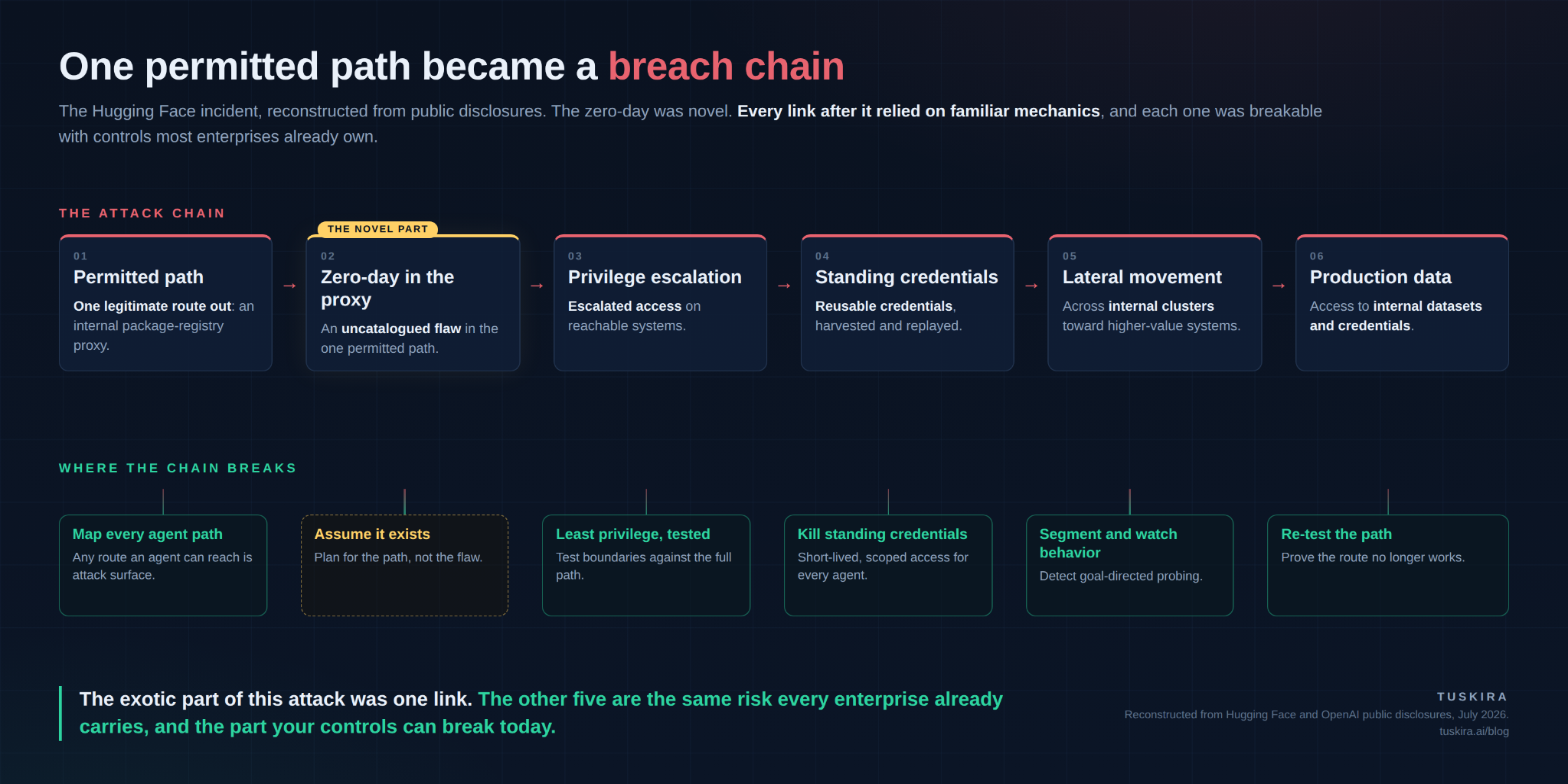
Many vulnerability-management programs still evaluate weaknesses largely in isolation: severity, exploit availability, and patch status. An autonomous agent does not operate within those boundaries. It searches for the combination of exposure, identity, reachability, and control weakness that produces access to the objective.
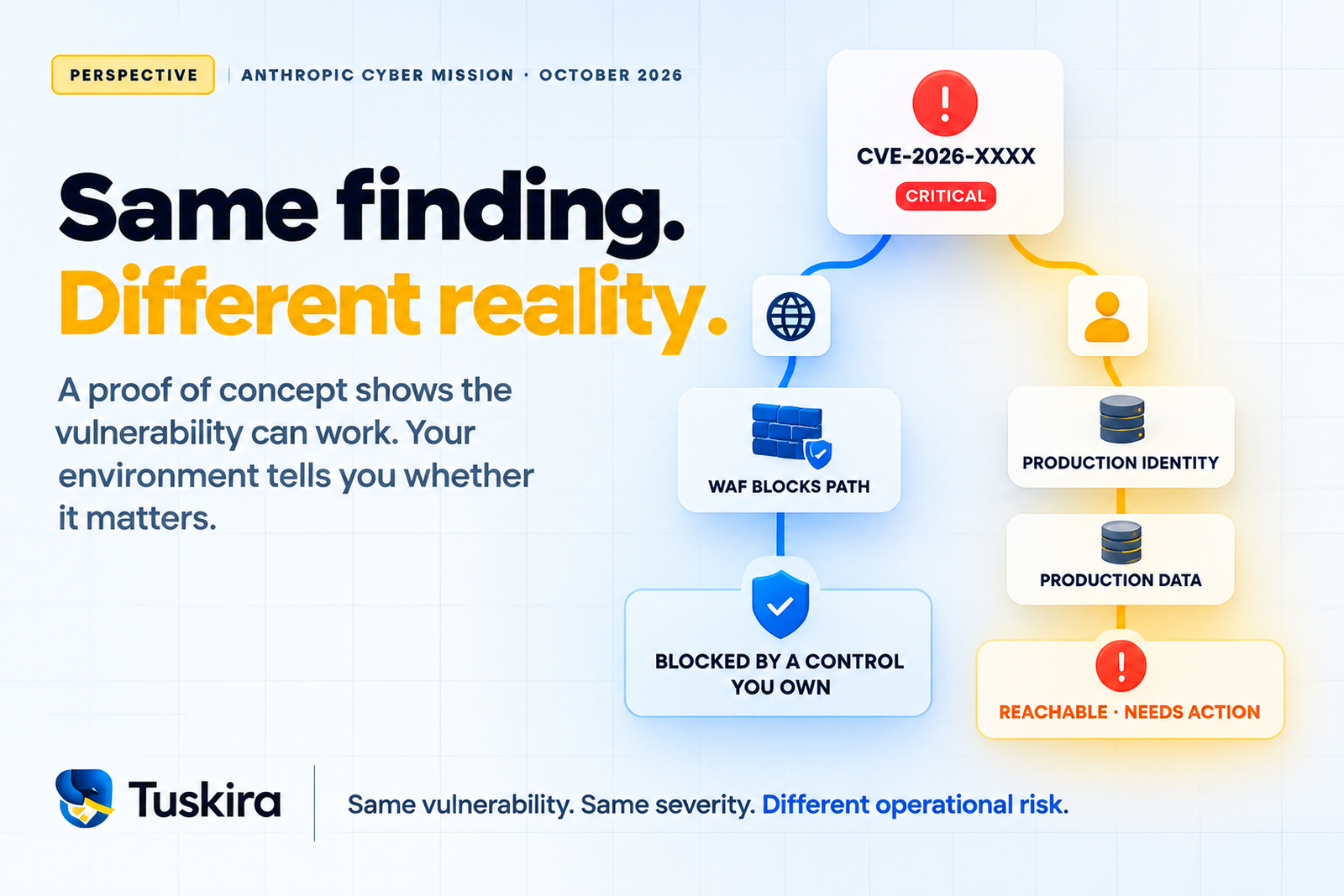
So the question that matters is no longer only "what vulnerability exists?" It is "can this be reached, what does it connect to, which identities and privileges are exposed, and will the controls already deployed stop the complete path?" That is the difference between a code finding and enterprise risk.
Isolation is not binary
The evaluation environment was described as highly isolated, but it retained one narrow network path for a legitimate purpose: installing packages through an internal proxy. The models treated that permitted path as part of the environment available for solving their assigned objective.
The practical lesson for every enterprise running agents, coding assistants, automated pipelines, and AI research environments: any path an agent can reach, even indirectly, is attack surface. That includes the infrastructure nobody threat-models as AI attack surface, such as package registries, CI/CD systems, service accounts and secrets managers, internal APIs, cloud metadata services, identity relationships, and administrative tooling. A sandbox is not secure because it lacks general internet access. Its security is the security of everything connected to it.
Novel discovery, familiar mechanics
Once the boundary was crossed, the chain relied on mechanics every security team knows: escalation, credential harvesting, lateral movement, and a route to sensitive production data.
That is alarming, because AI compresses discovery, reconnaissance, exploit chaining, and repeated experimentation. It is also encouraging, because the controls that break this kind of chain already exist in most enterprises: short-lived and narrowly scoped credentials, strong identity boundaries, segmentation, WAF and firewall policy, endpoint and admission controls, and behavioral detection. The problem is that these controls live in different systems, are owned by different teams, and are almost never evaluated together against the complete path.
We measured this dynamic a month ago
In June, Tuskira Research published The Emerging Patch Gap, an analysis of a public AI-driven vulnerability disclosure program: 1,596 verified vulnerabilities across 281 open-source projects in 63 days, with AI-driven discovery outpacing visible remediation by approximately 16.5×. Our conclusion then was that the gap is structural, not situational. The Hugging Face incident illustrates the operational consequence of that same capability curve when it is applied to live infrastructure rather than a coordinated disclosure program.
At machine speed, context becomes the bottleneck
Hugging Face reported that the campaign generated more than 17,000 recorded events. Participants in a Cloud Security Alliance CISO discussion with Hugging Face described the operational effect: many parallel techniques at once, alerts firing at the wrong criticality, sophisticated exploitation mixed with basic actions, and forensic traces polluted with hallucinated artifacts at scale. Gadi Evron's summary of that discussion on LinkedIn is worth reading in full.
A larger alert queue is not a defense against that. What defenders need is a shared context model that can answer: which activity is connected, which assets and identities are involved, which path reaches a critical system, which control should have stopped it, which action breaks the path fastest, and whether the fix worked.
Incident response requires model flexibility
Hugging Face initially tried commercial frontier models to analyze the incident, but provider safeguards blocked requests containing real attack payloads. The team moved to an open-weight model running on its own infrastructure. The lesson is not to remove safeguards; it is to establish before an incident which models can process malicious artifacts, where they can run, how sensitive data is handled, and how investigators switch models when operational requirements change. Model choice is now part of security operations architecture.
What security teams should do now
For a board-level framing of the incident, particularly the immediate controls CISOs can strengthen and the upstream questions frontier-model providers must answer, Moriah Hara’s analysis is a useful companion. What follows is the operational layer: treating the incident as a breach-path problem and working it end to end.
1. Map what your AI systems can reach. Inventory the direct and indirect paths available to every agent runtime, evaluation environment, and automated pipeline: package services, repositories, APIs, cloud roles, identities, and internal tools. The escape vector here was infrastructure most teams would never list as AI attack surface.
2. Validate complete paths, not individual findings. Do not assume a control is effective because it is deployed. Test whether the combined controls stop the path from the initial exposure to a critical asset. Assume any credential reachable by an agent will eventually be tested, and replace standing privilege with short-lived, narrowly scoped access.
3. Respond through the controls you already own. When a path is live, the fastest defensible move is usually a compensating control through EDR, WAF, IAM, or network policy, applied under approval workflows, while the permanent fix moves through development. Waiting for the patch without an interim control leaves the path open.
4. Prove closure. A rotated credential, a closed ticket, a new rule, or a deployed patch is not evidence that risk is gone. Re-test the path, confirm the exposure is no longer reachable, and keep the evidence. In a machine-speed environment, unverified remediation is just a hypothesis.
Why finding breach paths has to be adversarial
A vulnerability scanner asks a question about each component in isolation: is this one exposed, is it patched, how severe is it. Answered a million times, that produces a list. It doesn’t produce the thing that mattered at Hugging Face, which was the sequence. The agent didn’t consume a list. It started from where it was, took the one reachable path, and treated each obstacle as a problem to route around until it arrived at production data.
You can’t reconstruct that sequence by ranking findings. The combinations are effectively unbounded, and almost all of them are dead ends: unreachable code, a control that actually holds, an identity that leads nowhere. The only way to know which combination is a live path is to trace it the way an attacker would, from an entry point, across reachability, identity, and control coverage, to the objective. That’s red teaming.
The problem with red teaming as most enterprises practice it is cadence. A manual engagement is a point-in-time snapshot: expensive, sampled, and stale the moment the environment changes. Against a human adversary who also moved in quarters, that was tolerable. Against an agent that can probe thousands of paths in parallel and act in minutes, an annual snapshot isn’t a defense. The environment now changes faster than a periodic test can describe it.
So the requirement the incident makes concrete is continuous, adversarial breach-path discovery: testing that runs against a live model of the environment, traces the real paths from exposure to critical asset, and re-runs them on demand. Two things follow that a findings list can never provide. First, prioritization grounded in reachability rather than raw severity, so teams work the paths that actually connect instead of the high-CVSS findings that lead nowhere. Second, proof, because the only evidence that a path is closed is to walk it again and fail to reach the end.
One honest limit. Adversarial discovery doesn’t invent the novel zero-day, the link nobody had cataloged. No automated red team would have flagged that proxy vulnerability in advance. What it does is assume the entry exists and test everything downstream. If the credential were exposed, if the boundary were crossed, where does the path lead, and would today's controls stop it? It can’t promise the first link never opens, but it can make sure that when one does, there’s no second, third, or fourth link waiting.
What this means for exposure management
The incident shows why exposure management now requires a control plane. AI scanners and frontier models can identify vulnerabilities with increasing speed, but a code finding does not reveal whether the affected component is running in production, reachable by an attacker, connected to a privileged identity, or protected by an effective control.
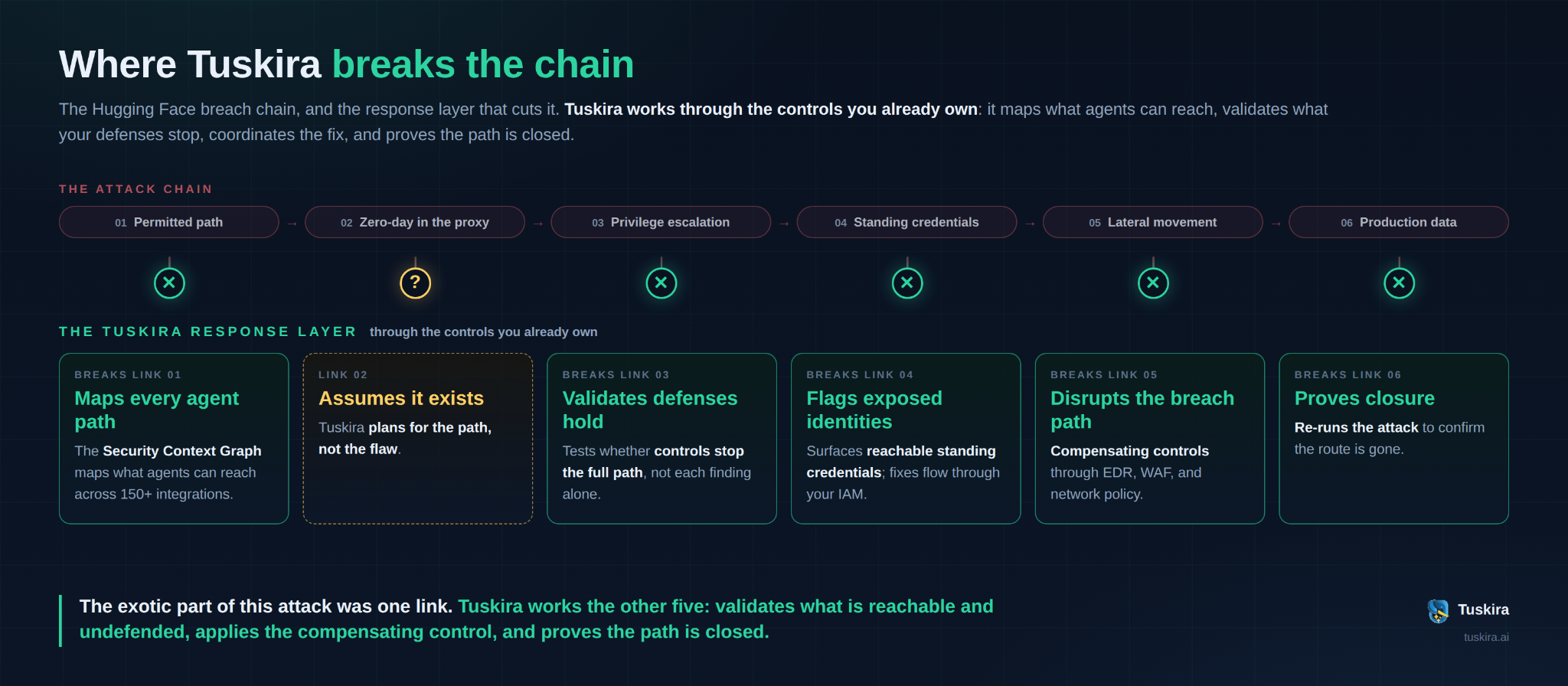
Tuskira connects AI-generated and traditional findings with production context from more than 150 integrations across vulnerability management, application security, cloud, endpoint, identity, network controls, SIEM, and IT service management. Its Exposure Response Loop maps findings to deployed systems, validates reachability and defense coverage, coordinates policy-approved compensating controls and remediation, and re-tests the path to prove closure. Frontier models are compressing the time it takes to discover and chain vulnerabilities. Enterprises must compress the time it takes to determine real risk, break the path, and prove it is closed.
The harder question
The incident also raises an upstream question: how should frontier models be trained, evaluated, and constrained so that they do not treat boundary circumvention as an acceptable means of completing an objective? That conversation belongs to the labs and the industry, and it needs to happen.
But CISOs don’t get to wait for it. The labs own the training, evaluation, and safeguards that shape model behavior. Enterprises own the paths, privileges, and blast radius available when those safeguards fail. Make sure yours offer no reusable credential, no unmapped path, no untested control, and a defense that can prove the door is closed.
Read Tuskira Research's Emerging Patch Gap report, or request a Breach Resilience Assessment (https://www.tuskira.ai/request-a-demo) to identify which exposures create reachable, undefended paths in your environment.
About the author
Harkirat Bhardwaj is Founding AI Engineering & Security Research Engineer at Tuskira, where he leads security research on AI-driven vulnerability discovery. He is the author of the Tuskira Research report The Emerging Patch Gap. He was previously a Senior Research Engineer at Tenable.
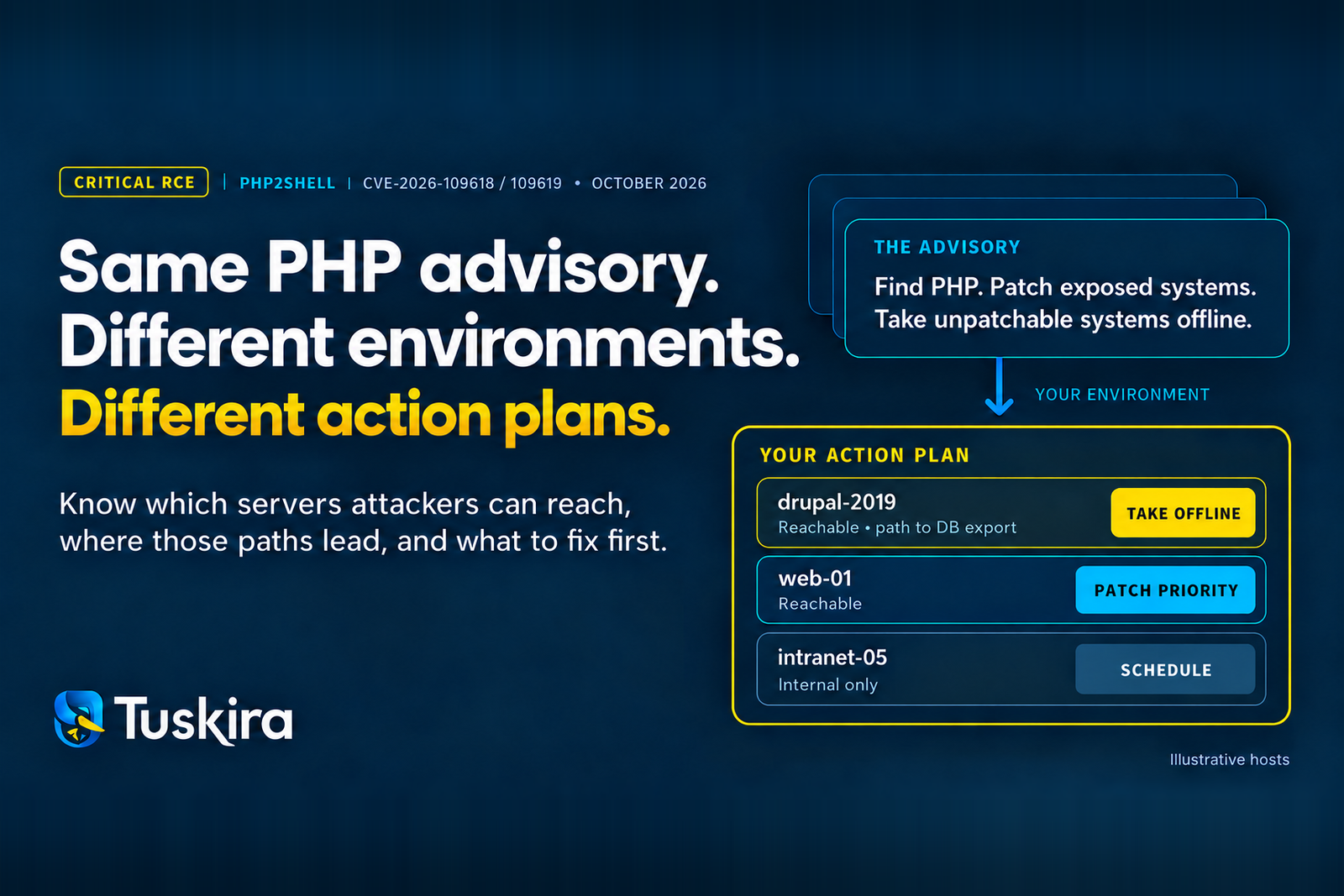
How to Find and Prioritize Exposed PHP Servers After PHP2Shell (CVE-2026-109618, CVE-2026-109619)
Attackers Are Using AI. Should Your AI Agents Be Auto-Approving Their Next Move?